

300
4 Problems with Variable Boundaries
O
x
y
A
B
C
y = ϕ(x)
α
β 1
β 2
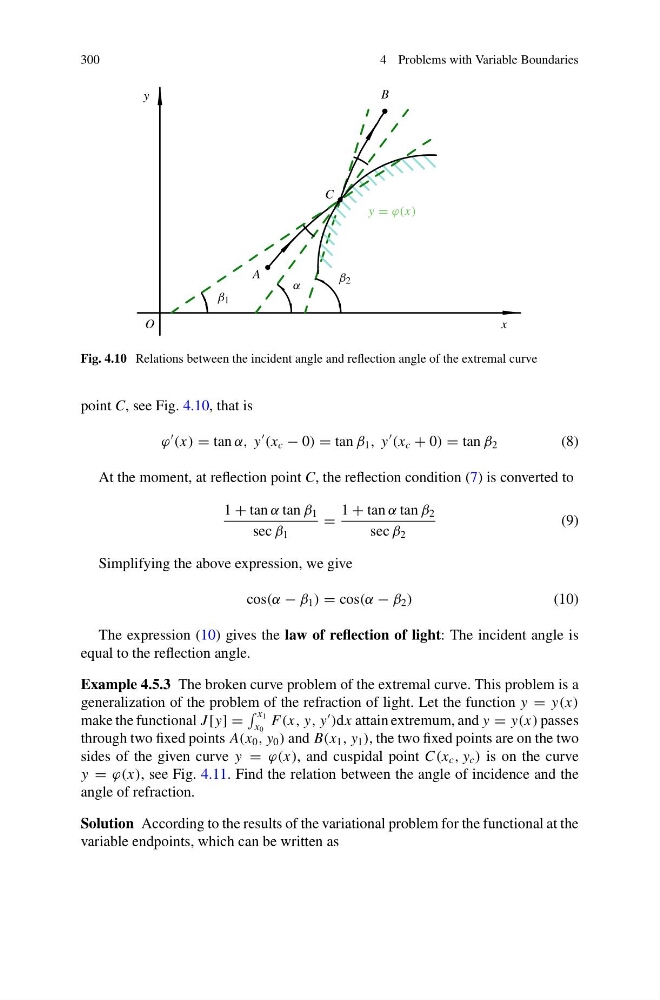
Fig. 4.10 Relations between the incident angle and reflection angle of the extremal curve
point C, see Fig. 4.10, that is
ϕ
(x) = tan α, y
(x c − 0) = tan β 1 , y
(x c + 0) = tan β 2
(8)
At the moment, at reflection point C, the reflection condition (7) is converted to
1 + tan α tan β 1
sec β 1
=
1 + tan α tan β 2
sec β 2
(9)
Simplifying the above expression, we give
cos(α − β 1 ) = cos(α − β 2 )
(10)
The expression (10) gives the law of reflection of light: The incident angle is
equal to the reflection angle.
Example 4.5.3 The broken curve problem of the extremal curve. This problem is a
generalization of the problem of the refraction of light. Let the function y = y(x)
make the functional J [y] =
x 1
x 0
F(x, y, y
)dx attain extremum, and y = y(x) passes
through two fixed points A(x 0 , y 0 ) and B(x 1 , y 1 ), the two fixed points are on the two
sides of the given curve y = ϕ(x), and cuspidal point C(x c , y c ) is on the curve
y = ϕ(x), see Fig. 4.11. Find the relation between the angle of incidence and the
angle of refraction.
Solution According to the results of the variational problem for the functional at the
variable endpoints, which can be written as
4 Problems with Variable Boundaries
O
x
y
A
B
C
y = ϕ(x)
α
β 1
β 2
Fig. 4.10 Relations between the incident angle and reflection angle of the extremal curve
point C, see Fig. 4.10, that is
ϕ
(x) = tan α, y
(x c − 0) = tan β 1 , y
(x c + 0) = tan β 2
(8)
At the moment, at reflection point C, the reflection condition (7) is converted to
1 + tan α tan β 1
sec β 1
=
1 + tan α tan β 2
sec β 2
(9)
Simplifying the above expression, we give
cos(α − β 1 ) = cos(α − β 2 )
(10)
The expression (10) gives the law of reflection of light: The incident angle is
equal to the reflection angle.
Example 4.5.3 The broken curve problem of the extremal curve. This problem is a
generalization of the problem of the refraction of light. Let the function y = y(x)
make the functional J [y] =
x 1
x 0
F(x, y, y
)dx attain extremum, and y = y(x) passes
through two fixed points A(x 0 , y 0 ) and B(x 1 , y 1 ), the two fixed points are on the two
sides of the given curve y = ϕ(x), and cuspidal point C(x c , y c ) is on the curve
y = ϕ(x), see Fig. 4.11. Find the relation between the angle of incidence and the
angle of refraction.
Solution According to the results of the variational problem for the functional at the
variable endpoints, which can be written as