

4.5 Extremal Curves with Cuspidal Points
299
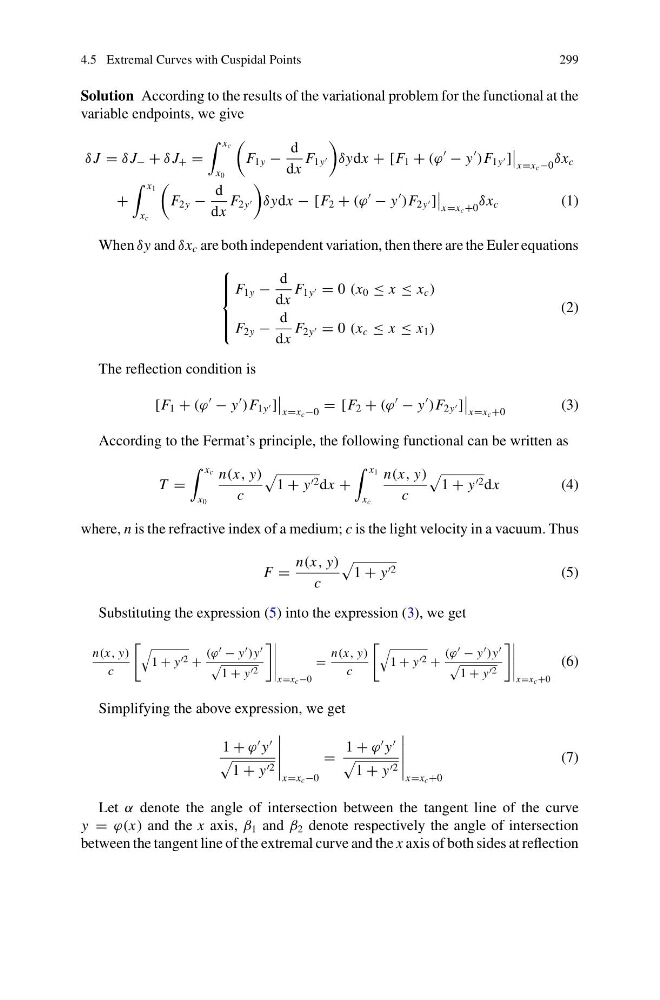
Solution According to the results of the variational problem for the functional at the
variable endpoints, we give
δ J = δ J − + δ J + =
x c
x 0
F 1y −
d
dx
F 1y
δydx + [F 1 + (ϕ
− y
)F 1y ]
x=x c −0
δx c
+
x 1
x c
F 2y −
d
dx
F 2y
δydx − [F 2 + (ϕ
− y
)F 2y ]
x=x c +0
δx c
(1)
When δy and δx c are both independent variation, then there are the Euler equations
⎧
⎪ ⎪ ⎨
⎪ ⎪ ⎩
F 1y −
d
dx
F 1y = 0 (x 0 ≤ x ≤ x c )
F 2y −
d
dx
F 2y = 0 (x c ≤ x ≤ x 1 )
(2)
The reflection condition is
[F 1 + (ϕ
− y
)F 1y ]
x=x c −0
= [F 2 + (ϕ
− y
)F 2y ]
x=x c +0
(3)
According to the Fermat’s principle, the following functional can be written as
T =
x c
x 0
n(x, y)
c
1 + y 2 dx +
x 1
x c
n(x, y)
c
1 + y 2 dx
(4)
where, n is the refractive index of a medium; c is the light velocity in a vacuum. Thus
F =
n(x, y)
c
1 + y 2
(5)
Substituting the expression (5) into the expression (3), we get
n(x, y)
c
1 + y 2 +
(ϕ − y )y
1 + y 2
x=xc−0
=
n(x, y)
c
1 + y 2 +
(ϕ − y )y
1 + y 2
x=xc+0
(6)
Simplifying the above expression, we get
1 + ϕ
y
1 + y 2
x=x c −0
=
1 + ϕ
y
1 + y 2
x=x c +0
(7)
Let α denote the angle of intersection between the tangent line of the curve
y = ϕ(x) and the x axis, β 1 and β 2 denote respectively the angle of intersection
between the tangent line of the extremal curve and the x axis of both sides at reflection
299
Solution According to the results of the variational problem for the functional at the
variable endpoints, we give
δ J = δ J − + δ J + =
x c
x 0
F 1y −
d
dx
F 1y
δydx + [F 1 + (ϕ
− y
)F 1y ]
x=x c −0
δx c
+
x 1
x c
F 2y −
d
dx
F 2y
δydx − [F 2 + (ϕ
− y
)F 2y ]
x=x c +0
δx c
(1)
When δy and δx c are both independent variation, then there are the Euler equations
⎧
⎪ ⎪ ⎨
⎪ ⎪ ⎩
F 1y −
d
dx
F 1y = 0 (x 0 ≤ x ≤ x c )
F 2y −
d
dx
F 2y = 0 (x c ≤ x ≤ x 1 )
(2)
The reflection condition is
[F 1 + (ϕ
− y
)F 1y ]
x=x c −0
= [F 2 + (ϕ
− y
)F 2y ]
x=x c +0
(3)
According to the Fermat’s principle, the following functional can be written as
T =
x c
x 0
n(x, y)
c
1 + y 2 dx +
x 1
x c
n(x, y)
c
1 + y 2 dx
(4)
where, n is the refractive index of a medium; c is the light velocity in a vacuum. Thus
F =
n(x, y)
c
1 + y 2
(5)
Substituting the expression (5) into the expression (3), we get
n(x, y)
c
1 + y 2 +
(ϕ − y )y
1 + y 2
x=xc−0
=
n(x, y)
c
1 + y 2 +
(ϕ − y )y
1 + y 2
x=xc+0
(6)
Simplifying the above expression, we get
1 + ϕ
y
1 + y 2
x=x c −0
=
1 + ϕ
y
1 + y 2
x=x c +0
(7)
Let α denote the angle of intersection between the tangent line of the curve
y = ϕ(x) and the x axis, β 1 and β 2 denote respectively the angle of intersection
between the tangent line of the extremal curve and the x axis of both sides at reflection