

4.5 Extremal Curves with Cuspidal Points
297
∂ F −
∂ y
x=x c −0
=
∂ F +
∂ y
x=x c +0
(4.5.6)
F − − y
∂ F −
∂ y
x=x c −0
=
F + − y
∂ F +
∂ y
x=x c +0
(4.5.7)
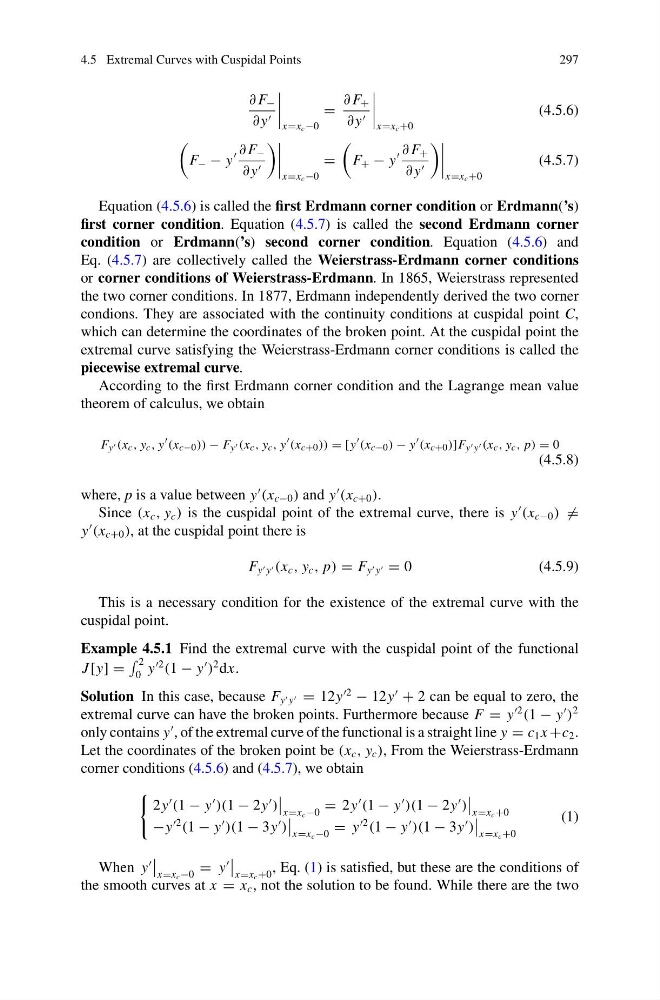
Equation (4.5.6) is called the first Erdmann corner condition or Erdmann(’s)
first corner condition. Equation (4.5.7) is called the second Erdmann corner
condition or Erdmann(’s) second corner condition. Equation (4.5.6) and
Eq. (4.5.7) are collectively called the Weierstrass-Erdmann corner conditions
or corner conditions of Weierstrass-Erdmann. In 1865, Weierstrass represented
the two corner conditions. In 1877, Erdmann independently derived the two corner
condions. They are associated with the continuity conditions at cuspidal point C,
which can determine the coordinates of the broken point. At the cuspidal point the
extremal curve satisfying the Weierstrass-Erdmann corner conditions is called the
piecewise extremal curve.
According to the first Erdmann corner condition and the Lagrange mean value
theorem of calculus, we obtain
F y (x c , y c , y
(x c−0 )) − F y (x c , y c , y
(x c+0 )) = [y
(x c−0 ) − y
(x c+0 )]F y y (x c , y c , p) = 0
(4.5.8)
where, p is a value between y
(x c−0 ) and y
(x c+0 ).
Since (x c , y c ) is the cuspidal point of the extremal curve, there is y
(x c−0 ) =
y
(x c+0 ), at the cuspidal point there is
F y y (x c , y c , p) = F y y = 0
(4.5.9)
This is a necessary condition for the existence of the extremal curve with the
cuspidal point.
Example 4.5.1 Find the extremal curve with the cuspidal point of the functional
J [y] =
2
0 y
2
(1 − y
)
2 dx.
Solution In this case, because F y y = 12y
2
− 12y
+ 2 can be equal to zero, the
extremal curve can have the broken points. Furthermore because F = y
2
(1 − y
)
2
only contains y
, of the extremal curve of the functional is a straight line y = c 1 x +c 2 .
Let the coordinates of the broken point be (x c , y c ), From the Weierstrass-Erdmann
corner conditions (4.5.6) and (4.5.7), we obtain
2y
(1 − y
)(1 − 2y
)
x=x c −0
= 2y
(1 − y
)(1 − 2y
)
x=x c +0
−y
2
(1 − y
)(1 − 3y
)
x=x c −0
= y
2
(1 − y
)(1 − 3y
)
x=x c +0
(1)
When y
x=x c −0
= y
x=x c +0
, Eq. (1) is satisfied, but these are the conditions of
the smooth curves at x = x c , not the solution to be found. While there are the two
297
∂ F −
∂ y
x=x c −0
=
∂ F +
∂ y
x=x c +0
(4.5.6)
F − − y
∂ F −
∂ y
x=x c −0
=
F + − y
∂ F +
∂ y
x=x c +0
(4.5.7)
Equation (4.5.6) is called the first Erdmann corner condition or Erdmann(’s)
first corner condition. Equation (4.5.7) is called the second Erdmann corner
condition or Erdmann(’s) second corner condition. Equation (4.5.6) and
Eq. (4.5.7) are collectively called the Weierstrass-Erdmann corner conditions
or corner conditions of Weierstrass-Erdmann. In 1865, Weierstrass represented
the two corner conditions. In 1877, Erdmann independently derived the two corner
condions. They are associated with the continuity conditions at cuspidal point C,
which can determine the coordinates of the broken point. At the cuspidal point the
extremal curve satisfying the Weierstrass-Erdmann corner conditions is called the
piecewise extremal curve.
According to the first Erdmann corner condition and the Lagrange mean value
theorem of calculus, we obtain
F y (x c , y c , y
(x c−0 )) − F y (x c , y c , y
(x c+0 )) = [y
(x c−0 ) − y
(x c+0 )]F y y (x c , y c , p) = 0
(4.5.8)
where, p is a value between y
(x c−0 ) and y
(x c+0 ).
Since (x c , y c ) is the cuspidal point of the extremal curve, there is y
(x c−0 ) =
y
(x c+0 ), at the cuspidal point there is
F y y (x c , y c , p) = F y y = 0
(4.5.9)
This is a necessary condition for the existence of the extremal curve with the
cuspidal point.
Example 4.5.1 Find the extremal curve with the cuspidal point of the functional
J [y] =
2
0 y
2
(1 − y
)
2 dx.
Solution In this case, because F y y = 12y
2
− 12y
+ 2 can be equal to zero, the
extremal curve can have the broken points. Furthermore because F = y
2
(1 − y
)
2
only contains y
, of the extremal curve of the functional is a straight line y = c 1 x +c 2 .
Let the coordinates of the broken point be (x c , y c ), From the Weierstrass-Erdmann
corner conditions (4.5.6) and (4.5.7), we obtain
2y
(1 − y
)(1 − 2y
)
x=x c −0
= 2y
(1 − y
)(1 − 2y
)
x=x c +0
−y
2
(1 − y
)(1 − 3y
)
x=x c −0
= y
2
(1 − y
)(1 − 3y
)
x=x c +0
(1)
When y
x=x c −0
= y
x=x c +0
, Eq. (1) is satisfied, but these are the conditions of
the smooth curves at x = x c , not the solution to be found. While there are the two