

296
4 Problems with Variable Boundaries
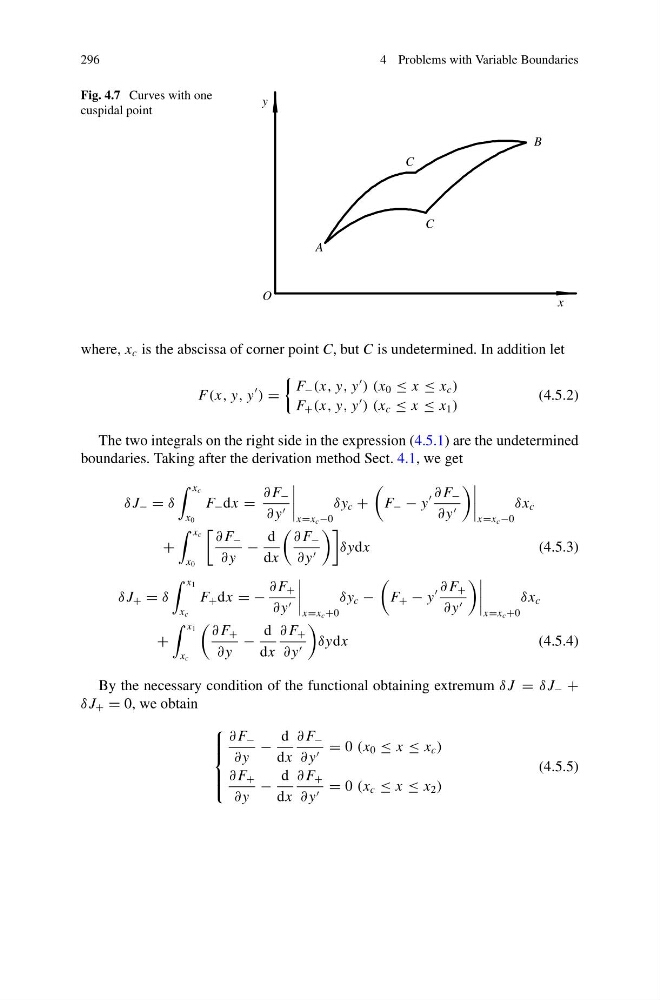
Fig. 4.7 Curves with one
cuspidal point
O
x
y
A
B
C
C
where, x c is the abscissa of corner point C, but C is undetermined. In addition let
F(x, y, y
) =
F − (x, y, y
) (x 0 ≤ x ≤ x c )
F + (x, y, y
) (x c ≤ x ≤ x 1 )
(4.5.2)
The two integrals on the right side in the expression (4.5.1) are the undetermined
boundaries. Taking after the derivation method Sect. 4.1, we get
δ J − = δ
x c
x 0
F − dx =
∂ F −
∂ y
x=x c −0
δy c +
F − − y
∂ F −
∂ y
x=x c −0
δx c
+
x c
x 0
∂ F −
∂ y
−
d
dx
∂ F −
∂ y
δydx
(4.5.3)
δ J + = δ
x 1
x c
F + dx = −
∂ F +
∂ y
x=x c +0
δy c −
F + − y
∂ F +
∂ y
x=x c +0
δx c
+
x 1
x c
∂ F +
∂ y
−
d
dx
∂ F +
∂ y
δydx
(4.5.4)
By the necessary condition of the functional obtaining extremum δ J = δ J − +
δ J + = 0, we obtain
⎧
⎪ ⎪ ⎨
⎪ ⎪ ⎩
∂ F −
∂ y
−
d
dx
∂ F −
∂ y = 0 (x 0 ≤ x ≤ x c )
∂ F +
∂ y
−
d
dx
∂ F +
∂ y = 0 (x c ≤ x ≤ x 2 )
(4.5.5)
4 Problems with Variable Boundaries
Fig. 4.7 Curves with one
cuspidal point
O
x
y
A
B
C
C
where, x c is the abscissa of corner point C, but C is undetermined. In addition let
F(x, y, y
) =
F − (x, y, y
) (x 0 ≤ x ≤ x c )
F + (x, y, y
) (x c ≤ x ≤ x 1 )
(4.5.2)
The two integrals on the right side in the expression (4.5.1) are the undetermined
boundaries. Taking after the derivation method Sect. 4.1, we get
δ J − = δ
x c
x 0
F − dx =
∂ F −
∂ y
x=x c −0
δy c +
F − − y
∂ F −
∂ y
x=x c −0
δx c
+
x c
x 0
∂ F −
∂ y
−
d
dx
∂ F −
∂ y
δydx
(4.5.3)
δ J + = δ
x 1
x c
F + dx = −
∂ F +
∂ y
x=x c +0
δy c −
F + − y
∂ F +
∂ y
x=x c +0
δx c
+
x 1
x c
∂ F +
∂ y
−
d
dx
∂ F +
∂ y
δydx
(4.5.4)
By the necessary condition of the functional obtaining extremum δ J = δ J − +
δ J + = 0, we obtain
⎧
⎪ ⎪ ⎨
⎪ ⎪ ⎩
∂ F −
∂ y
−
d
dx
∂ F −
∂ y = 0 (x 0 ≤ x ≤ x c )
∂ F +
∂ y
−
d
dx
∂ F +
∂ y = 0 (x c ≤ x ≤ x 2 )
(4.5.5)