

272
4 Problems with Variable Boundaries
δ J =
Fδx + F y δy + F y δy
−
d F y
dx
δy
x=x 1
(4.3.6)
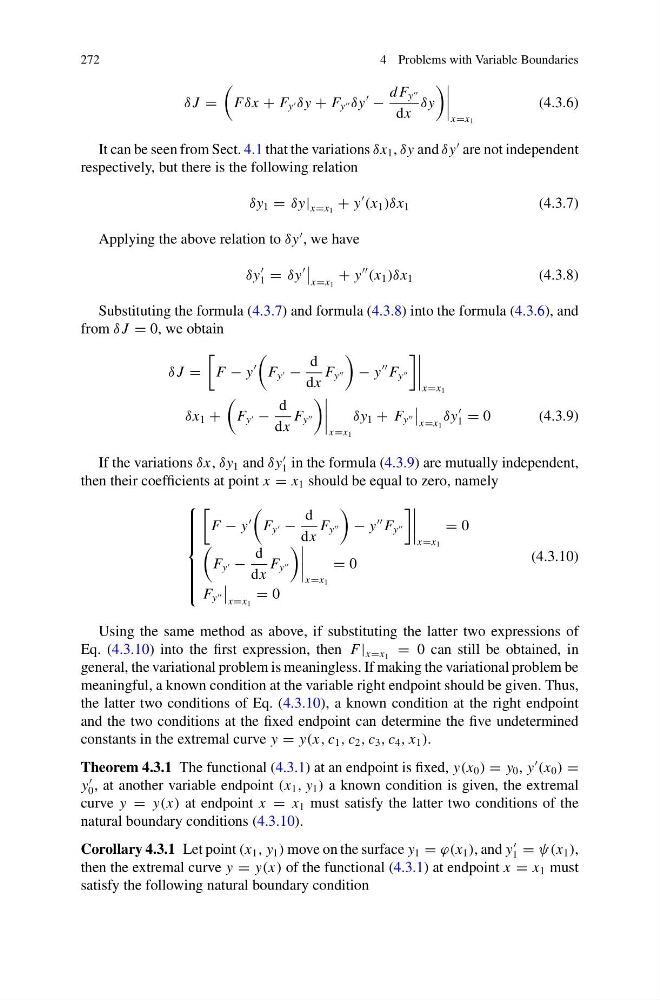
It can be seen from Sect. 4.1 that the variations δx 1 , δy and δy
are not independent
respectively, but there is the following relation
δy 1 = δy| x=x 1 + y
(x 1 )δx 1
(4.3.7)
Applying the above relation to δy
, we have
δy
1 = δy
x=x 1
+ y
(x 1 )δx 1
(4.3.8)
Substituting the formula (4.3.7) and formula (4.3.8) into the formula (4.3.6), and
from δ J = 0, we obtain
δ J =
F − y
F y −
d
dx
F y
− y
F y
x=x 1
δx 1 +
F y −
d
dx
F y
x=x 1
δy 1 + F y
x=x 1
δy
1 = 0
(4.3.9)
If the variations δx, δy 1 and δy
1 in the formula (4.3.9) are mutually independent,
then their coefficients at point x = x 1 should be equal to zero, namely
⎧
⎪ ⎪ ⎪ ⎪ ⎪ ⎨
⎪ ⎪ ⎪ ⎪ ⎪ ⎩
F − y
F y −
d
dx
F y
− y
F y
x=x 1
= 0
F y −
d
dx
F y
x=x 1
= 0
F y
x=x 1
= 0
(4.3.10)
Using the same method as above, if substituting the latter two expressions of
Eq. (4.3.10) into the first expression, then F| x=x 1 = 0 can still be obtained, in
general, the variational problem is meaningless. If making the variational problem be
meaningful, a known condition at the variable right endpoint should be given. Thus,
the latter two conditions of Eq. (4.3.10), a known condition at the right endpoint
and the two conditions at the fixed endpoint can determine the five undetermined
constants in the extremal curve y = y(x, c 1 , c 2 , c 3 , c 4 , x 1 ).
Theorem 4.3.1 The functional (4.3.1) at an endpoint is fixed, y(x 0 ) = y 0 , y
(x 0 ) =
y
0 , at another variable endpoint (x 1 , y 1 ) a known condition is given, the extremal
curve y = y(x) at endpoint x = x 1 must satisfy the latter two conditions of the
natural boundary conditions (4.3.10).
Corollary 4.3.1 Let point (x 1 , y 1 ) move on the surface y 1 = ϕ(x 1 ), and y
1 = ψ(x 1 ),
then the extremal curve y = y(x) of the functional (4.3.1) at endpoint x = x 1 must
satisfy the following natural boundary condition
4 Problems with Variable Boundaries
δ J =
Fδx + F y δy + F y δy
−
d F y
dx
δy
x=x 1
(4.3.6)
It can be seen from Sect. 4.1 that the variations δx 1 , δy and δy
are not independent
respectively, but there is the following relation
δy 1 = δy| x=x 1 + y
(x 1 )δx 1
(4.3.7)
Applying the above relation to δy
, we have
δy
1 = δy
x=x 1
+ y
(x 1 )δx 1
(4.3.8)
Substituting the formula (4.3.7) and formula (4.3.8) into the formula (4.3.6), and
from δ J = 0, we obtain
δ J =
F − y
F y −
d
dx
F y
− y
F y
x=x 1
δx 1 +
F y −
d
dx
F y
x=x 1
δy 1 + F y
x=x 1
δy
1 = 0
(4.3.9)
If the variations δx, δy 1 and δy
1 in the formula (4.3.9) are mutually independent,
then their coefficients at point x = x 1 should be equal to zero, namely
⎧
⎪ ⎪ ⎪ ⎪ ⎪ ⎨
⎪ ⎪ ⎪ ⎪ ⎪ ⎩
F − y
F y −
d
dx
F y
− y
F y
x=x 1
= 0
F y −
d
dx
F y
x=x 1
= 0
F y
x=x 1
= 0
(4.3.10)
Using the same method as above, if substituting the latter two expressions of
Eq. (4.3.10) into the first expression, then F| x=x 1 = 0 can still be obtained, in
general, the variational problem is meaningless. If making the variational problem be
meaningful, a known condition at the variable right endpoint should be given. Thus,
the latter two conditions of Eq. (4.3.10), a known condition at the right endpoint
and the two conditions at the fixed endpoint can determine the five undetermined
constants in the extremal curve y = y(x, c 1 , c 2 , c 3 , c 4 , x 1 ).
Theorem 4.3.1 The functional (4.3.1) at an endpoint is fixed, y(x 0 ) = y 0 , y
(x 0 ) =
y
0 , at another variable endpoint (x 1 , y 1 ) a known condition is given, the extremal
curve y = y(x) at endpoint x = x 1 must satisfy the latter two conditions of the
natural boundary conditions (4.3.10).
Corollary 4.3.1 Let point (x 1 , y 1 ) move on the surface y 1 = ϕ(x 1 ), and y
1 = ψ(x 1 ),
then the extremal curve y = y(x) of the functional (4.3.1) at endpoint x = x 1 must
satisfy the following natural boundary condition