

4.3 Variational Problems of Functionals with Higher Order Derivatives
271
F y −
d F y
dx
+
d
2 F y
dx 2 = 0
(4.3.2)
In general case, Eq. (4.3.2) is an ordinary differential equation of fourth order,
the general solution has four arbitrary constants. Because the right endpoint B is
variable, x 1 is also undetermined, so five arbitrary constants need to be determined
in all. Because the left endpoint A is fixed, the two arbitrary constants of the general
solution of the Euler-Poisson equation can be determined by the boundary conditions
y(x 0 ) = y 0 and y
(x 0 ) = y
0 . In order to determine the unique solution, it is necessary
to find out other three equations to determine the rest three undetermined constants,
the three equations can be got by means of the necessary condition δ J = 0 of the
functional obtaining extremum. Here the general case is discussed, first the increment
J of the functional (4.3.1) is calculated, and then its main linear part δ J is separated
out.
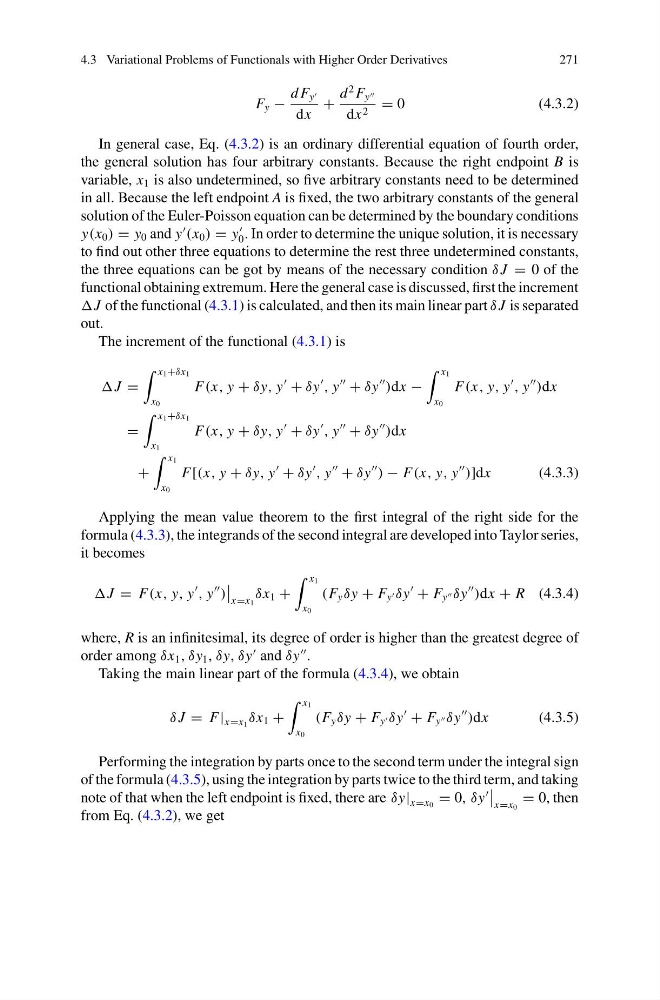
The increment of the functional (4.3.1) is
J =
x 1 +δx 1
x 0
F(x, y + δy, y
+ δy
, y
+ δy
)dx −
x 1
x 0
F(x, y, y
, y
)dx
=
x 1 +δx 1
x 1
F(x, y + δy, y
+ δy
, y
+ δy
)dx
+
x 1
x 0
F[(x, y + δy, y
+ δy
, y
+ δy
) − F(x, y, y
)]dx
(4.3.3)
Applying the mean value theorem to the first integral of the right side for the
formula (4.3.3), the integrands of the second integral are developed into Taylor series,
it becomes
J = F(x, y, y
, y
)
x=x 1
δx 1 +
x 1
x 0
(F y δy + F y δy
+ F y δy
)dx + R (4.3.4)
where, R is an infinitesimal, its degree of order is higher than the greatest degree of
order among δx 1 , δy 1 , δy, δy
and δy
.
Taking the main linear part of the formula (4.3.4), we obtain
δ J = F| x=x 1 δx 1 +
x 1
x 0
(F y δy + F y δy
+ F y δy
)dx
(4.3.5)
Performing the integration by parts once to the second term under the integral sign
of the formula (4.3.5), using the integration by parts twice to the third term, and taking
note of that when the left endpoint is fixed, there are δy| x=x 0 = 0, δy
x=x 0
= 0, then
from Eq. (4.3.2), we get
271
F y −
d F y
dx
+
d
2 F y
dx 2 = 0
(4.3.2)
In general case, Eq. (4.3.2) is an ordinary differential equation of fourth order,
the general solution has four arbitrary constants. Because the right endpoint B is
variable, x 1 is also undetermined, so five arbitrary constants need to be determined
in all. Because the left endpoint A is fixed, the two arbitrary constants of the general
solution of the Euler-Poisson equation can be determined by the boundary conditions
y(x 0 ) = y 0 and y
(x 0 ) = y
0 . In order to determine the unique solution, it is necessary
to find out other three equations to determine the rest three undetermined constants,
the three equations can be got by means of the necessary condition δ J = 0 of the
functional obtaining extremum. Here the general case is discussed, first the increment
J of the functional (4.3.1) is calculated, and then its main linear part δ J is separated
out.
The increment of the functional (4.3.1) is
J =
x 1 +δx 1
x 0
F(x, y + δy, y
+ δy
, y
+ δy
)dx −
x 1
x 0
F(x, y, y
, y
)dx
=
x 1 +δx 1
x 1
F(x, y + δy, y
+ δy
, y
+ δy
)dx
+
x 1
x 0
F[(x, y + δy, y
+ δy
, y
+ δy
) − F(x, y, y
)]dx
(4.3.3)
Applying the mean value theorem to the first integral of the right side for the
formula (4.3.3), the integrands of the second integral are developed into Taylor series,
it becomes
J = F(x, y, y
, y
)
x=x 1
δx 1 +
x 1
x 0
(F y δy + F y δy
+ F y δy
)dx + R (4.3.4)
where, R is an infinitesimal, its degree of order is higher than the greatest degree of
order among δx 1 , δy 1 , δy, δy
and δy
.
Taking the main linear part of the formula (4.3.4), we obtain
δ J = F| x=x 1 δx 1 +
x 1
x 0
(F y δy + F y δy
+ F y δy
)dx
(4.3.5)
Performing the integration by parts once to the second term under the integral sign
of the formula (4.3.5), using the integration by parts twice to the third term, and taking
note of that when the left endpoint is fixed, there are δy| x=x 0 = 0, δy
x=x 0
= 0, then
from Eq. (4.3.2), we get