

4.1 Variational Problems of the Simplest Functional
255
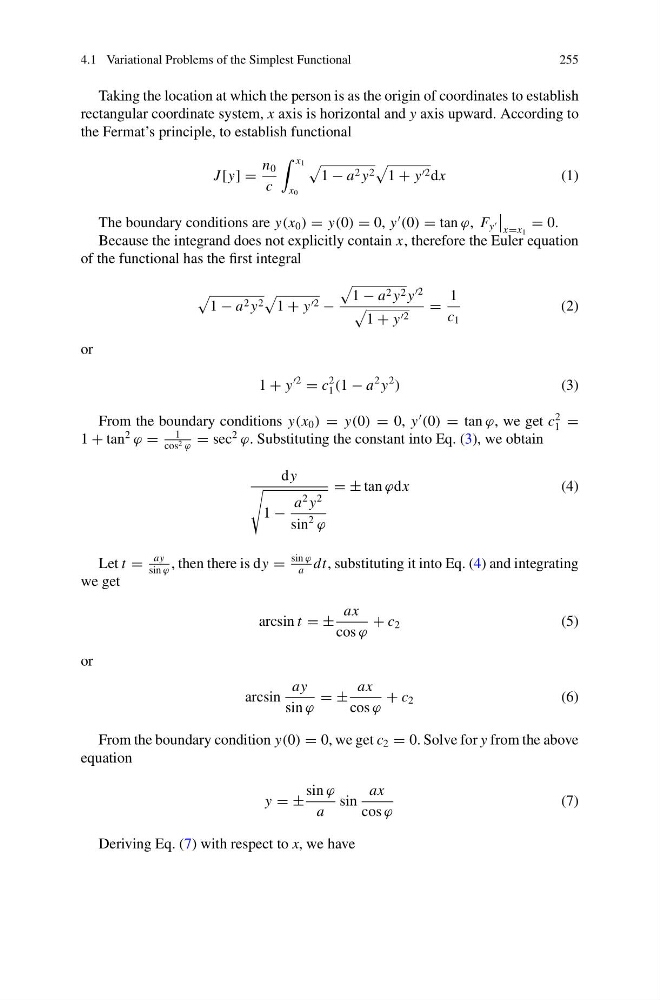
Taking the location at which the person is as the origin of coordinates to establish
rectangular coordinate system, x axis is horizontal and y axis upward. According to
the Fermat’s principle, to establish functional
J [y] =
n 0
c
x 1
x 0
1 − a 2 y 2
1 + y 2 dx
(1)
The boundary conditions are y(x 0 ) = y(0) = 0, y
(0) = tan ϕ, F y
x=x 1
= 0.
Because the integrand does not explicitly contain x, therefore the Euler equation
of the functional has the first integral
1 − a 2 y 2
1 + y 2 −
1 − a 2 y 2 y
2
1 + y 2
=
1
c 1
(2)
or
1 + y
2
= c
2
1 (1 − a
2 y
2
)
(3)
From the boundary conditions y(x 0 ) = y(0) = 0, y
(0) = tan ϕ, we get c
2
1 =
1 + tan
2
ϕ =
1
cos 2 ϕ
= sec
2
ϕ. Substituting the constant into Eq. (3), we obtain
dy
1 −
a
2 y
2
sin
2
ϕ
= ± tan ϕdx
(4)
Let t =
ay
sin ϕ
, then there is dy =
sin ϕ
a
dt, substituting it into Eq. (4) and integrating
we get
arcsin t = ±
ax
cos ϕ
+ c 2
(5)
or
arcsin
ay
sin ϕ
= ±
ax
cos ϕ
+ c 2
(6)
From the boundary condition y(0) = 0, we get c 2 = 0. Solve for y from the above
equation
y = ±
sin ϕ
a
sin
ax
cos ϕ
(7)
Deriving Eq. (7) with respect to x, we have
255
Taking the location at which the person is as the origin of coordinates to establish
rectangular coordinate system, x axis is horizontal and y axis upward. According to
the Fermat’s principle, to establish functional
J [y] =
n 0
c
x 1
x 0
1 − a 2 y 2
1 + y 2 dx
(1)
The boundary conditions are y(x 0 ) = y(0) = 0, y
(0) = tan ϕ, F y
x=x 1
= 0.
Because the integrand does not explicitly contain x, therefore the Euler equation
of the functional has the first integral
1 − a 2 y 2
1 + y 2 −
1 − a 2 y 2 y
2
1 + y 2
=
1
c 1
(2)
or
1 + y
2
= c
2
1 (1 − a
2 y
2
)
(3)
From the boundary conditions y(x 0 ) = y(0) = 0, y
(0) = tan ϕ, we get c
2
1 =
1 + tan
2
ϕ =
1
cos 2 ϕ
= sec
2
ϕ. Substituting the constant into Eq. (3), we obtain
dy
1 −
a
2 y
2
sin
2
ϕ
= ± tan ϕdx
(4)
Let t =
ay
sin ϕ
, then there is dy =
sin ϕ
a
dt, substituting it into Eq. (4) and integrating
we get
arcsin t = ±
ax
cos ϕ
+ c 2
(5)
or
arcsin
ay
sin ϕ
= ±
ax
cos ϕ
+ c 2
(6)
From the boundary condition y(0) = 0, we get c 2 = 0. Solve for y from the above
equation
y = ±
sin ϕ
a
sin
ax
cos ϕ
(7)
Deriving Eq. (7) with respect to x, we have