

256
4 Problems with Variable Boundaries
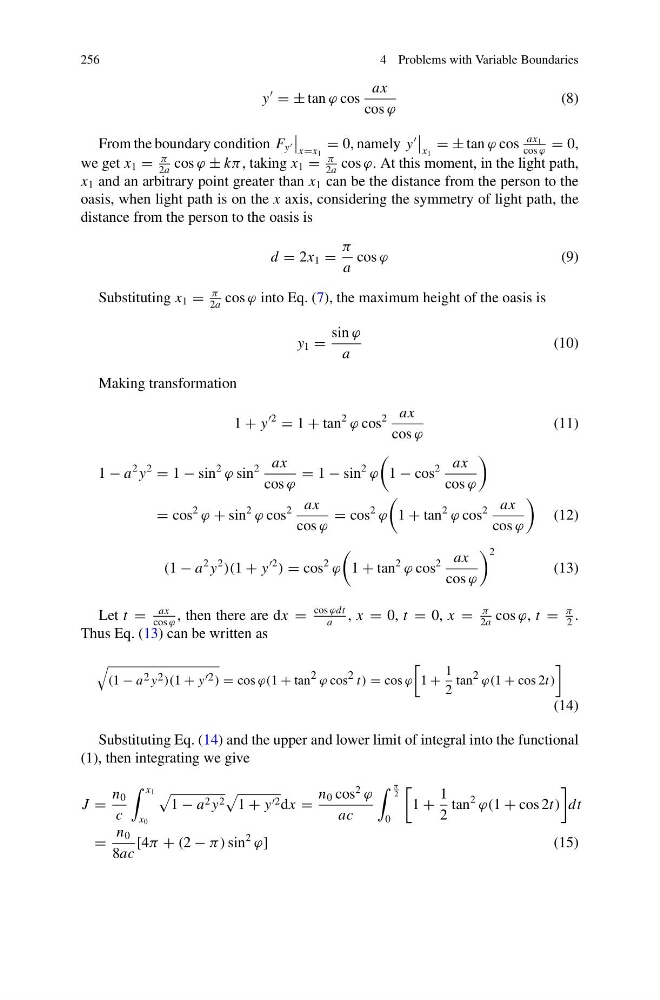
y
= ± tan ϕ cos
ax
cos ϕ
(8)
From the boundary condition F y
x=x 1
= 0, namely y
x 1
= ± tan ϕ cos
ax 1
cos ϕ
= 0,
we get x 1 =
π
2a
cos ϕ ± kπ , taking x 1 =
π
2a
cos ϕ. At this moment, in the light path,
x 1 and an arbitrary point greater than x 1 can be the distance from the person to the
oasis, when light path is on the x axis, considering the symmetry of light path, the
distance from the person to the oasis is
d = 2x 1 =
π
a
cos ϕ
(9)
Substituting x 1 =
π
2a
cos ϕ into Eq. (7), the maximum height of the oasis is
y 1 =
sin ϕ
a
(10)
Making transformation
1 + y
2
= 1 + tan
2
ϕ cos
2 ax
cos ϕ
(11)
1 − a
2 y
2
= 1 − sin
2
ϕ sin
2 ax
cos ϕ
= 1 − sin
2
ϕ
1 − cos
2 ax
cos ϕ
= cos
2
ϕ + sin
2
ϕ cos
2 ax
cos ϕ
= cos
2
ϕ
1 + tan
2
ϕ cos
2 ax
cos ϕ
(12)
(1 − a
2 y
2
)(1 + y
2
) = cos
2
ϕ
1 + tan
2
ϕ cos
2 ax
cos ϕ
2
(13)
Let t =
ax
cos ϕ
, then there are dx =
cos ϕdt
a
, x = 0, t = 0, x =
π
2a
cos ϕ, t =
π
2
.
Thus Eq. (13) can be written as
(1 − a 2 y 2 )(1 + y 2 ) = cos ϕ(1 + tan 2 ϕ cos 2 t) = cos ϕ
1 +
1
2
tan 2 ϕ(1 + cos 2t)
(14)
Substituting Eq. (14) and the upper and lower limit of integral into the functional
(1), then integrating we give
J =
n 0
c
x 1
x 0
1 − a 2 y 2
1 + y 2 dx =
n 0 cos
2
ϕ
ac
π
2
0
1 +
1
2
tan
2
ϕ(1 + cos 2t)
dt
=
n 0
8ac
[4π + (2 − π) sin
2
ϕ]
(15)
4 Problems with Variable Boundaries
y
= ± tan ϕ cos
ax
cos ϕ
(8)
From the boundary condition F y
x=x 1
= 0, namely y
x 1
= ± tan ϕ cos
ax 1
cos ϕ
= 0,
we get x 1 =
π
2a
cos ϕ ± kπ , taking x 1 =
π
2a
cos ϕ. At this moment, in the light path,
x 1 and an arbitrary point greater than x 1 can be the distance from the person to the
oasis, when light path is on the x axis, considering the symmetry of light path, the
distance from the person to the oasis is
d = 2x 1 =
π
a
cos ϕ
(9)
Substituting x 1 =
π
2a
cos ϕ into Eq. (7), the maximum height of the oasis is
y 1 =
sin ϕ
a
(10)
Making transformation
1 + y
2
= 1 + tan
2
ϕ cos
2 ax
cos ϕ
(11)
1 − a
2 y
2
= 1 − sin
2
ϕ sin
2 ax
cos ϕ
= 1 − sin
2
ϕ
1 − cos
2 ax
cos ϕ
= cos
2
ϕ + sin
2
ϕ cos
2 ax
cos ϕ
= cos
2
ϕ
1 + tan
2
ϕ cos
2 ax
cos ϕ
(12)
(1 − a
2 y
2
)(1 + y
2
) = cos
2
ϕ
1 + tan
2
ϕ cos
2 ax
cos ϕ
2
(13)
Let t =
ax
cos ϕ
, then there are dx =
cos ϕdt
a
, x = 0, t = 0, x =
π
2a
cos ϕ, t =
π
2
.
Thus Eq. (13) can be written as
(1 − a 2 y 2 )(1 + y 2 ) = cos ϕ(1 + tan 2 ϕ cos 2 t) = cos ϕ
1 +
1
2
tan 2 ϕ(1 + cos 2t)
(14)
Substituting Eq. (14) and the upper and lower limit of integral into the functional
(1), then integrating we give
J =
n 0
c
x 1
x 0
1 − a 2 y 2
1 + y 2 dx =
n 0 cos
2
ϕ
ac
π
2
0
1 +
1
2
tan
2
ϕ(1 + cos 2t)
dt
=
n 0
8ac
[4π + (2 − π) sin
2
ϕ]
(15)