

254
4 Problems with Variable Boundaries
c 1 x 0 + c 2 = −x 0 − 1,
c 1 x 1 + c 2 =
1
x 1
1 − c 1 = 0,
1 −
c 1
x
2
1
= 0
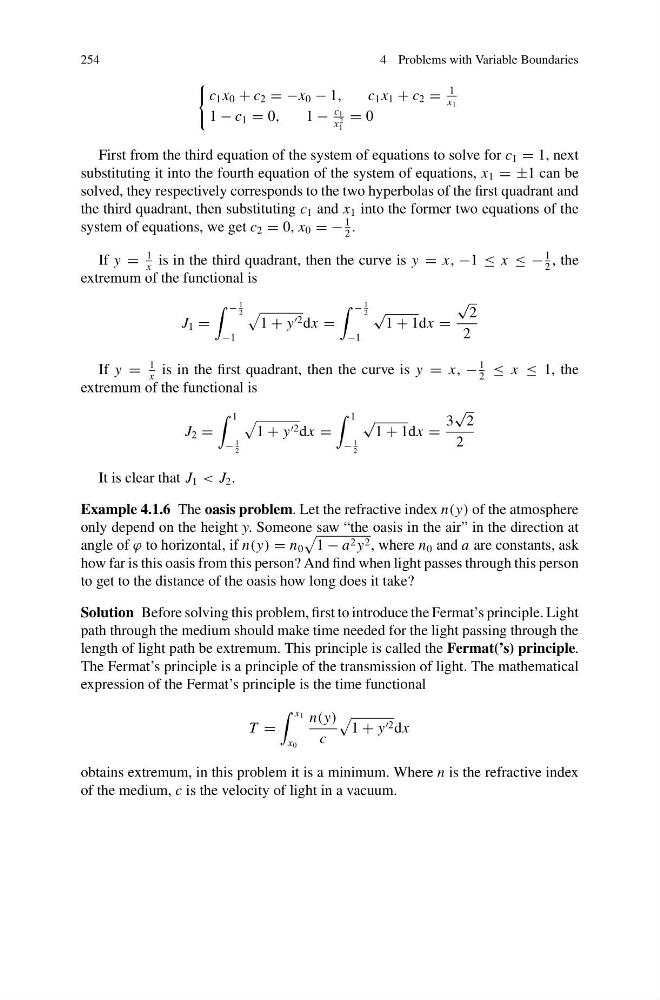
First from the third equation of the system of equations to solve for c 1 = 1, next
substituting it into the fourth equation of the system of equations, x 1 = ±1 can be
solved, they respectively corresponds to the two hyperbolas of the first quadrant and
the third quadrant, then substituting c 1 and x 1 into the former two equations of the
system of equations, we get c 2 = 0, x 0 = −
1
2
.
If y =
1
x
is in the third quadrant, then the curve is y = x, −1 ≤ x ≤ −
1
2
, the
extremum of the functional is
J 1 =
−
1
2
−1
1 + y 2 dx =
−
1
2
−1
√
1 + 1dx =
√
2
2
If y =
1
x
is in the first quadrant, then the curve is y = x, −
1
2
≤ x ≤ 1, the
extremum of the functional is
J 2 =
1
−
1
2
1 + y 2 dx =
1
−
1
2
√
1 + 1dx =
3
√
2
2
It is clear that J 1 < J 2 .
Example 4.1.6 The oasis problem. Let the refractive index n(y) of the atmosphere
only depend on the height y. Someone saw “the oasis in the air” in the direction at
angle of ϕ to horizontal, if n(y) = n 0
1 − a 2 y 2 , where n 0 and a are constants, ask
how far is this oasis from this person? And find when light passes through this person
to get to the distance of the oasis how long does it take?
Solution Before solving this problem, first to introduce the Fermat’s principle. Light
path through the medium should make time needed for the light passing through the
length of light path be extremum. This principle is called the Fermat(’s) principle.
The Fermat’s principle is a principle of the transmission of light. The mathematical
expression of the Fermat’s principle is the time functional
T =
x 1
x 0
n(y)
c
1 + y 2 dx
obtains extremum, in this problem it is a minimum. Where n is the refractive index
of the medium, c is the velocity of light in a vacuum.
4 Problems with Variable Boundaries
c 1 x 0 + c 2 = −x 0 − 1,
c 1 x 1 + c 2 =
1
x 1
1 − c 1 = 0,
1 −
c 1
x
2
1
= 0
First from the third equation of the system of equations to solve for c 1 = 1, next
substituting it into the fourth equation of the system of equations, x 1 = ±1 can be
solved, they respectively corresponds to the two hyperbolas of the first quadrant and
the third quadrant, then substituting c 1 and x 1 into the former two equations of the
system of equations, we get c 2 = 0, x 0 = −
1
2
.
If y =
1
x
is in the third quadrant, then the curve is y = x, −1 ≤ x ≤ −
1
2
, the
extremum of the functional is
J 1 =
−
1
2
−1
1 + y 2 dx =
−
1
2
−1
√
1 + 1dx =
√
2
2
If y =
1
x
is in the first quadrant, then the curve is y = x, −
1
2
≤ x ≤ 1, the
extremum of the functional is
J 2 =
1
−
1
2
1 + y 2 dx =
1
−
1
2
√
1 + 1dx =
3
√
2
2
It is clear that J 1 < J 2 .
Example 4.1.6 The oasis problem. Let the refractive index n(y) of the atmosphere
only depend on the height y. Someone saw “the oasis in the air” in the direction at
angle of ϕ to horizontal, if n(y) = n 0
1 − a 2 y 2 , where n 0 and a are constants, ask
how far is this oasis from this person? And find when light passes through this person
to get to the distance of the oasis how long does it take?
Solution Before solving this problem, first to introduce the Fermat’s principle. Light
path through the medium should make time needed for the light passing through the
length of light path be extremum. This principle is called the Fermat(’s) principle.
The Fermat’s principle is a principle of the transmission of light. The mathematical
expression of the Fermat’s principle is the time functional
T =
x 1
x 0
n(y)
c
1 + y 2 dx
obtains extremum, in this problem it is a minimum. Where n is the refractive index
of the medium, c is the velocity of light in a vacuum.