

4.1 Variational Problems of the Simplest Functional
241
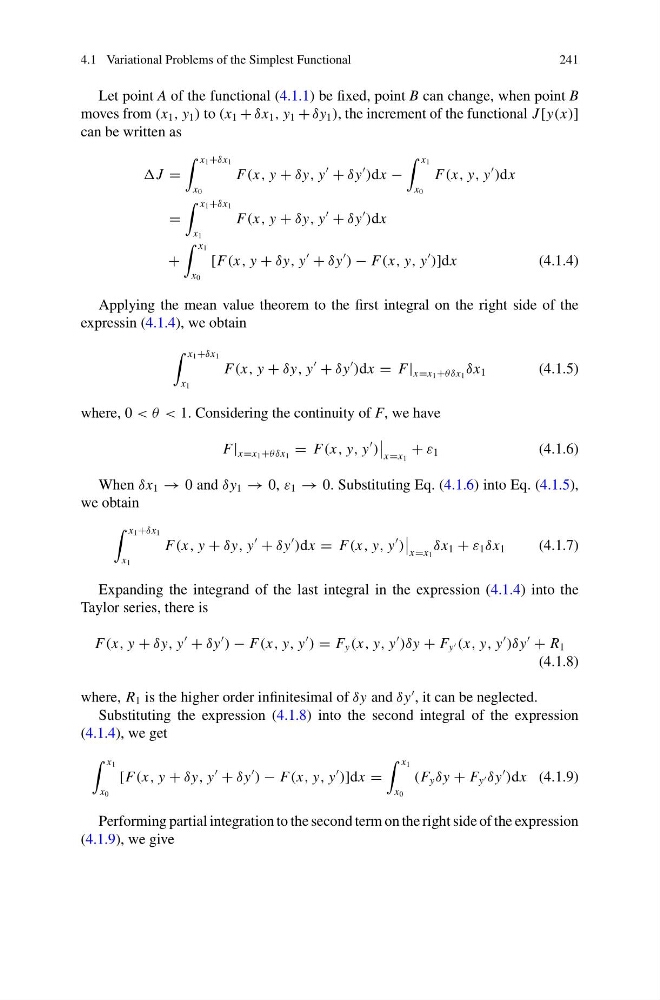
Let point A of the functional (4.1.1) be fixed, point B can change, when point B
moves from (x 1 , y 1 ) to (x 1 + δx 1 , y 1 + δy 1 ), the increment of the functional J [y(x)]
can be written as
J =
x 1 +δx 1
x 0
F(x, y + δy, y
+ δy
)dx −
x 1
x 0
F(x, y, y
)dx
=
x 1 +δx 1
x 1
F(x, y + δy, y
+ δy
)dx
+
x 1
x 0
[F(x, y + δy, y
+ δy
) − F(x, y, y
)]dx
(4.1.4)
Applying the mean value theorem to the first integral on the right side of the
expressin (4.1.4), we obtain
x 1 +δx 1
x 1
F(x, y + δy, y
+ δy
)dx = F| x=x 1 +θδx 1 δx 1
(4.1.5)
where, 0 < θ < 1. Considering the continuity of F, we have
F| x=x 1 +θδx 1 = F(x, y, y
)
x=x 1
+ ε 1
(4.1.6)
When δx 1 → 0 and δy 1 → 0, ε 1 → 0. Substituting Eq. (4.1.6) into Eq. (4.1.5),
we obtain
x 1 +δx 1
x 1
F(x, y + δy, y
+ δy
)dx = F(x, y, y
)
x=x 1
δx 1 + ε 1 δx 1
(4.1.7)
Expanding the integrand of the last integral in the expression (4.1.4) into the
Taylor series, there is
F(x, y + δy, y
+ δy
) − F(x, y, y
) = F y (x, y, y
)δy + F y (x, y, y
)δy
+ R 1
(4.1.8)
where, R 1 is the higher order infinitesimal of δy and δy
, it can be neglected.
Substituting the expression (4.1.8) into the second integral of the expression
(4.1.4), we get
x 1
x 0
[F(x, y + δy, y
+ δy
) − F(x, y, y
)]dx =
x 1
x 0
(F y δy + F y δy
)dx (4.1.9)
Performing partial integration to the second term on the right side of the expression
(4.1.9), we give
241
Let point A of the functional (4.1.1) be fixed, point B can change, when point B
moves from (x 1 , y 1 ) to (x 1 + δx 1 , y 1 + δy 1 ), the increment of the functional J [y(x)]
can be written as
J =
x 1 +δx 1
x 0
F(x, y + δy, y
+ δy
)dx −
x 1
x 0
F(x, y, y
)dx
=
x 1 +δx 1
x 1
F(x, y + δy, y
+ δy
)dx
+
x 1
x 0
[F(x, y + δy, y
+ δy
) − F(x, y, y
)]dx
(4.1.4)
Applying the mean value theorem to the first integral on the right side of the
expressin (4.1.4), we obtain
x 1 +δx 1
x 1
F(x, y + δy, y
+ δy
)dx = F| x=x 1 +θδx 1 δx 1
(4.1.5)
where, 0 < θ < 1. Considering the continuity of F, we have
F| x=x 1 +θδx 1 = F(x, y, y
)
x=x 1
+ ε 1
(4.1.6)
When δx 1 → 0 and δy 1 → 0, ε 1 → 0. Substituting Eq. (4.1.6) into Eq. (4.1.5),
we obtain
x 1 +δx 1
x 1
F(x, y + δy, y
+ δy
)dx = F(x, y, y
)
x=x 1
δx 1 + ε 1 δx 1
(4.1.7)
Expanding the integrand of the last integral in the expression (4.1.4) into the
Taylor series, there is
F(x, y + δy, y
+ δy
) − F(x, y, y
) = F y (x, y, y
)δy + F y (x, y, y
)δy
+ R 1
(4.1.8)
where, R 1 is the higher order infinitesimal of δy and δy
, it can be neglected.
Substituting the expression (4.1.8) into the second integral of the expression
(4.1.4), we get
x 1
x 0
[F(x, y + δy, y
+ δy
) − F(x, y, y
)]dx =
x 1
x 0
(F y δy + F y δy
)dx (4.1.9)
Performing partial integration to the second term on the right side of the expression
(4.1.9), we give