

240
4 Problems with Variable Boundaries
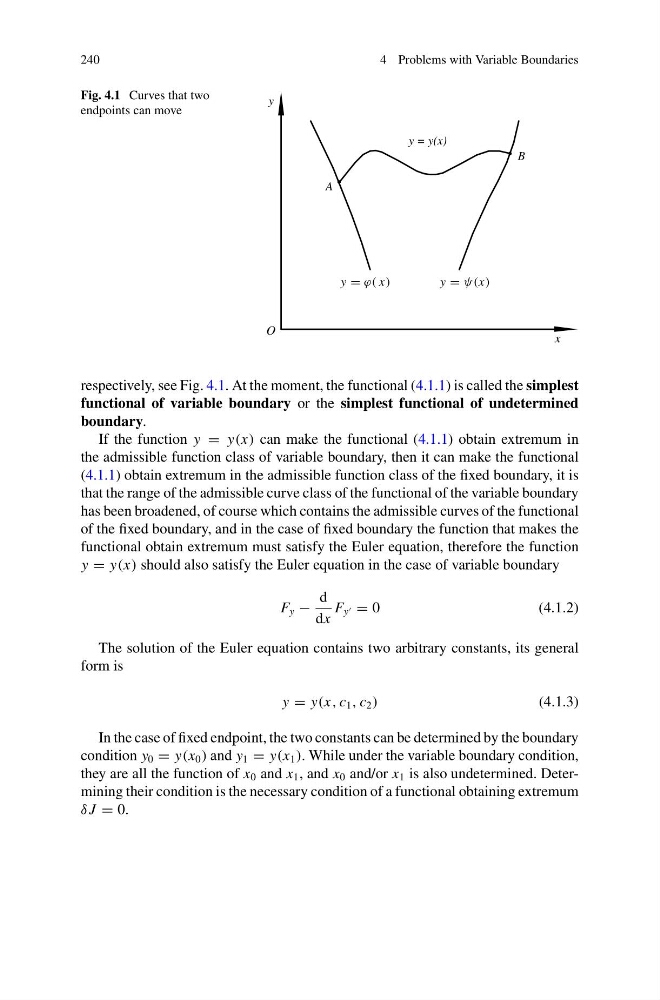
Fig. 4.1 Curves that two
endpoints can move
y
A
B
y = y(x)
y = ϕ( x)
y = ψ(x)
O
x
respectively, see Fig. 4.1. At the moment, the functional (4.1.1) is called the simplest
functional of variable boundary or the simplest functional of undetermined
boundary.
If the function y = y(x) can make the functional (4.1.1) obtain extremum in
the admissible function class of variable boundary, then it can make the functional
(4.1.1) obtain extremum in the admissible function class of the fixed boundary, it is
that the range of the admissible curve class of the functional of the variable boundary
has been broadened, of course which contains the admissible curves of the functional
of the fixed boundary, and in the case of fixed boundary the function that makes the
functional obtain extremum must satisfy the Euler equation, therefore the function
y = y(x) should also satisfy the Euler equation in the case of variable boundary
F y −
d
dx
F y = 0
(4.1.2)
The solution of the Euler equation contains two arbitrary constants, its general
form is
y = y(x, c 1 , c 2 )
(4.1.3)
In the case of fixed endpoint, the two constants can be determined by the boundary
condition y 0 = y(x 0 ) and y 1 = y(x 1 ). While under the variable boundary condition,
they are all the function of x 0 and x 1 , and x 0 and/or x 1 is also undetermined. Determining their condition is the necessary condition of a functional obtaining extremum
δ J = 0.
4 Problems with Variable Boundaries
Fig. 4.1 Curves that two
endpoints can move
y
A
B
y = y(x)
y = ϕ( x)
y = ψ(x)
O
x
respectively, see Fig. 4.1. At the moment, the functional (4.1.1) is called the simplest
functional of variable boundary or the simplest functional of undetermined
boundary.
If the function y = y(x) can make the functional (4.1.1) obtain extremum in
the admissible function class of variable boundary, then it can make the functional
(4.1.1) obtain extremum in the admissible function class of the fixed boundary, it is
that the range of the admissible curve class of the functional of the variable boundary
has been broadened, of course which contains the admissible curves of the functional
of the fixed boundary, and in the case of fixed boundary the function that makes the
functional obtain extremum must satisfy the Euler equation, therefore the function
y = y(x) should also satisfy the Euler equation in the case of variable boundary
F y −
d
dx
F y = 0
(4.1.2)
The solution of the Euler equation contains two arbitrary constants, its general
form is
y = y(x, c 1 , c 2 )
(4.1.3)
In the case of fixed endpoint, the two constants can be determined by the boundary
condition y 0 = y(x 0 ) and y 1 = y(x 1 ). While under the variable boundary condition,
they are all the function of x 0 and x 1 , and x 0 and/or x 1 is also undetermined. Determining their condition is the necessary condition of a functional obtaining extremum
δ J = 0.