

212
3 Sufficient Conditions of Extrema of Functionals
The expression (3.3.4) is called the Hilbert invariant integral. It was posed by
Hilbert in 1900. Where, p = p(x, y) is the slope of the extremal curve field at
considered point (x, y), while y
is the slope along the admissible curve C. Here
the difference between y
and p should be noted, when two points A, B are fixed, the
extremal curve through point (x, y) generally has only one, the slope of the extremal
curve through the point usually only has one, this is the slope p of the extremal
curve field, however the admissible curve C through point (x, y) can be arbitrary
quantity, accordingly, the slope y
at the point can also be arbitrary quantity, the two
are different.
Auxiliary functional (3.3.4) has the following two properties:
(1) When taking the admissible curve C to be the extremal curve C, because of y
=
p(x, y), so the auxiliary functional becomes the functional
C F(x, y, y
)dx
corresponding to the extremal curve C.
(2) It is the integral of the total differential integral for a function.
Now to prove the second property.
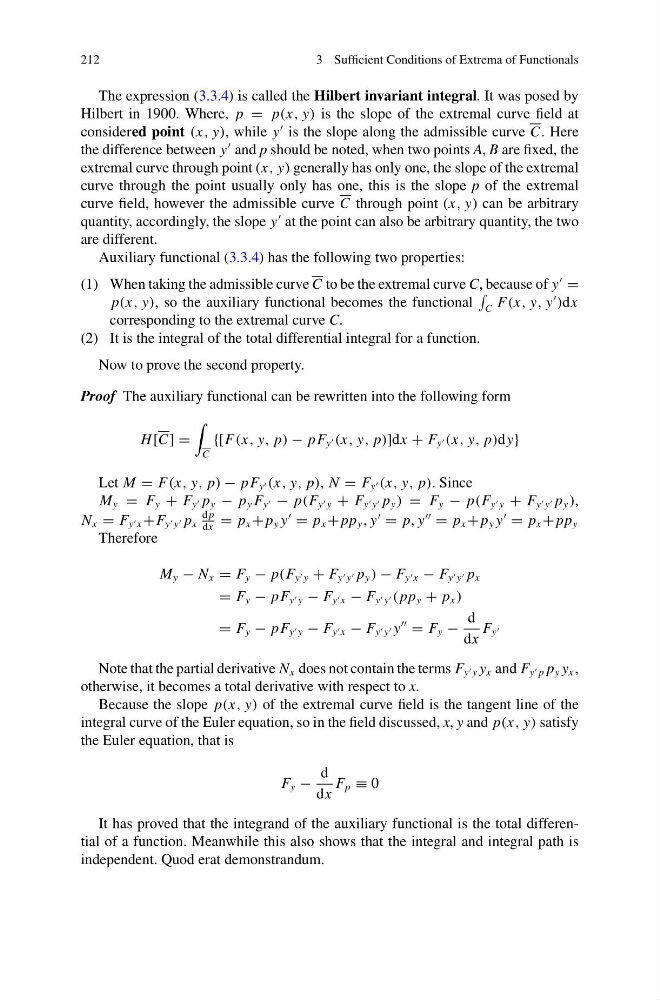
Proof The auxiliary functional can be rewritten into the following form
H [C] =
C
{[F(x, y, p) − pF y (x, y, p)]dx + F y (x, y, p)dy}
Let M = F(x, y, p) − pF y (x, y, p), N = F y (x, y, p). Since
M y = F y + F y p y − p y F y − p(F y y + F y y p y ) = F y − p(F y y + F y y p y ),
N x = F y x +F y y p x
d p
dx
= p x + p y y
= p x + pp y , y
= p, y
= p x + p y y
= p x + pp y
Therefore
M y − N x = F y − p(F y y + F y y p y ) − F y x − F y y p x
= F y − pF y y − F y x − F y y ( pp y + p x )
= F y − pF y y − F y x − F y y y
= F y −
d
dx
F y
Note that the partial derivative N x does not contain the terms F y y y x and F y p p y y x ,
otherwise, it becomes a total derivative with respect to x.
Because the slope p(x, y) of the extremal curve field is the tangent line of the
integral curve of the Euler equation, so in the field discussed, x, y and p(x, y) satisfy
the Euler equation, that is
F y −
d
dx
F p ≡ 0
It has proved that the integrand of the auxiliary functional is the total differential of a function. Meanwhile this also shows that the integral and integral path is
independent. Quod erat demonstrandum.
3 Sufficient Conditions of Extrema of Functionals
The expression (3.3.4) is called the Hilbert invariant integral. It was posed by
Hilbert in 1900. Where, p = p(x, y) is the slope of the extremal curve field at
considered point (x, y), while y
is the slope along the admissible curve C. Here
the difference between y
and p should be noted, when two points A, B are fixed, the
extremal curve through point (x, y) generally has only one, the slope of the extremal
curve through the point usually only has one, this is the slope p of the extremal
curve field, however the admissible curve C through point (x, y) can be arbitrary
quantity, accordingly, the slope y
at the point can also be arbitrary quantity, the two
are different.
Auxiliary functional (3.3.4) has the following two properties:
(1) When taking the admissible curve C to be the extremal curve C, because of y
=
p(x, y), so the auxiliary functional becomes the functional
C F(x, y, y
)dx
corresponding to the extremal curve C.
(2) It is the integral of the total differential integral for a function.
Now to prove the second property.
Proof The auxiliary functional can be rewritten into the following form
H [C] =
C
{[F(x, y, p) − pF y (x, y, p)]dx + F y (x, y, p)dy}
Let M = F(x, y, p) − pF y (x, y, p), N = F y (x, y, p). Since
M y = F y + F y p y − p y F y − p(F y y + F y y p y ) = F y − p(F y y + F y y p y ),
N x = F y x +F y y p x
d p
dx
= p x + p y y
= p x + pp y , y
= p, y
= p x + p y y
= p x + pp y
Therefore
M y − N x = F y − p(F y y + F y y p y ) − F y x − F y y p x
= F y − pF y y − F y x − F y y ( pp y + p x )
= F y − pF y y − F y x − F y y y
= F y −
d
dx
F y
Note that the partial derivative N x does not contain the terms F y y y x and F y p p y y x ,
otherwise, it becomes a total derivative with respect to x.
Because the slope p(x, y) of the extremal curve field is the tangent line of the
integral curve of the Euler equation, so in the field discussed, x, y and p(x, y) satisfy
the Euler equation, that is
F y −
d
dx
F p ≡ 0
It has proved that the integrand of the auxiliary functional is the total differential of a function. Meanwhile this also shows that the integral and integral path is
independent. Quod erat demonstrandum.