

210
3 Sufficient Conditions of Extrema of Functionals
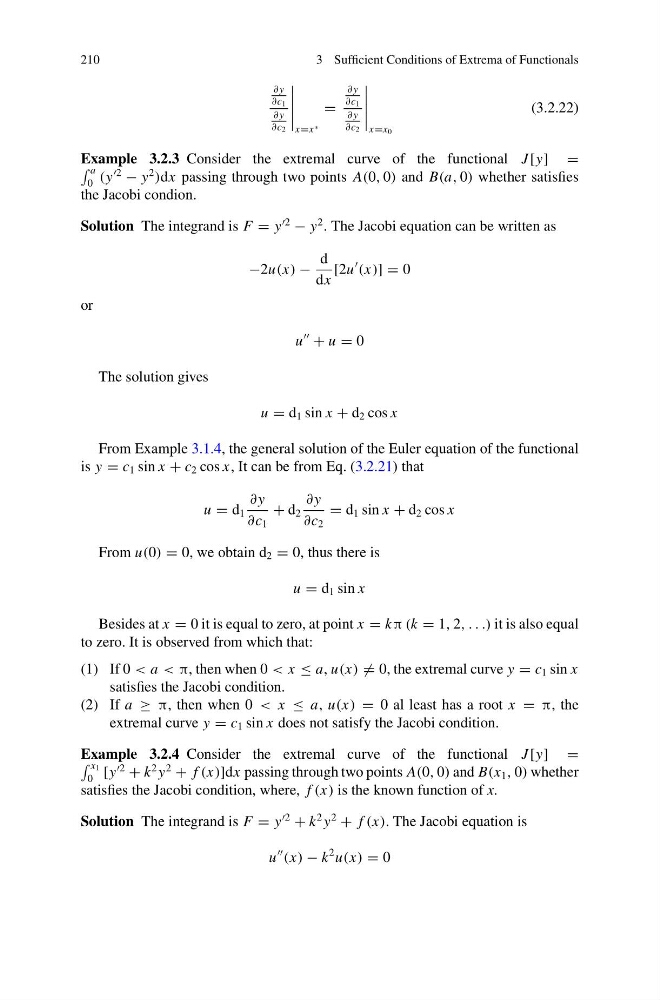
∂ y
∂c 1
∂ y
∂c 2
x=x ∗
=
∂ y
∂c 1
∂ y
∂c 2
x=x 0
(3.2.22)
Example 3.2.3 Consider the extremal curve of the functional J [y] =
a
0 (y
2
− y
2
)dx passing through two points A(0, 0) and B(a, 0) whether satisfies
the Jacobi condion.
Solution The integrand is F = y
2
− y
2 . The Jacobi equation can be written as
−2u(x) −
d
dx
[2u
(x)] = 0
or
u
+ u = 0
The solution gives
u = d 1 sin x + d 2 cos x
From Example 3.1.4, the general solution of the Euler equation of the functional
is y = c 1 sin x + c 2 cos x, It can be from Eq. (3.2.21) that
u = d 1
∂ y
∂c 1
+ d 2
∂ y
∂c 2
= d 1 sin x + d 2 cos x
From u(0) = 0, we obtain d 2 = 0, thus there is
u = d 1 sin x
Besides at x = 0 it is equal to zero, at point x = kπ (k = 1, 2, . . .) it is also equal
to zero. It is observed from which that:
(1) If 0 < a < π, then when 0 < x ≤ a, u(x) = 0, the extremal curve y = c 1 sin x
satisfies the Jacobi condition.
(2) If a ≥ π, then when 0 < x ≤ a, u(x) = 0 al least has a root x = π, the
extremal curve y = c 1 sin x does not satisfy the Jacobi condition.
Example 3.2.4 Consider the extremal curve of the functional J [y] =
x 1
0 [y
2
+ k
2 y
2
+ f (x)]dx passing through two points A(0, 0) and B(x 1 , 0) whether
satisfies the Jacobi condition, where, f (x) is the known function of x.
Solution The integrand is F = y
2
+ k
2 y
2
+ f (x). The Jacobi equation is
u
(x) − k
2 u(x) = 0
3 Sufficient Conditions of Extrema of Functionals
∂ y
∂c 1
∂ y
∂c 2
x=x ∗
=
∂ y
∂c 1
∂ y
∂c 2
x=x 0
(3.2.22)
Example 3.2.3 Consider the extremal curve of the functional J [y] =
a
0 (y
2
− y
2
)dx passing through two points A(0, 0) and B(a, 0) whether satisfies
the Jacobi condion.
Solution The integrand is F = y
2
− y
2 . The Jacobi equation can be written as
−2u(x) −
d
dx
[2u
(x)] = 0
or
u
+ u = 0
The solution gives
u = d 1 sin x + d 2 cos x
From Example 3.1.4, the general solution of the Euler equation of the functional
is y = c 1 sin x + c 2 cos x, It can be from Eq. (3.2.21) that
u = d 1
∂ y
∂c 1
+ d 2
∂ y
∂c 2
= d 1 sin x + d 2 cos x
From u(0) = 0, we obtain d 2 = 0, thus there is
u = d 1 sin x
Besides at x = 0 it is equal to zero, at point x = kπ (k = 1, 2, . . .) it is also equal
to zero. It is observed from which that:
(1) If 0 < a < π, then when 0 < x ≤ a, u(x) = 0, the extremal curve y = c 1 sin x
satisfies the Jacobi condition.
(2) If a ≥ π, then when 0 < x ≤ a, u(x) = 0 al least has a root x = π, the
extremal curve y = c 1 sin x does not satisfy the Jacobi condition.
Example 3.2.4 Consider the extremal curve of the functional J [y] =
x 1
0 [y
2
+ k
2 y
2
+ f (x)]dx passing through two points A(0, 0) and B(x 1 , 0) whether
satisfies the Jacobi condition, where, f (x) is the known function of x.
Solution The integrand is F = y
2
+ k
2 y
2
+ f (x). The Jacobi equation is
u
(x) − k
2 u(x) = 0