

2.10 Invariance of the Euler Equation
183
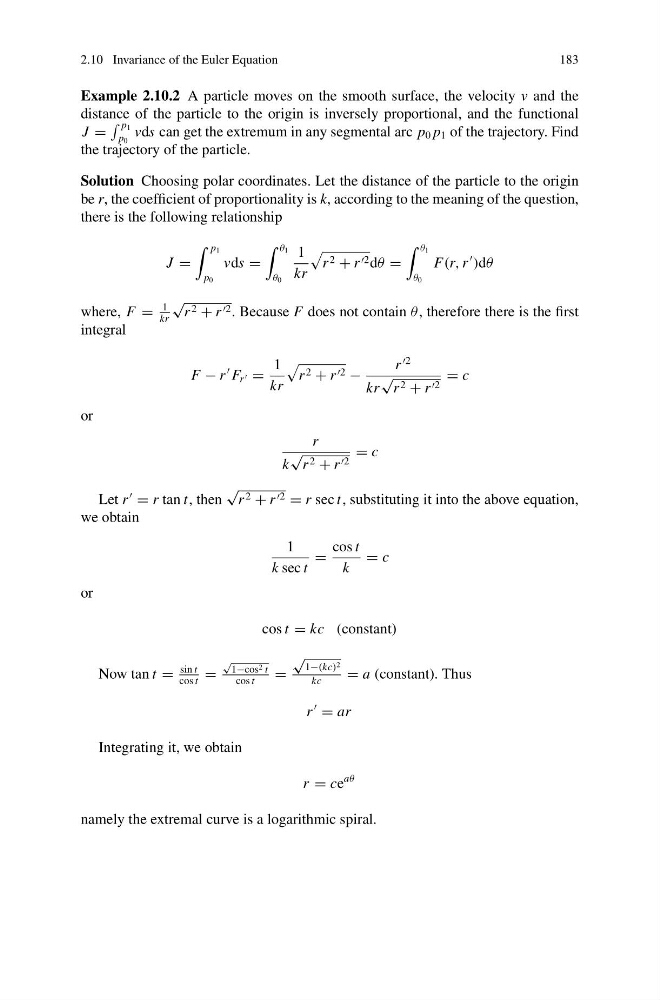
Example 2.10.2 A particle moves on the smooth surface, the velocity v and the
distance of the particle to the origin is inversely proportional, and the functional
J =
p 1
p 0
vds can get the extremum in any segmental arc p 0 p 1 of the trajectory. Find
the trajectory of the particle.
Solution Choosing polar coordinates. Let the distance of the particle to the origin
be r, the coefficient of proportionality is k, according to the meaning of the question,
there is the following relationship
J =
p 1
p 0
vds =
θ 1
θ 0
1
kr
r 2 + r 2 dθ =
θ 1
θ 0
F(r, r
)dθ
where, F =
1
kr
√
r 2 + r 2 . Because F does not contain θ , therefore there is the first
integral
F − r
F r =
1
kr
r 2 + r 2 −
r
2
kr
√
r 2 + r 2
= c
or
r
k
√
r 2 + r 2
= c
Let r
= r tan t, then
√
r 2 + r 2 = r sec t, substituting it into the above equation,
we obtain
1
k sec t
=
cos t
k
= c
or
cos t = kc (constant)
Now tan t =
sin t
cos t
=
√
1−cos 2 t
cos t
=
√
1−(kc) 2
kc
= a (constant). Thus
r
= ar
Integrating it, we obtain
r = ce
aθ
namely the extremal curve is a logarithmic spiral.
183
Example 2.10.2 A particle moves on the smooth surface, the velocity v and the
distance of the particle to the origin is inversely proportional, and the functional
J =
p 1
p 0
vds can get the extremum in any segmental arc p 0 p 1 of the trajectory. Find
the trajectory of the particle.
Solution Choosing polar coordinates. Let the distance of the particle to the origin
be r, the coefficient of proportionality is k, according to the meaning of the question,
there is the following relationship
J =
p 1
p 0
vds =
θ 1
θ 0
1
kr
r 2 + r 2 dθ =
θ 1
θ 0
F(r, r
)dθ
where, F =
1
kr
√
r 2 + r 2 . Because F does not contain θ , therefore there is the first
integral
F − r
F r =
1
kr
r 2 + r 2 −
r
2
kr
√
r 2 + r 2
= c
or
r
k
√
r 2 + r 2
= c
Let r
= r tan t, then
√
r 2 + r 2 = r sec t, substituting it into the above equation,
we obtain
1
k sec t
=
cos t
k
= c
or
cos t = kc (constant)
Now tan t =
sin t
cos t
=
√
1−cos 2 t
cos t
=
√
1−(kc) 2
kc
= a (constant). Thus
r
= ar
Integrating it, we obtain
r = ce
aθ
namely the extremal curve is a logarithmic spiral.