

182
2 Variational Problems with Fixed Boundaries
∂u
∂ y
=
∂U
∂r
∂r
∂ y
+
∂U
∂θ
∂θ
∂ y
=
∂U
∂r
sin θ +
∂U
∂θ
cos θ
r
Therefore
J [u(x, y)] = J [U (r, θ)] =
¨
D
G(r, θ, U, U r , U θ )dr dθ
where
G(r, θ, U, U r , U θ ) = F
r cos θ, r sin θ, U, U r cos θ − U θ
sin θ
r
, U r sin θ + U θ
cos θ
r
r
The Euler equation of the functional is
G U −
∂
∂r
G U r −
∂
∂θ
G U θ = 0
namely
r F u −
∂
∂r
(r F u x cos θ + r F u y sin θ) −
∂
∂θ
(−F u x sin θ + F u y cos θ) = 0
The above equation is expanded and simplified, we get
r F u − r cos θ
∂
∂r
F u x − r sin θ
∂
∂r
F u y + sin θ
∂
∂θ
F u x − cos θ
∂
∂θ
F u y = 0
Using the equalities
∂
∂r
F ux = cos θ
∂
∂ x
F ux + sin θ
∂
∂ y
F ux ,
∂
∂r
F u y = cos θ
∂
∂ x
F u y + sin θ
∂
∂ y
F u y
∂
∂θ
F ux = −r sin θ
∂
∂ x
F ux + r cos θ
∂
∂ y
F ux ,
∂
∂θ
F u y = −r sin θ
∂
∂ x
F u y + r cos θ
∂
∂ y
F u y
The above equation can be reduced to
r
F u −
∂
∂ x
F u x −
∂
∂ y
F u y
= 0
or
F u −
∂
∂ x
F u x −
∂
∂ y
F u y = 0
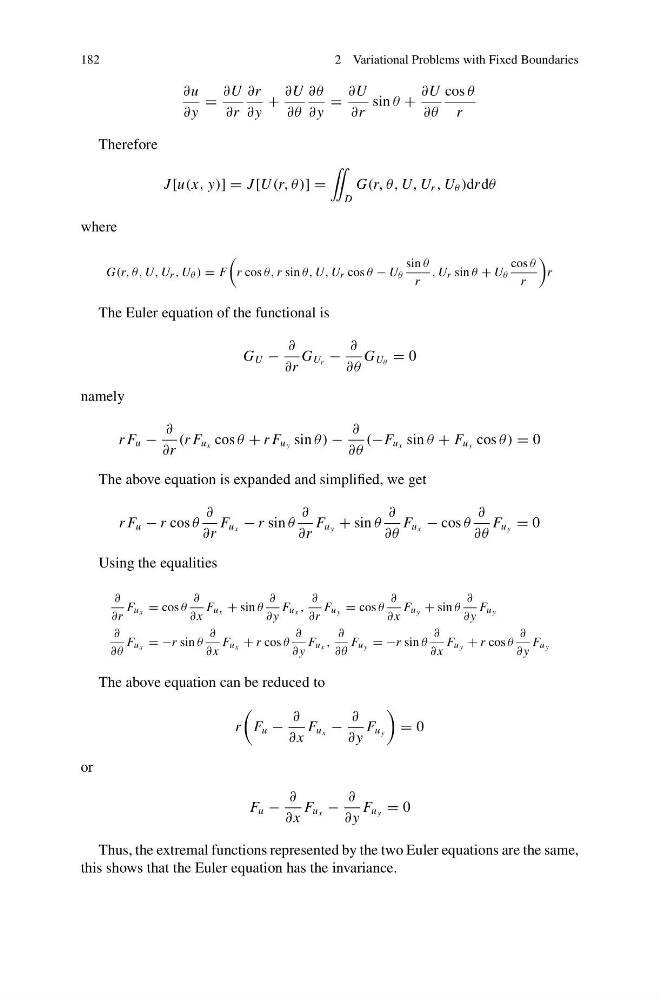
Thus, the extremal functions represented by the two Euler equations are the same,
this shows that the Euler equation has the invariance.
2 Variational Problems with Fixed Boundaries
∂u
∂ y
=
∂U
∂r
∂r
∂ y
+
∂U
∂θ
∂θ
∂ y
=
∂U
∂r
sin θ +
∂U
∂θ
cos θ
r
Therefore
J [u(x, y)] = J [U (r, θ)] =
¨
D
G(r, θ, U, U r , U θ )dr dθ
where
G(r, θ, U, U r , U θ ) = F
r cos θ, r sin θ, U, U r cos θ − U θ
sin θ
r
, U r sin θ + U θ
cos θ
r
r
The Euler equation of the functional is
G U −
∂
∂r
G U r −
∂
∂θ
G U θ = 0
namely
r F u −
∂
∂r
(r F u x cos θ + r F u y sin θ) −
∂
∂θ
(−F u x sin θ + F u y cos θ) = 0
The above equation is expanded and simplified, we get
r F u − r cos θ
∂
∂r
F u x − r sin θ
∂
∂r
F u y + sin θ
∂
∂θ
F u x − cos θ
∂
∂θ
F u y = 0
Using the equalities
∂
∂r
F ux = cos θ
∂
∂ x
F ux + sin θ
∂
∂ y
F ux ,
∂
∂r
F u y = cos θ
∂
∂ x
F u y + sin θ
∂
∂ y
F u y
∂
∂θ
F ux = −r sin θ
∂
∂ x
F ux + r cos θ
∂
∂ y
F ux ,
∂
∂θ
F u y = −r sin θ
∂
∂ x
F u y + r cos θ
∂
∂ y
F u y
The above equation can be reduced to
r
F u −
∂
∂ x
F u x −
∂
∂ y
F u y
= 0
or
F u −
∂
∂ x
F u x −
∂
∂ y
F u y = 0
Thus, the extremal functions represented by the two Euler equations are the same,
this shows that the Euler equation has the invariance.