

172
2 Variational Problems with Fixed Boundaries
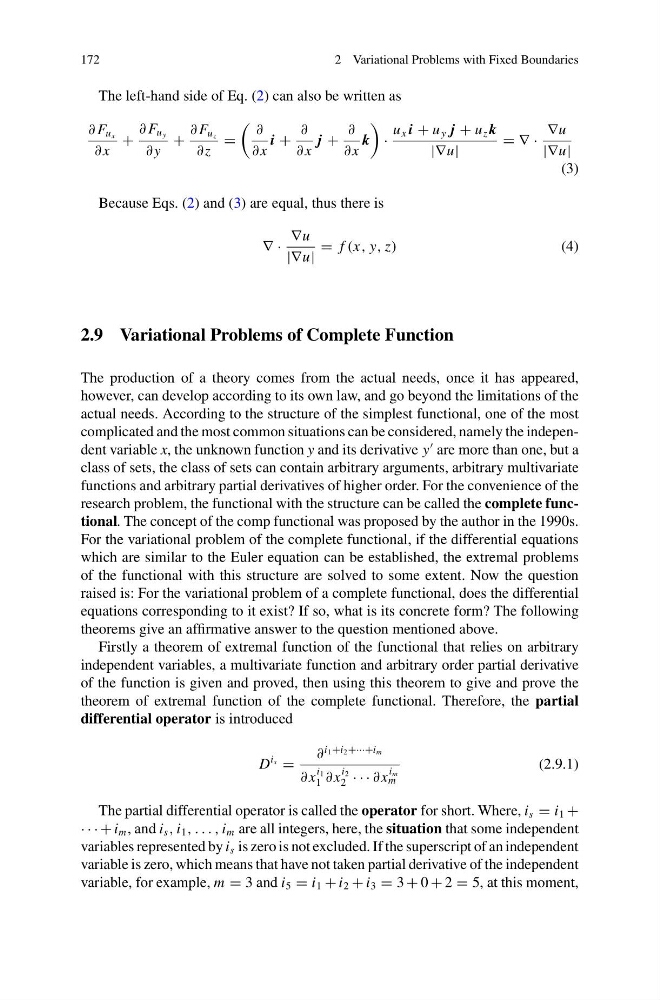
The left-hand side of Eq. (2) can also be written as
∂ F u x
∂ x
+
∂ F u y
∂ y
+
∂ F u z
∂z
=
∂
∂ x
i +
∂
∂ x
j +
∂
∂ x
k
·
u x i + u y j + u z k
|∇u|
= ∇ ·
∇u
|∇u|
(3)
Because Eqs. (2) and (3) are equal, thus there is
∇ ·
∇u
|∇u|
= f (x, y, z)
(4)
2.9 Variational Problems of Complete Function
The production of a theory comes from the actual needs, once it has appeared,
however, can develop according to its own law, and go beyond the limitations of the
actual needs. According to the structure of the simplest functional, one of the most
complicated and the most common situations can be considered, namely the independent variable x, the unknown function y and its derivative y
are more than one, but a
class of sets, the class of sets can contain arbitrary arguments, arbitrary multivariate
functions and arbitrary partial derivatives of higher order. For the convenience of the
research problem, the functional with the structure can be called the complete functional. The concept of the comp functional was proposed by the author in the 1990s.
For the variational problem of the complete functional, if the differential equations
which are similar to the Euler equation can be established, the extremal problems
of the functional with this structure are solved to some extent. Now the question
raised is: For the variational problem of a complete functional, does the differential
equations corresponding to it exist? If so, what is its concrete form? The following
theorems give an affirmative answer to the question mentioned above.
Firstly a theorem of extremal function of the functional that relies on arbitrary
independent variables, a multivariate function and arbitrary order partial derivative
of the function is given and proved, then using this theorem to give and prove the
theorem of extremal function of the complete functional. Therefore, the partial
differential operator is introduced
D
i s =
∂
i 1 +i 2 +···+i m
∂ x
i 1
1 ∂ x
i 2
2 · · · ∂ x
i m
m
(2.9.1)
The partial differential operator is called the operator for short. Where, i s = i 1 +
· · · + i m , and i s , i 1 , . . . , i m are all integers, here, the situation that some independent
variables represented by i s is zero is not excluded. If the superscript of an independent
variable is zero, which means that have not taken partial derivative of the independent
variable, for example, m = 3 and i 5 = i 1 + i 2 + i 3 = 3 + 0 + 2 = 5, at this moment,
2 Variational Problems with Fixed Boundaries
The left-hand side of Eq. (2) can also be written as
∂ F u x
∂ x
+
∂ F u y
∂ y
+
∂ F u z
∂z
=
∂
∂ x
i +
∂
∂ x
j +
∂
∂ x
k
·
u x i + u y j + u z k
|∇u|
= ∇ ·
∇u
|∇u|
(3)
Because Eqs. (2) and (3) are equal, thus there is
∇ ·
∇u
|∇u|
= f (x, y, z)
(4)
2.9 Variational Problems of Complete Function
The production of a theory comes from the actual needs, once it has appeared,
however, can develop according to its own law, and go beyond the limitations of the
actual needs. According to the structure of the simplest functional, one of the most
complicated and the most common situations can be considered, namely the independent variable x, the unknown function y and its derivative y
are more than one, but a
class of sets, the class of sets can contain arbitrary arguments, arbitrary multivariate
functions and arbitrary partial derivatives of higher order. For the convenience of the
research problem, the functional with the structure can be called the complete functional. The concept of the comp functional was proposed by the author in the 1990s.
For the variational problem of the complete functional, if the differential equations
which are similar to the Euler equation can be established, the extremal problems
of the functional with this structure are solved to some extent. Now the question
raised is: For the variational problem of a complete functional, does the differential
equations corresponding to it exist? If so, what is its concrete form? The following
theorems give an affirmative answer to the question mentioned above.
Firstly a theorem of extremal function of the functional that relies on arbitrary
independent variables, a multivariate function and arbitrary order partial derivative
of the function is given and proved, then using this theorem to give and prove the
theorem of extremal function of the complete functional. Therefore, the partial
differential operator is introduced
D
i s =
∂
i 1 +i 2 +···+i m
∂ x
i 1
1 ∂ x
i 2
2 · · · ∂ x
i m
m
(2.9.1)
The partial differential operator is called the operator for short. Where, i s = i 1 +
· · · + i m , and i s , i 1 , . . . , i m are all integers, here, the situation that some independent
variables represented by i s is zero is not excluded. If the superscript of an independent
variable is zero, which means that have not taken partial derivative of the independent
variable, for example, m = 3 and i 5 = i 1 + i 2 + i 3 = 3 + 0 + 2 = 5, at this moment,