

2.9 Variational Problems of Complete Function
173
the independent variable operator is not written as
D
i s =
∂
5
∂ x
3
1 ∂ x
0
2 ∂ x
2
3
(2.9.2)
but
D
i s =
∂
5
∂ x
3
1 ∂ x
2
3
(2.9.3)
that is to say, if the operator does not contain partial derivative of a variable, then
the derivatives of the independent variables in the operator can be left out. If i s = 0,
then D
i s u = D
0 u = u, namely the zero order partial derivative of a function with
respect to an independent variable is that it does not take the partial derivative with
respect to the independent variable, that is the function itself.
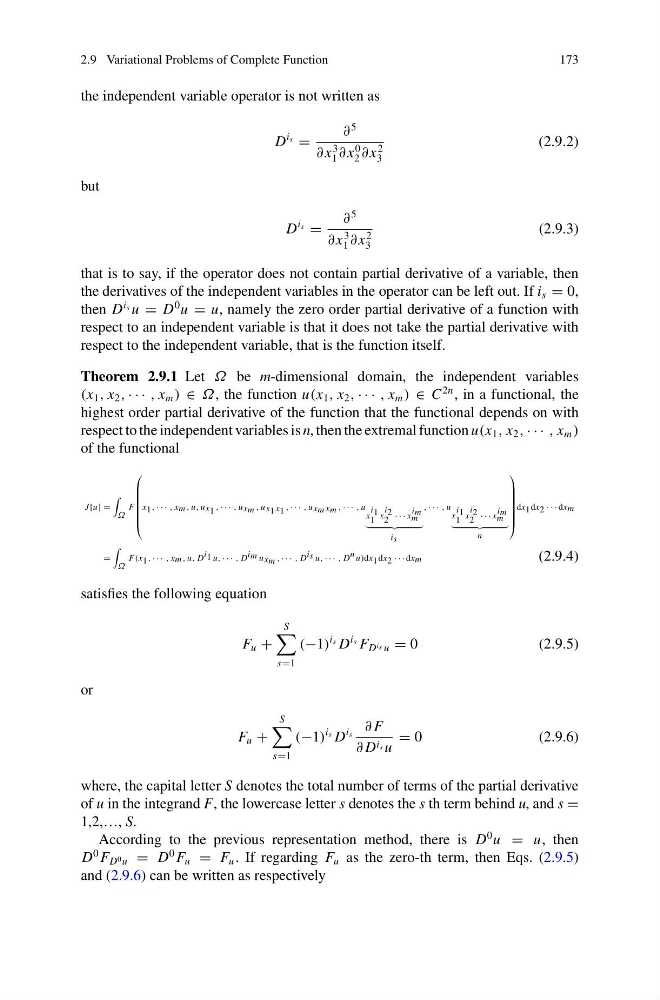
Theorem 2.9.1 Let Ω be m-dimensional domain, the independent variables
(x 1 , x 2 , · · · , x m ) ∈ Ω, the function u(x 1 , x 2 , · · · , x m ) ∈ C
2n , in a functional, the
highest order partial derivative of the function that the functional depends on with
respect to the independent variables is n, then the extremal function u(x 1 , x 2 , · · · , x m )
of the functional
J [u] =
Ω
F
⎛
⎜
⎜
⎜
⎜
⎜
⎜
⎝
x 1 , · · · , xm , u, ux 1 , · · · , ux m , ux 1 x 1 , · · · , ux m xm , · · · , u
x
i 1
1 x
i 2
2 · · · x
im
m
is
, · · · , u
x
i 1
1 x
i 2
2 · · · x
im
m
n
⎞
⎟
⎟
⎟
⎟
⎟
⎟
⎠
dx 1 dx 2 · · · dxm
=
Ω
F(x 1 , · · · , xm , u, D i 1 u, · · · , D im ux m , · · · , D is u, · · · , D n u)dx 1 dx 2 · · · dxm
(2.9.4)
satisfies the following equation
F u +
S
s=1
(−1)
i s D
i s F D is u = 0
(2.9.5)
or
F u +
S
s=1
(−1)
i s D
i s
∂ F
∂ D i s u
= 0
(2.9.6)
where, the capital letter S denotes the total number of terms of the partial derivative
of u in the integrand F, the lowercase letter s denotes the s th term behind u, and s =
1,2,…, S.
According to the previous representation method, there is D
0 u = u, then
D
0 F D 0 u = D
0 F u = F u . If regarding F u as the zero-th term, then Eqs. (2.9.5)
and (2.9.6) can be written as respectively
173
the independent variable operator is not written as
D
i s =
∂
5
∂ x
3
1 ∂ x
0
2 ∂ x
2
3
(2.9.2)
but
D
i s =
∂
5
∂ x
3
1 ∂ x
2
3
(2.9.3)
that is to say, if the operator does not contain partial derivative of a variable, then
the derivatives of the independent variables in the operator can be left out. If i s = 0,
then D
i s u = D
0 u = u, namely the zero order partial derivative of a function with
respect to an independent variable is that it does not take the partial derivative with
respect to the independent variable, that is the function itself.
Theorem 2.9.1 Let Ω be m-dimensional domain, the independent variables
(x 1 , x 2 , · · · , x m ) ∈ Ω, the function u(x 1 , x 2 , · · · , x m ) ∈ C
2n , in a functional, the
highest order partial derivative of the function that the functional depends on with
respect to the independent variables is n, then the extremal function u(x 1 , x 2 , · · · , x m )
of the functional
J [u] =
Ω
F
⎛
⎜
⎜
⎜
⎜
⎜
⎜
⎝
x 1 , · · · , xm , u, ux 1 , · · · , ux m , ux 1 x 1 , · · · , ux m xm , · · · , u
x
i 1
1 x
i 2
2 · · · x
im
m
is
, · · · , u
x
i 1
1 x
i 2
2 · · · x
im
m
n
⎞
⎟
⎟
⎟
⎟
⎟
⎟
⎠
dx 1 dx 2 · · · dxm
=
Ω
F(x 1 , · · · , xm , u, D i 1 u, · · · , D im ux m , · · · , D is u, · · · , D n u)dx 1 dx 2 · · · dxm
(2.9.4)
satisfies the following equation
F u +
S
s=1
(−1)
i s D
i s F D is u = 0
(2.9.5)
or
F u +
S
s=1
(−1)
i s D
i s
∂ F
∂ D i s u
= 0
(2.9.6)
where, the capital letter S denotes the total number of terms of the partial derivative
of u in the integrand F, the lowercase letter s denotes the s th term behind u, and s =
1,2,…, S.
According to the previous representation method, there is D
0 u = u, then
D
0 F D 0 u = D
0 F u = F u . If regarding F u as the zero-th term, then Eqs. (2.9.5)
and (2.9.6) can be written as respectively