

2.8 Variational Problems Depending on Functions of Several Variables
171
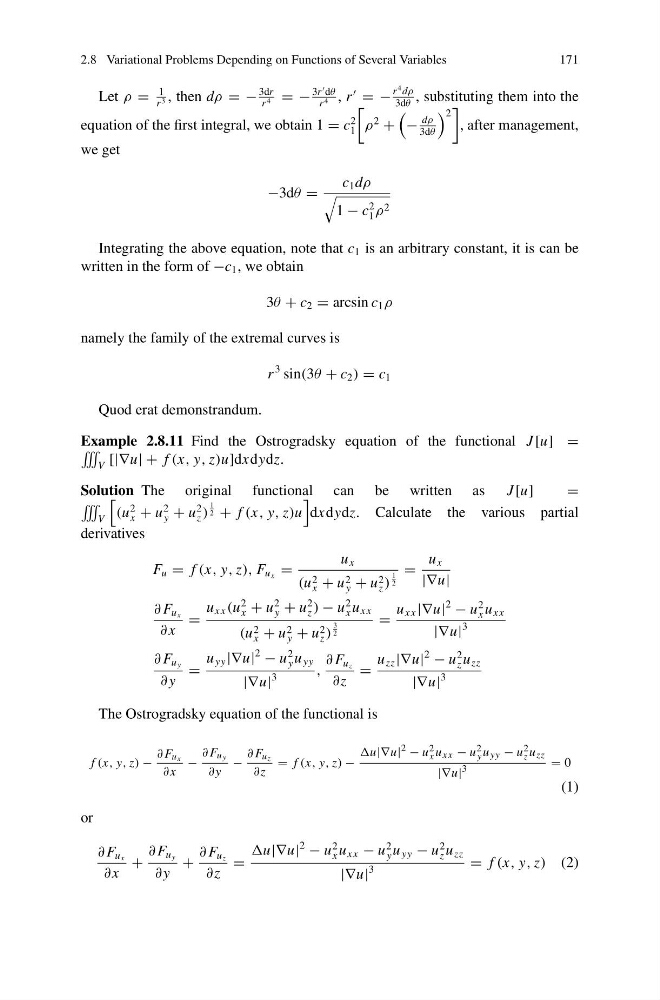
Let ρ =
1
r 3 , then dρ = −
3dr
r 4 = −
3r
dθ
r 4 , r
= −
r
4 dρ
3dθ
, substituting them into the
equation of the first integral, we obtain 1 = c
2
1
ρ
2
+
−
dρ
3dθ
2
, after management,
we get
−3dθ =
c 1 dρ
1 − c
2
1 ρ 2
Integrating the above equation, note that c 1 is an arbitrary constant, it is can be
written in the form of −c 1 , we obtain
3θ + c 2 = arcsin c 1 ρ
namely the family of the extremal curves is
r
3 sin(3θ + c 2 ) = c 1
Quod erat demonstrandum.
Example 2.8.11 Find the Ostrogradsky equation of the functional J [u] =
˝
V [|∇u| + f (x, y, z)u]dxdydz.
Solution The original functional can be written as J [u]
=
˝
V
(u
2
x + u
2
y + u
2
z )
1
2 + f (x, y, z)u
dxdydz. Calculate the various partial
derivatives
F u = f (x, y, z), F u x =
u x
(u 2
x + u 2
y + u 2
z )
1
2
=
u x
|∇u|
∂ F u x
∂ x
=
u xx (u
2
x + u
2
y + u
2
z ) − u
2
x u xx
(u 2
x + u 2
y + u 2
z )
3
2
=
u xx |∇u|
2
− u
2
x u xx
|∇u|
3
∂ F u y
∂ y
=
u yy |∇u|
2
− u
2
y u yy
|∇u|
3
,
∂ F u z
∂z
=
u zz |∇u|
2
− u
2
z u zz
|∇u|
3
The Ostrogradsky equation of the functional is
f (x, y, z) −
∂ F ux
∂ x
−
∂ F u y
∂ y
−
∂ F uz
∂z
= f (x, y, z) −
u|∇u|
2 − u 2
x u xx − u 2
y u yy − u 2
z u zz
|∇u| 3
= 0
(1)
or
∂ F u x
∂ x
+
∂ F u y
∂ y
+
∂ F u z
∂z
=
u|∇u|
2
− u
2
x u xx − u
2
y u yy − u
2
z u zz
|∇u|
3
= f (x, y, z) (2)
171
Let ρ =
1
r 3 , then dρ = −
3dr
r 4 = −
3r
dθ
r 4 , r
= −
r
4 dρ
3dθ
, substituting them into the
equation of the first integral, we obtain 1 = c
2
1
ρ
2
+
−
dρ
3dθ
2
, after management,
we get
−3dθ =
c 1 dρ
1 − c
2
1 ρ 2
Integrating the above equation, note that c 1 is an arbitrary constant, it is can be
written in the form of −c 1 , we obtain
3θ + c 2 = arcsin c 1 ρ
namely the family of the extremal curves is
r
3 sin(3θ + c 2 ) = c 1
Quod erat demonstrandum.
Example 2.8.11 Find the Ostrogradsky equation of the functional J [u] =
˝
V [|∇u| + f (x, y, z)u]dxdydz.
Solution The original functional can be written as J [u]
=
˝
V
(u
2
x + u
2
y + u
2
z )
1
2 + f (x, y, z)u
dxdydz. Calculate the various partial
derivatives
F u = f (x, y, z), F u x =
u x
(u 2
x + u 2
y + u 2
z )
1
2
=
u x
|∇u|
∂ F u x
∂ x
=
u xx (u
2
x + u
2
y + u
2
z ) − u
2
x u xx
(u 2
x + u 2
y + u 2
z )
3
2
=
u xx |∇u|
2
− u
2
x u xx
|∇u|
3
∂ F u y
∂ y
=
u yy |∇u|
2
− u
2
y u yy
|∇u|
3
,
∂ F u z
∂z
=
u zz |∇u|
2
− u
2
z u zz
|∇u|
3
The Ostrogradsky equation of the functional is
f (x, y, z) −
∂ F ux
∂ x
−
∂ F u y
∂ y
−
∂ F uz
∂z
= f (x, y, z) −
u|∇u|
2 − u 2
x u xx − u 2
y u yy − u 2
z u zz
|∇u| 3
= 0
(1)
or
∂ F u x
∂ x
+
∂ F u y
∂ y
+
∂ F u z
∂z
=
u|∇u|
2
− u
2
x u xx − u
2
y u yy − u
2
z u zz
|∇u|
3
= f (x, y, z) (2)