

2.5 Several Special Cases of the Euler Equation and Their Integrals
135
Solution Because the integrand F =
1 + y
2
2gy
does not contain x, so the first
integral the Euler equation is
1 + y 2
2gy
−
y
2
2gy(1 + y 2 )
= c 1
(2)
Let c =
1
2gc
2
1
, simplify the above equation, we obtain
y(1 + y
2
) = c
(3)
Let y
= cot θ , then the equation is changed into
y =
c
1 + y 2 = c sin
2
θ =
c
2
(1 − cos 2θ)
(4)
And because of
dx =
dy
y =
c sin 2θ dθ
cot θ
=
c sin θ cos θ dθ
cot θ
= c(1 − cos 2θ)dθ
(5)
Integrating it, we obtain
x =
c
2
(2θ − sin 2θ) + c 2
(6)
In term of the boundary condition y(0) = 0, we obtain c 2 = 0. Let t = 2θ , a =
c
2
,
then the solution of the brachistochrone problem is
x = a(t − sin t)
y = a(1 − cos t)
(7)
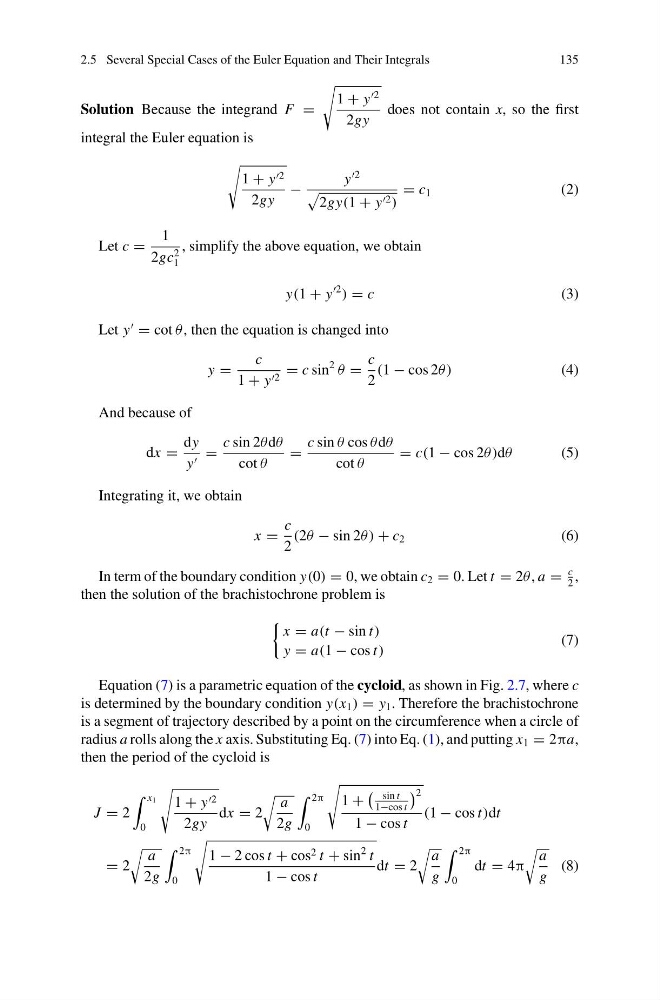
Equation (7) is a parametric equation of the cycloid, as shown in Fig. 2.7, where c
is determined by the boundary condition y(x 1 ) = y 1 . Therefore the brachistochrone
is a segment of trajectory described by a point on the circumference when a circle of
radius a rolls along the x axis. Substituting Eq. (7) into Eq. (1), and putting x 1 = 2πa,
then the period of the cycloid is
J = 2
x 1
0
1 + y 2
2gy
dx = 2
a
2g
2π
0
1 +
sin t
1−cos t
2
1 − cos t
(1 − cos t)dt
= 2
a
2g
2π
0
1 − 2 cos t + cos 2 t + sin
2 t
1 − cos t
dt = 2
a
g
2π
0
dt = 4π
a
g
(8)
135
Solution Because the integrand F =
1 + y
2
2gy
does not contain x, so the first
integral the Euler equation is
1 + y 2
2gy
−
y
2
2gy(1 + y 2 )
= c 1
(2)
Let c =
1
2gc
2
1
, simplify the above equation, we obtain
y(1 + y
2
) = c
(3)
Let y
= cot θ , then the equation is changed into
y =
c
1 + y 2 = c sin
2
θ =
c
2
(1 − cos 2θ)
(4)
And because of
dx =
dy
y =
c sin 2θ dθ
cot θ
=
c sin θ cos θ dθ
cot θ
= c(1 − cos 2θ)dθ
(5)
Integrating it, we obtain
x =
c
2
(2θ − sin 2θ) + c 2
(6)
In term of the boundary condition y(0) = 0, we obtain c 2 = 0. Let t = 2θ , a =
c
2
,
then the solution of the brachistochrone problem is
x = a(t − sin t)
y = a(1 − cos t)
(7)
Equation (7) is a parametric equation of the cycloid, as shown in Fig. 2.7, where c
is determined by the boundary condition y(x 1 ) = y 1 . Therefore the brachistochrone
is a segment of trajectory described by a point on the circumference when a circle of
radius a rolls along the x axis. Substituting Eq. (7) into Eq. (1), and putting x 1 = 2πa,
then the period of the cycloid is
J = 2
x 1
0
1 + y 2
2gy
dx = 2
a
2g
2π
0
1 +
sin t
1−cos t
2
1 − cos t
(1 − cos t)dt
= 2
a
2g
2π
0
1 − 2 cos t + cos 2 t + sin
2 t
1 − cos t
dt = 2
a
g
2π
0
dt = 4π
a
g
(8)