

134
2 Variational Problems with Fixed Boundaries
Substituting the two integral constants into the equation of straight line, we obtain
y =
y 1 − y 0
x 1 − x 0
x +
y 0 x 1 − y 1 x 0
x 1 − x 0
or
y = y 0 +
y 1 − y 0
x 1 − x 0
(x − x 0 )
Thus, a straight line through boundary points is extremal curve. This solution
shows that in all the plane curves connecting the two given points, the straight line
is the shortest. When y(0) = 0, y(1) = 1, the extremal curve is y = x.
(5) F only depends on y and y
, namely F = F(y, y
)
At this time, F xy = 0, the Euler equation is
F y − F yy y
− F y y y
= 0
Take notice that F does not depend on x, so that
d
dx
(F − y
F y ) = F y y
+ F y y
− y
F y − y
d
dx
F y
= y
F y −
d
dx
F y
= y
(F y − F yy y
− F y y y
) = 0
The first integral is
F − y
F y = c 1
From which solve for y
= ϕ(y, c 1 ), after integral the family of extremal curves
is
x =
dy
ϕ(y, c 1 )
+ c 2
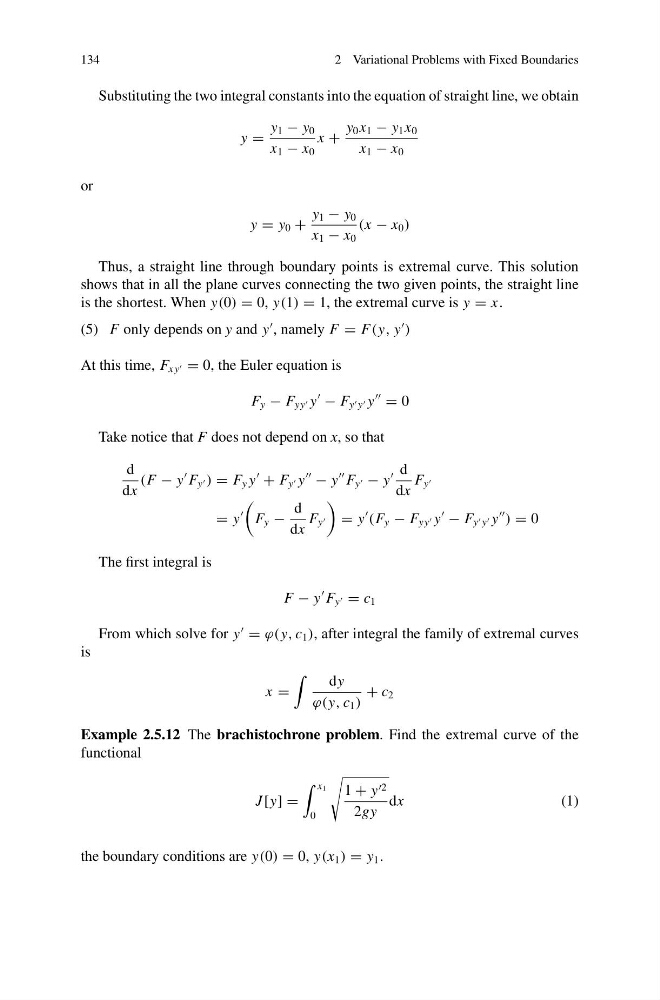
Example 2.5.12 The brachistochrone problem. Find the extremal curve of the
functional
J [y] =
x 1
0
1 + y 2
2gy
dx
(1)
the boundary conditions are y(0) = 0, y(x 1 ) = y 1 .
2 Variational Problems with Fixed Boundaries
Substituting the two integral constants into the equation of straight line, we obtain
y =
y 1 − y 0
x 1 − x 0
x +
y 0 x 1 − y 1 x 0
x 1 − x 0
or
y = y 0 +
y 1 − y 0
x 1 − x 0
(x − x 0 )
Thus, a straight line through boundary points is extremal curve. This solution
shows that in all the plane curves connecting the two given points, the straight line
is the shortest. When y(0) = 0, y(1) = 1, the extremal curve is y = x.
(5) F only depends on y and y
, namely F = F(y, y
)
At this time, F xy = 0, the Euler equation is
F y − F yy y
− F y y y
= 0
Take notice that F does not depend on x, so that
d
dx
(F − y
F y ) = F y y
+ F y y
− y
F y − y
d
dx
F y
= y
F y −
d
dx
F y
= y
(F y − F yy y
− F y y y
) = 0
The first integral is
F − y
F y = c 1
From which solve for y
= ϕ(y, c 1 ), after integral the family of extremal curves
is
x =
dy
ϕ(y, c 1 )
+ c 2
Example 2.5.12 The brachistochrone problem. Find the extremal curve of the
functional
J [y] =
x 1
0
1 + y 2
2gy
dx
(1)
the boundary conditions are y(0) = 0, y(x 1 ) = y 1 .