

2.4 The Euler Equations of the Simplest Functional
121
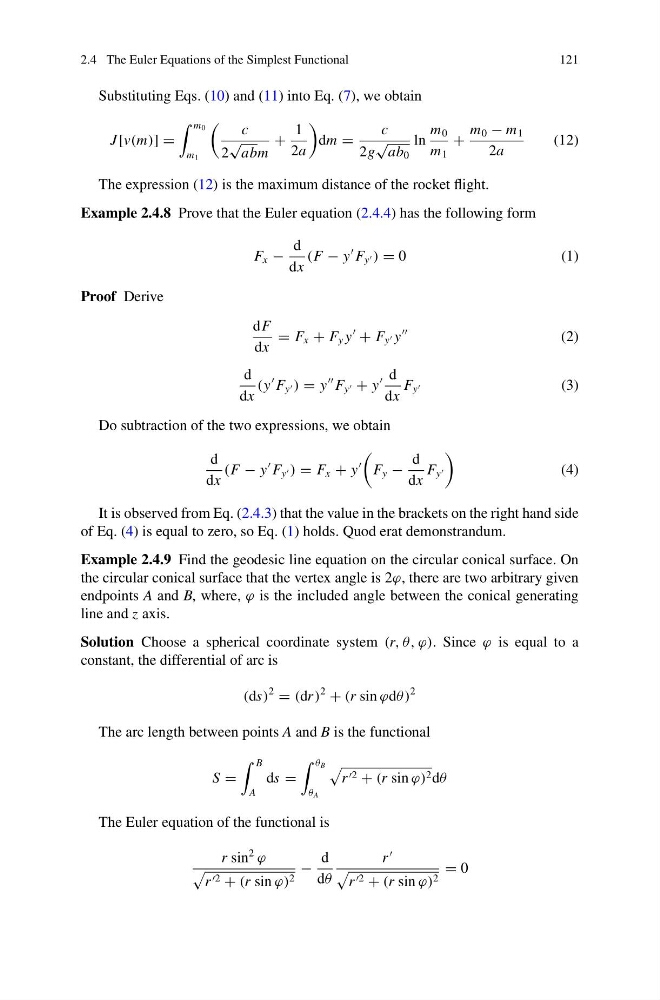
Substituting Eqs. (10) and (11) into Eq. (7), we obtain
J [v(m)] =
m 0
m 1
c
2
√
abm
+
1
2a
dm =
c
2g
√
ab 0
ln
m 0
m 1
+
m 0 − m 1
2a
(12)
The expression (12) is the maximum distance of the rocket flight.
Example 2.4.8 Prove that the Euler equation (2.4.4) has the following form
F x −
d
dx
(F − y
F y ) = 0
( 1 )
Proof Derive
dF
dx
= F x + F y y
+ F y y
(2)
d
dx
(y
F y ) = y
F y + y
d
dx
F y
(3)
Do subtraction of the two expressions, we obtain
d
dx
(F − y
F y ) = F x + y
F y −
d
dx
F y
(4)
It is observed from Eq. (2.4.3) that the value in the brackets on the right hand side
of Eq. (4) is equal to zero, so Eq. (1) holds. Quod erat demonstrandum.
Example 2.4.9 Find the geodesic line equation on the circular conical surface. On
the circular conical surface that the vertex angle is 2ϕ, there are two arbitrary given
endpoints A and B, where, ϕ is the included angle between the conical generating
line and z axis.
Solution Choose a spherical coordinate system (r, θ, ϕ). Since ϕ is equal to a
constant, the differential of arc is
(ds)
2
= (dr )
2
+ (r sin ϕdθ)
2
The arc length between points A and B is the functional
S =
B
A
ds =
θ B
θ A
r 2 + (r sin ϕ) 2 dθ
The Euler equation of the functional is
r sin
2
ϕ
r 2 + (r sin ϕ) 2
−
d
dθ
r
r 2 + (r sin ϕ) 2
= 0
121
Substituting Eqs. (10) and (11) into Eq. (7), we obtain
J [v(m)] =
m 0
m 1
c
2
√
abm
+
1
2a
dm =
c
2g
√
ab 0
ln
m 0
m 1
+
m 0 − m 1
2a
(12)
The expression (12) is the maximum distance of the rocket flight.
Example 2.4.8 Prove that the Euler equation (2.4.4) has the following form
F x −
d
dx
(F − y
F y ) = 0
( 1 )
Proof Derive
dF
dx
= F x + F y y
+ F y y
(2)
d
dx
(y
F y ) = y
F y + y
d
dx
F y
(3)
Do subtraction of the two expressions, we obtain
d
dx
(F − y
F y ) = F x + y
F y −
d
dx
F y
(4)
It is observed from Eq. (2.4.3) that the value in the brackets on the right hand side
of Eq. (4) is equal to zero, so Eq. (1) holds. Quod erat demonstrandum.
Example 2.4.9 Find the geodesic line equation on the circular conical surface. On
the circular conical surface that the vertex angle is 2ϕ, there are two arbitrary given
endpoints A and B, where, ϕ is the included angle between the conical generating
line and z axis.
Solution Choose a spherical coordinate system (r, θ, ϕ). Since ϕ is equal to a
constant, the differential of arc is
(ds)
2
= (dr )
2
+ (r sin ϕdθ)
2
The arc length between points A and B is the functional
S =
B
A
ds =
θ B
θ A
r 2 + (r sin ϕ) 2 dθ
The Euler equation of the functional is
r sin
2
ϕ
r 2 + (r sin ϕ) 2
−
d
dθ
r
r 2 + (r sin ϕ) 2
= 0