

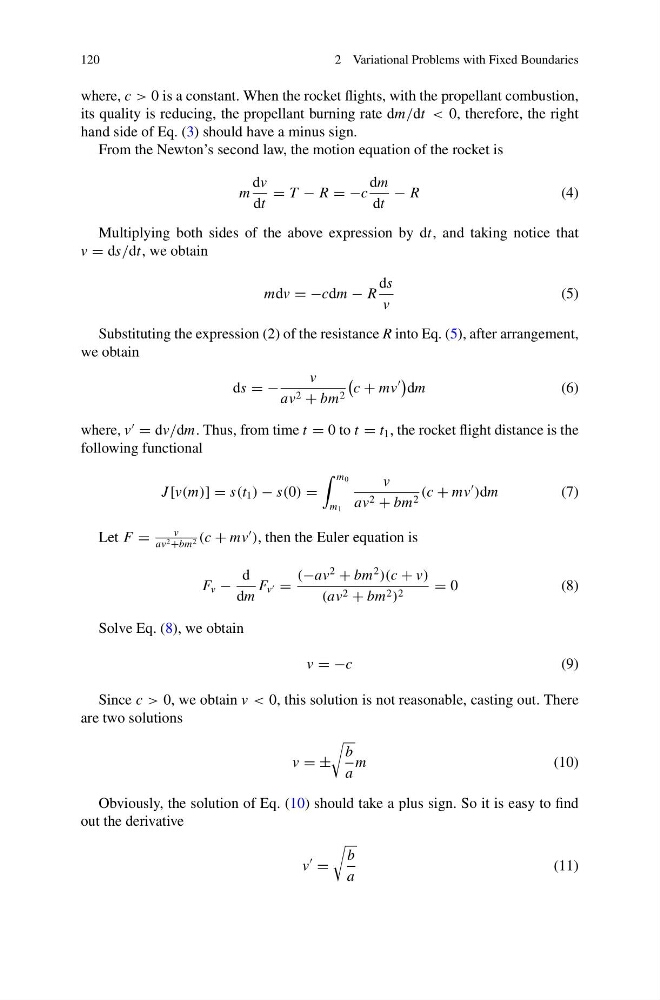
120
2 Variational Problems with Fixed Boundaries
where, c > 0 is a constant. When the rocket flights, with the propellant combustion,
its quality is reducing, the propellant burning rate dm/dt < 0, therefore, the right
hand side of Eq. (3) should have a minus sign.
From the Newton’s second law, the motion equation of the rocket is
m
dv
dt
= T − R = −c
dm
dt
− R
(4)
Multiplying both sides of the above expression by dt, and taking notice that
v = ds/dt, we obtain
mdv = −cdm − R
ds
v
(5)
Substituting the expression (2) of the resistance R into Eq. (5), after arrangement,
we obtain
ds = −
v
av 2 + bm 2
c + mv
dm
(6)
where, v
= dv/dm. Thus, from time t = 0 to t = t 1 , the rocket flight distance is the
following functional
J [v(m)] = s(t 1 ) − s(0) =
m 0
m 1
v
av 2 + bm 2 (c + mv
)dm
(7)
Let F =
v
av 2 +bm 2 (c + mv
), then the Euler equation is
F v −
d
dm
F v =
(−av
2
+ bm
2
)(c + v)
(av 2 + bm 2 ) 2
= 0
( 8 )
Solve Eq. (8), we obtain
v = −c
(9)
Since c > 0, we obtain v < 0, this solution is not reasonable, casting out. There
are two solutions
v = ±
b
a
m
(10)
Obviously, the solution of Eq. (10) should take a plus sign. So it is easy to find
out the derivative
v
=
b
a
(11)
2 Variational Problems with Fixed Boundaries
where, c > 0 is a constant. When the rocket flights, with the propellant combustion,
its quality is reducing, the propellant burning rate dm/dt < 0, therefore, the right
hand side of Eq. (3) should have a minus sign.
From the Newton’s second law, the motion equation of the rocket is
m
dv
dt
= T − R = −c
dm
dt
− R
(4)
Multiplying both sides of the above expression by dt, and taking notice that
v = ds/dt, we obtain
mdv = −cdm − R
ds
v
(5)
Substituting the expression (2) of the resistance R into Eq. (5), after arrangement,
we obtain
ds = −
v
av 2 + bm 2
c + mv
dm
(6)
where, v
= dv/dm. Thus, from time t = 0 to t = t 1 , the rocket flight distance is the
following functional
J [v(m)] = s(t 1 ) − s(0) =
m 0
m 1
v
av 2 + bm 2 (c + mv
)dm
(7)
Let F =
v
av 2 +bm 2 (c + mv
), then the Euler equation is
F v −
d
dm
F v =
(−av
2
+ bm
2
)(c + v)
(av 2 + bm 2 ) 2
= 0
( 8 )
Solve Eq. (8), we obtain
v = −c
(9)
Since c > 0, we obtain v < 0, this solution is not reasonable, casting out. There
are two solutions
v = ±
b
a
m
(10)
Obviously, the solution of Eq. (10) should take a plus sign. So it is easy to find
out the derivative
v
=
b
a
(11)