

2.4 The Euler Equations of the Simplest Functional
119
y
+ 2y
+ y = −
1
2
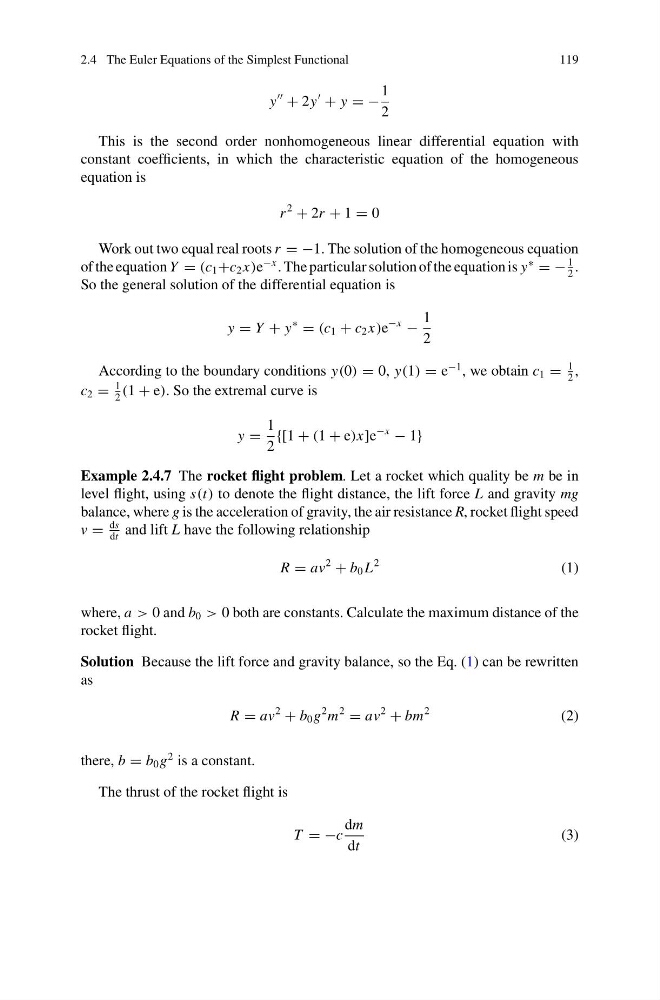
This is the second order nonhomogeneous linear differential equation with
constant coefficients, in which the characteristic equation of the homogeneous
equation is
r
2
+ 2r + 1 = 0
Work out two equal real roots r = −1. The solution of the homogeneous equation
of the equation Y = (c 1 +c 2 x)e
−x . The particular solution of the equation is y
∗
= −
1
2
.
So the general solution of the differential equation is
y = Y + y
∗
= (c 1 + c 2 x)e
−x
−
1
2
According to the boundary conditions y(0) = 0, y(1) = e
−1 , we obtain c 1 =
1
2
,
c 2 =
1
2
(1 + e). So the extremal curve is
y =
1
2
{[1 + (1 + e)x]e
−x
− 1}
Example 2.4.7 The rocket flight problem. Let a rocket which quality be m be in
level flight, using s(t) to denote the flight distance, the lift force L and gravity mg
balance, where g is the acceleration of gravity, the air resistance R, rocket flight speed
v =
ds
dt
and lift L have the following relationship
R = av
2
+ b 0 L
2
(1)
where, a > 0 and b 0 > 0 both are constants. Calculate the maximum distance of the
rocket flight.
Solution Because the lift force and gravity balance, so the Eq. (1) can be rewritten
as
R = av
2
+ b 0 g
2 m
2
= av
2
+ bm
2
(2)
there, b = b 0 g
2 is a constant.
The thrust of the rocket flight is
T = −c
dm
dt
(3)
119
y
+ 2y
+ y = −
1
2
This is the second order nonhomogeneous linear differential equation with
constant coefficients, in which the characteristic equation of the homogeneous
equation is
r
2
+ 2r + 1 = 0
Work out two equal real roots r = −1. The solution of the homogeneous equation
of the equation Y = (c 1 +c 2 x)e
−x . The particular solution of the equation is y
∗
= −
1
2
.
So the general solution of the differential equation is
y = Y + y
∗
= (c 1 + c 2 x)e
−x
−
1
2
According to the boundary conditions y(0) = 0, y(1) = e
−1 , we obtain c 1 =
1
2
,
c 2 =
1
2
(1 + e). So the extremal curve is
y =
1
2
{[1 + (1 + e)x]e
−x
− 1}
Example 2.4.7 The rocket flight problem. Let a rocket which quality be m be in
level flight, using s(t) to denote the flight distance, the lift force L and gravity mg
balance, where g is the acceleration of gravity, the air resistance R, rocket flight speed
v =
ds
dt
and lift L have the following relationship
R = av
2
+ b 0 L
2
(1)
where, a > 0 and b 0 > 0 both are constants. Calculate the maximum distance of the
rocket flight.
Solution Because the lift force and gravity balance, so the Eq. (1) can be rewritten
as
R = av
2
+ b 0 g
2 m
2
= av
2
+ bm
2
(2)
there, b = b 0 g
2 is a constant.
The thrust of the rocket flight is
T = −c
dm
dt
(3)