

122
2 Variational Problems with Fixed Boundaries
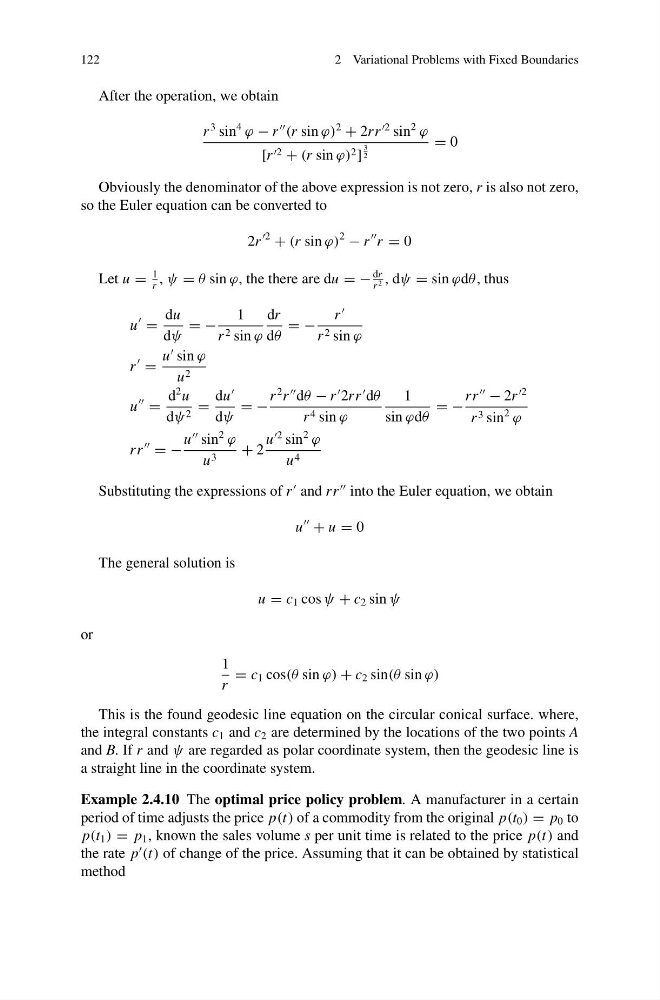
After the operation, we obtain
r
3 sin
4
ϕ − r
(r sin ϕ)
2
+ 2rr
2 sin
2
ϕ
[r 2 + (r sin ϕ) 2 ]
3
2
= 0
Obviously the denominator of the above expression is not zero, r is also not zero,
so the Euler equation can be converted to
2r
2
+ (r sin ϕ)
2
− r
r = 0
Let u =
1
r
, ψ = θ sin ϕ, the there are du = −
dr
r 2 , dψ = sin ϕdθ , thus
u
=
du
dψ
= −
1
r 2 sin ϕ
dr
dθ
= −
r
r 2 sin ϕ
r
=
u
sin ϕ
u 2
u
=
d
2 u
dψ 2 =
du
dψ
= −
r
2 r
dθ − r
2rr
dθ
r 4 sin ϕ
1
sin ϕdθ
= −
rr
− 2r
2
r 3 sin
2
ϕ
rr
= −
u
sin
2
ϕ
u 3
+ 2
u
2 sin
2
ϕ
u 4
Substituting the expressions of r
and rr
into the Euler equation, we obtain
u
+ u = 0
The general solution is
u = c 1 cos ψ + c 2 sin ψ
or
1
r
= c 1 cos(θ sin ϕ) + c 2 sin(θ sin ϕ)
This is the found geodesic line equation on the circular conical surface. where,
the integral constants c 1 and c 2 are determined by the locations of the two points A
and B. If r and ψ are regarded as polar coordinate system, then the geodesic line is
a straight line in the coordinate system.
Example 2.4.10 The optimal price policy problem. A manufacturer in a certain
period of time adjusts the price p(t) of a commodity from the original p(t 0 ) = p 0 to
p(t 1 ) = p 1 , known the sales volume s per unit time is related to the price p(t) and
the rate p
(t) of change of the price. Assuming that it can be obtained by statistical
method
2 Variational Problems with Fixed Boundaries
After the operation, we obtain
r
3 sin
4
ϕ − r
(r sin ϕ)
2
+ 2rr
2 sin
2
ϕ
[r 2 + (r sin ϕ) 2 ]
3
2
= 0
Obviously the denominator of the above expression is not zero, r is also not zero,
so the Euler equation can be converted to
2r
2
+ (r sin ϕ)
2
− r
r = 0
Let u =
1
r
, ψ = θ sin ϕ, the there are du = −
dr
r 2 , dψ = sin ϕdθ , thus
u
=
du
dψ
= −
1
r 2 sin ϕ
dr
dθ
= −
r
r 2 sin ϕ
r
=
u
sin ϕ
u 2
u
=
d
2 u
dψ 2 =
du
dψ
= −
r
2 r
dθ − r
2rr
dθ
r 4 sin ϕ
1
sin ϕdθ
= −
rr
− 2r
2
r 3 sin
2
ϕ
rr
= −
u
sin
2
ϕ
u 3
+ 2
u
2 sin
2
ϕ
u 4
Substituting the expressions of r
and rr
into the Euler equation, we obtain
u
+ u = 0
The general solution is
u = c 1 cos ψ + c 2 sin ψ
or
1
r
= c 1 cos(θ sin ϕ) + c 2 sin(θ sin ϕ)
This is the found geodesic line equation on the circular conical surface. where,
the integral constants c 1 and c 2 are determined by the locations of the two points A
and B. If r and ψ are regarded as polar coordinate system, then the geodesic line is
a straight line in the coordinate system.
Example 2.4.10 The optimal price policy problem. A manufacturer in a certain
period of time adjusts the price p(t) of a commodity from the original p(t 0 ) = p 0 to
p(t 1 ) = p 1 , known the sales volume s per unit time is related to the price p(t) and
the rate p
(t) of change of the price. Assuming that it can be obtained by statistical
method