

2.4 The Euler Equations of the Simplest Functional
115
δ J =
x 1
x 0
F y −
d
dx
F y
δydx = 0
( 5 )
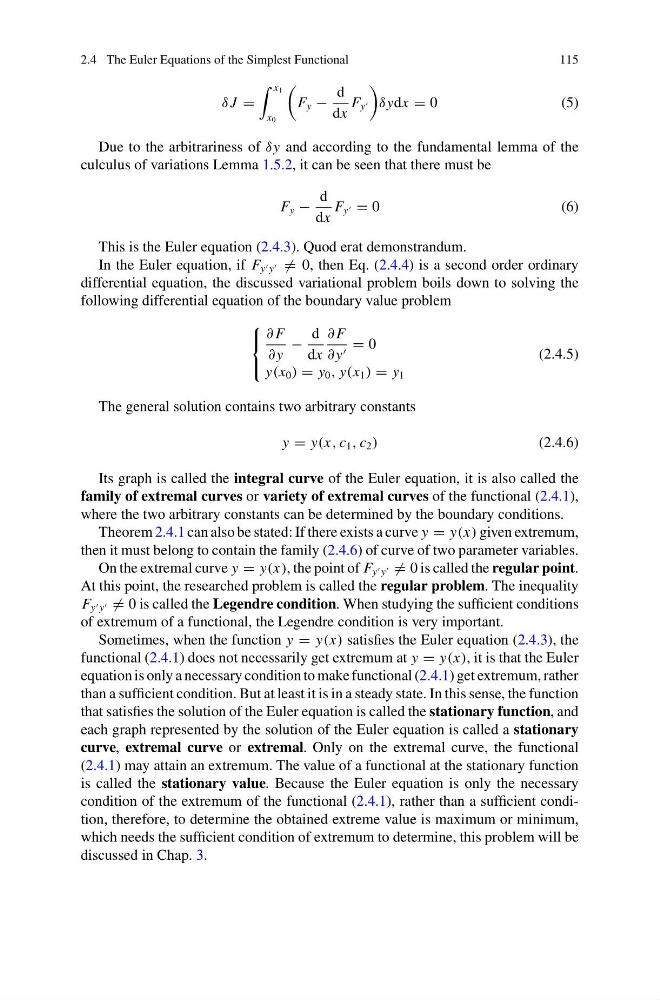
Due to the arbitrariness of δy and according to the fundamental lemma of the
culculus of variations Lemma 1.5.2, it can be seen that there must be
F y −
d
dx
F y = 0
( 6 )
This is the Euler equation (2.4.3). Quod erat demonstrandum.
In the Euler equation, if F y y = 0, then Eq. (2.4.4) is a second order ordinary
differential equation, the discussed variational problem boils down to solving the
following differential equation of the boundary value problem
⎧
⎨
⎩
∂ F
∂ y
−
d
dx
∂ F
∂ y = 0
y(x 0 ) = y 0 , y(x 1 ) = y 1
(2.4.5)
The general solution contains two arbitrary constants
y = y(x, c 1 , c 2 )
(2.4.6)
Its graph is called the integral curve of the Euler equation, it is also called the
family of extremal curves or variety of extremal curves of the functional (2.4.1),
where the two arbitrary constants can be determined by the boundary conditions.
Theorem 2.4.1 can also be stated: If there exists a curve y = y(x) given extremum,
then it must belong to contain the family (2.4.6) of curve of two parameter variables.
On the extremal curve y = y(x), the point of F y y = 0 is called the regular point.
At this point, the researched problem is called the regular problem. The inequality
F y y = 0 is called the Legendre condition. When studying the sufficient conditions
of extremum of a functional, the Legendre condition is very important.
Sometimes, when the function y = y(x) satisfies the Euler equation (2.4.3), the
functional (2.4.1) does not necessarily get extremum at y = y(x), it is that the Euler
equation is only a necessary condition to make functional (2.4.1) get extremum, rather
than a sufficient condition. But at least it is in a steady state. In this sense, the function
that satisfies the solution of the Euler equation is called the stationary function, and
each graph represented by the solution of the Euler equation is called a stationary
curve, extremal curve or extremal. Only on the extremal curve, the functional
(2.4.1) may attain an extremum. The value of a functional at the stationary function
is called the stationary value. Because the Euler equation is only the necessary
condition of the extremum of the functional (2.4.1), rather than a sufficient condition, therefore, to determine the obtained extreme value is maximum or minimum,
which needs the sufficient condition of extremum to determine, this problem will be
discussed in Chap. 3.
115
δ J =
x 1
x 0
F y −
d
dx
F y
δydx = 0
( 5 )
Due to the arbitrariness of δy and according to the fundamental lemma of the
culculus of variations Lemma 1.5.2, it can be seen that there must be
F y −
d
dx
F y = 0
( 6 )
This is the Euler equation (2.4.3). Quod erat demonstrandum.
In the Euler equation, if F y y = 0, then Eq. (2.4.4) is a second order ordinary
differential equation, the discussed variational problem boils down to solving the
following differential equation of the boundary value problem
⎧
⎨
⎩
∂ F
∂ y
−
d
dx
∂ F
∂ y = 0
y(x 0 ) = y 0 , y(x 1 ) = y 1
(2.4.5)
The general solution contains two arbitrary constants
y = y(x, c 1 , c 2 )
(2.4.6)
Its graph is called the integral curve of the Euler equation, it is also called the
family of extremal curves or variety of extremal curves of the functional (2.4.1),
where the two arbitrary constants can be determined by the boundary conditions.
Theorem 2.4.1 can also be stated: If there exists a curve y = y(x) given extremum,
then it must belong to contain the family (2.4.6) of curve of two parameter variables.
On the extremal curve y = y(x), the point of F y y = 0 is called the regular point.
At this point, the researched problem is called the regular problem. The inequality
F y y = 0 is called the Legendre condition. When studying the sufficient conditions
of extremum of a functional, the Legendre condition is very important.
Sometimes, when the function y = y(x) satisfies the Euler equation (2.4.3), the
functional (2.4.1) does not necessarily get extremum at y = y(x), it is that the Euler
equation is only a necessary condition to make functional (2.4.1) get extremum, rather
than a sufficient condition. But at least it is in a steady state. In this sense, the function
that satisfies the solution of the Euler equation is called the stationary function, and
each graph represented by the solution of the Euler equation is called a stationary
curve, extremal curve or extremal. Only on the extremal curve, the functional
(2.4.1) may attain an extremum. The value of a functional at the stationary function
is called the stationary value. Because the Euler equation is only the necessary
condition of the extremum of the functional (2.4.1), rather than a sufficient condition, therefore, to determine the obtained extreme value is maximum or minimum,
which needs the sufficient condition of extremum to determine, this problem will be
discussed in Chap. 3.