

116
2 Variational Problems with Fixed Boundaries
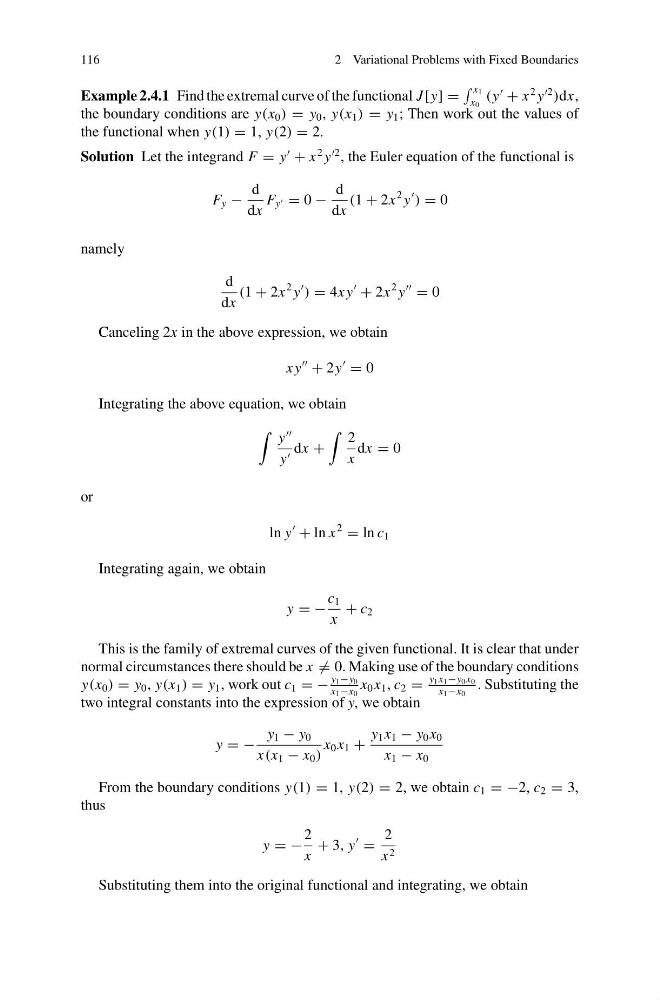
Example 2.4.1 Find the extremal curve of the functional J [y] =
x 1
x 0
(y
+ x
2 y
2
)dx,
the boundary conditions are y(x 0 ) = y 0 , y(x 1 ) = y 1 ; Then work out the values of
the functional when y(1) = 1, y(2) = 2.
Solution Let the integrand F = y
+ x
2 y
2 , the Euler equation of the functional is
F y −
d
dx
F y = 0 −
d
dx
(1 + 2x
2 y
) = 0
namely
d
dx
(1 + 2x
2 y
) = 4x y
+ 2x
2 y
= 0
Canceling 2x in the above expression, we obtain
x y
+ 2y
= 0
Integrating the above equation, we obtain
y
y dx +
2
x
dx = 0
or
ln y
+ ln x
2
= ln c 1
Integrating again, we obtain
y = −
c 1
x
+ c 2
This is the family of extremal curves of the given functional. It is clear that under
normal circumstances there should be x = 0. Making use of the boundary conditions
y(x 0 ) = y 0 , y(x 1 ) = y 1 , work out c 1 = −
y 1 −y 0
x 1 −x 0
x 0 x 1 , c 2 =
y 1 x 1 −y 0 x 0
x 1 −x 0
. Substituting the
two integral constants into the expression of y, we obtain
y = −
y 1 − y 0
x(x 1 − x 0 )
x 0 x 1 +
y 1 x 1 − y 0 x 0
x 1 − x 0
From the boundary conditions y(1) = 1, y(2) = 2, we obtain c 1 = −2, c 2 = 3,
thus
y = −
2
x
+ 3, y
=
2
x 2
Substituting them into the original functional and integrating, we obtain
2 Variational Problems with Fixed Boundaries
Example 2.4.1 Find the extremal curve of the functional J [y] =
x 1
x 0
(y
+ x
2 y
2
)dx,
the boundary conditions are y(x 0 ) = y 0 , y(x 1 ) = y 1 ; Then work out the values of
the functional when y(1) = 1, y(2) = 2.
Solution Let the integrand F = y
+ x
2 y
2 , the Euler equation of the functional is
F y −
d
dx
F y = 0 −
d
dx
(1 + 2x
2 y
) = 0
namely
d
dx
(1 + 2x
2 y
) = 4x y
+ 2x
2 y
= 0
Canceling 2x in the above expression, we obtain
x y
+ 2y
= 0
Integrating the above equation, we obtain
y
y dx +
2
x
dx = 0
or
ln y
+ ln x
2
= ln c 1
Integrating again, we obtain
y = −
c 1
x
+ c 2
This is the family of extremal curves of the given functional. It is clear that under
normal circumstances there should be x = 0. Making use of the boundary conditions
y(x 0 ) = y 0 , y(x 1 ) = y 1 , work out c 1 = −
y 1 −y 0
x 1 −x 0
x 0 x 1 , c 2 =
y 1 x 1 −y 0 x 0
x 1 −x 0
. Substituting the
two integral constants into the expression of y, we obtain
y = −
y 1 − y 0
x(x 1 − x 0 )
x 0 x 1 +
y 1 x 1 − y 0 x 0
x 1 − x 0
From the boundary conditions y(1) = 1, y(2) = 2, we obtain c 1 = −2, c 2 = 3,
thus
y = −
2
x
+ 3, y
=
2
x 2
Substituting them into the original functional and integrating, we obtain