

3 FLP Reduction of Carbon Monoxide and Related Reactions
89
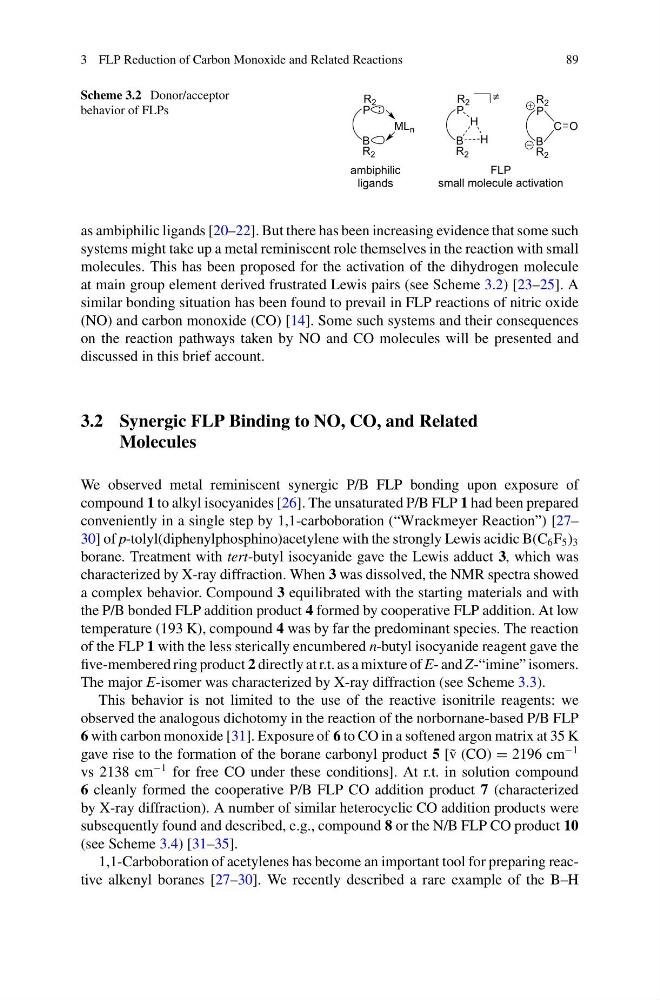
Scheme 3.2 Donor/acceptor
behavior of FLPs
P
B
C O
R 2
R 2
ML n
ambiphilic
ligands
P
B
R 2
R 2
H
H
≠
P
B
R 2
R 2
FLP
small molecule activation
as ambiphilic ligands [20–22]. But there has been increasing evidence that some such
systems might take up a metal reminiscent role themselves in the reaction with small
molecules. This has been proposed for the activation of the dihydrogen molecule
at main group element derived frustrated Lewis pairs (see Scheme 3.2) [23–25]. A
similar bonding situation has been found to prevail in FLP reactions of nitric oxide
(NO) and carbon monoxide (CO) [14]. Some such systems and their consequences
on the reaction pathways taken by NO and CO molecules will be presented and
discussed in this brief account.
3.2 Synergic FLP Binding to NO, CO, and Related
Molecules
We observed metal reminiscent synergic P/B FLP bonding upon exposure of
compound 1 to alkyl isocyanides [26]. The unsaturated P/B FLP 1 had been prepared
conveniently in a single step by 1,1-carboboration (“Wrackmeyer Reaction”) [27–
30] of p-tolyl(diphenylphosphino)acetylene with the strongly Lewis acidic B(C 6 F 5 ) 3
borane. Treatment with tert-butyl isocyanide gave the Lewis adduct 3, which was
characterized by X-ray diffraction. When 3 was dissolved, the NMR spectra showed
a complex behavior. Compound 3 equilibrated with the starting materials and with
the P/B bonded FLP addition product 4 formed by cooperative FLP addition. At low
temperature (193 K), compound 4 was by far the predominant species. The reaction
of the FLP 1 with the less sterically encumbered n-butyl isocyanide reagent gave the
five-membered ring product 2 directly at r.t. as a mixture of E- and Z-“imine” isomers.
The major E-isomer was characterized by X-ray diffraction (see Scheme 3.3).
This behavior is not limited to the use of the reactive isonitrile reagents: we
observed the analogous dichotomy in the reaction of the norbornane-based P/B FLP
6 with carbon monoxide [31]. Exposure of 6 to CO in a softened argon matrix at 35 K
gave rise to the formation of the borane carbonyl product 5 [˜ v (CO) = 2196 cm
−1
vs 2138 cm
−1 for free CO under these conditions]. At r.t. in solution compound
6 cleanly formed the cooperative P/B FLP CO addition product 7 (characterized
by X-ray diffraction). A number of similar heterocyclic CO addition products were
subsequently found and described, e.g., compound 8 or the N/B FLP CO product 10
(see Scheme 3.4) [31–35].
1,1-Carboboration of acetylenes has become an important tool for preparing reactive alkenyl boranes [27–30]. We recently described a rare example of the B–H
89
Scheme 3.2 Donor/acceptor
behavior of FLPs
P
B
C O
R 2
R 2
ML n
ambiphilic
ligands
P
B
R 2
R 2
H
H
≠
P
B
R 2
R 2
FLP
small molecule activation
as ambiphilic ligands [20–22]. But there has been increasing evidence that some such
systems might take up a metal reminiscent role themselves in the reaction with small
molecules. This has been proposed for the activation of the dihydrogen molecule
at main group element derived frustrated Lewis pairs (see Scheme 3.2) [23–25]. A
similar bonding situation has been found to prevail in FLP reactions of nitric oxide
(NO) and carbon monoxide (CO) [14]. Some such systems and their consequences
on the reaction pathways taken by NO and CO molecules will be presented and
discussed in this brief account.
3.2 Synergic FLP Binding to NO, CO, and Related
Molecules
We observed metal reminiscent synergic P/B FLP bonding upon exposure of
compound 1 to alkyl isocyanides [26]. The unsaturated P/B FLP 1 had been prepared
conveniently in a single step by 1,1-carboboration (“Wrackmeyer Reaction”) [27–
30] of p-tolyl(diphenylphosphino)acetylene with the strongly Lewis acidic B(C 6 F 5 ) 3
borane. Treatment with tert-butyl isocyanide gave the Lewis adduct 3, which was
characterized by X-ray diffraction. When 3 was dissolved, the NMR spectra showed
a complex behavior. Compound 3 equilibrated with the starting materials and with
the P/B bonded FLP addition product 4 formed by cooperative FLP addition. At low
temperature (193 K), compound 4 was by far the predominant species. The reaction
of the FLP 1 with the less sterically encumbered n-butyl isocyanide reagent gave the
five-membered ring product 2 directly at r.t. as a mixture of E- and Z-“imine” isomers.
The major E-isomer was characterized by X-ray diffraction (see Scheme 3.3).
This behavior is not limited to the use of the reactive isonitrile reagents: we
observed the analogous dichotomy in the reaction of the norbornane-based P/B FLP
6 with carbon monoxide [31]. Exposure of 6 to CO in a softened argon matrix at 35 K
gave rise to the formation of the borane carbonyl product 5 [˜ v (CO) = 2196 cm
−1
vs 2138 cm
−1 for free CO under these conditions]. At r.t. in solution compound
6 cleanly formed the cooperative P/B FLP CO addition product 7 (characterized
by X-ray diffraction). A number of similar heterocyclic CO addition products were
subsequently found and described, e.g., compound 8 or the N/B FLP CO product 10
(see Scheme 3.4) [31–35].
1,1-Carboboration of acetylenes has become an important tool for preparing reactive alkenyl boranes [27–30]. We recently described a rare example of the B–H