

88
T. Wang et al.
FLP
frustrated Lewis pair
Fmes
2,4,6-tris(trifluoromethyl)phenyl
Mes
mesityl
Mes*
2,4,6-tri(tert-butyl)phenyl
NMR
nuclear magnetic resonance
PINO
phthalimide-N-oxyl
TEMPO 2,2,6,6-tetramethylpiperidinyloxyl
Tipp
2,4,6-tri(iso-propyl)phenyl
3.1 Introduction
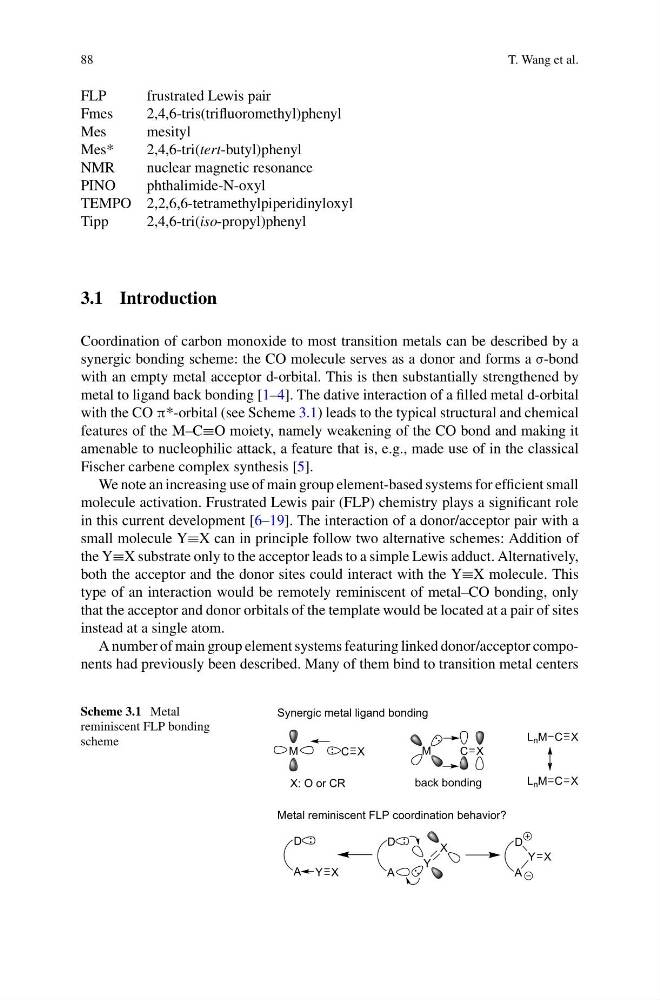
Coordination of carbon monoxide to most transition metals can be described by a
synergic bonding scheme: the CO molecule serves as a donor and forms a σ-bond
with an empty metal acceptor d-orbital. This is then substantially strengthened by
metal to ligand back bonding [1–4]. The dative interaction of a filled metal d-orbital
with the CO π*-orbital (see Scheme 3.1) leads to the typical structural and chemical
features of the M–C≡O moiety, namely weakening of the CO bond and making it
amenable to nucleophilic attack, a feature that is, e.g., made use of in the classical
Fischer carbene complex synthesis [5].
We note an increasing use of main group element-based systems for efficient small
molecule activation. Frustrated Lewis pair (FLP) chemistry plays a significant role
in this current development [6–19]. The interaction of a donor/acceptor pair with a
small molecule Y≡X can in principle follow two alternative schemes: Addition of
the Y≡X substrate only to the acceptor leads to a simple Lewis adduct. Alternatively,
both the acceptor and the donor sites could interact with the Y≡X molecule. This
type of an interaction would be remotely reminiscent of metal–CO bonding, only
that the acceptor and donor orbitals of the template would be located at a pair of sites
instead at a single atom.
A number of main group element systems featuring linked donor/acceptor components had previously been described. Many of them bind to transition metal centers
Scheme 3.1 Metal
reminiscent FLP bonding
scheme
Synergic metal ligand bonding
M
C X
X: O or CR
M
C X
back bonding
C X
L n M
C X
L n M
Metal reminiscent FLP coordination behavior?
D
A Y X
D
A
Y
X
D
A
Y X
T. Wang et al.
FLP
frustrated Lewis pair
Fmes
2,4,6-tris(trifluoromethyl)phenyl
Mes
mesityl
Mes*
2,4,6-tri(tert-butyl)phenyl
NMR
nuclear magnetic resonance
PINO
phthalimide-N-oxyl
TEMPO 2,2,6,6-tetramethylpiperidinyloxyl
Tipp
2,4,6-tri(iso-propyl)phenyl
3.1 Introduction
Coordination of carbon monoxide to most transition metals can be described by a
synergic bonding scheme: the CO molecule serves as a donor and forms a σ-bond
with an empty metal acceptor d-orbital. This is then substantially strengthened by
metal to ligand back bonding [1–4]. The dative interaction of a filled metal d-orbital
with the CO π*-orbital (see Scheme 3.1) leads to the typical structural and chemical
features of the M–C≡O moiety, namely weakening of the CO bond and making it
amenable to nucleophilic attack, a feature that is, e.g., made use of in the classical
Fischer carbene complex synthesis [5].
We note an increasing use of main group element-based systems for efficient small
molecule activation. Frustrated Lewis pair (FLP) chemistry plays a significant role
in this current development [6–19]. The interaction of a donor/acceptor pair with a
small molecule Y≡X can in principle follow two alternative schemes: Addition of
the Y≡X substrate only to the acceptor leads to a simple Lewis adduct. Alternatively,
both the acceptor and the donor sites could interact with the Y≡X molecule. This
type of an interaction would be remotely reminiscent of metal–CO bonding, only
that the acceptor and donor orbitals of the template would be located at a pair of sites
instead at a single atom.
A number of main group element systems featuring linked donor/acceptor components had previously been described. Many of them bind to transition metal centers
Scheme 3.1 Metal
reminiscent FLP bonding
scheme
Synergic metal ligand bonding
M
C X
X: O or CR
M
C X
back bonding
C X
L n M
C X
L n M
Metal reminiscent FLP coordination behavior?
D
A Y X
D
A
Y
X
D
A
Y X