

32
X. Feng et al.
B
C 6 F 5
C 6 F 5
2008
Ph
B(C 6 F 5)2
2010
Klankermayer J.
P t Bu 3
B(C 6 F 5)2
P t Bu 2
2012
N
B(C 6 F 5)2
2011
Repo T.
B C 6 F 5
2012
Oestreich M.
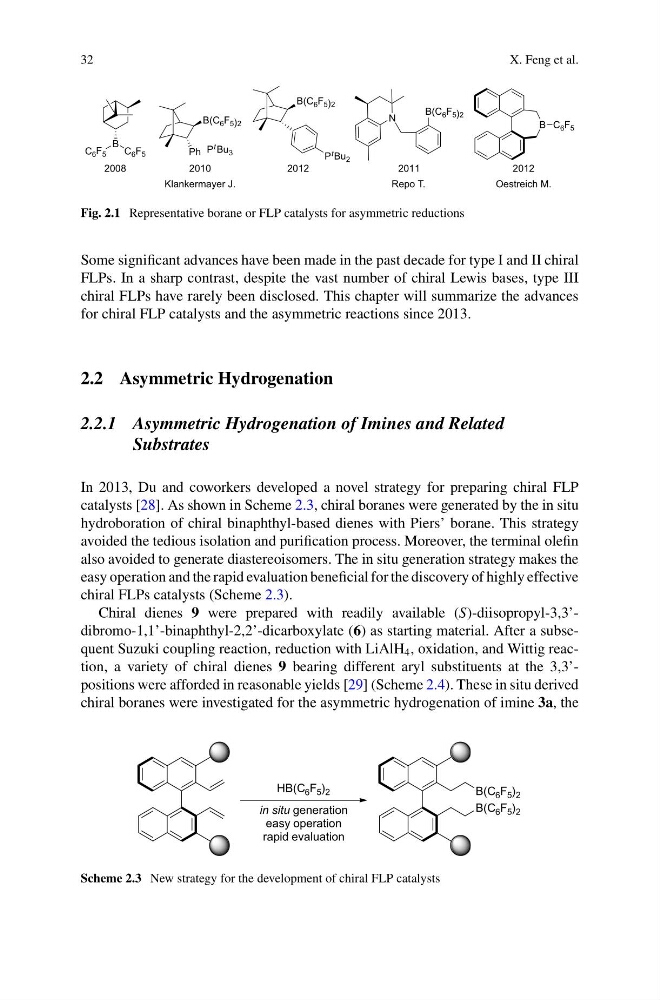
Fig. 2.1 Representative borane or FLP catalysts for asymmetric reductions
Some significant advances have been made in the past decade for type I and II chiral
FLPs. In a sharp contrast, despite the vast number of chiral Lewis bases, type III
chiral FLPs have rarely been disclosed. This chapter will summarize the advances
for chiral FLP catalysts and the asymmetric reactions since 2013.
2.2 Asymmetric Hydrogenation
2.2.1 Asymmetric Hydrogenation of Imines and Related
Substrates
In 2013, Du and coworkers developed a novel strategy for preparing chiral FLP
catalysts [28]. As shown in Scheme 2.3, chiral boranes were generated by the in situ
hydroboration of chiral binaphthyl-based dienes with Piers’ borane. This strategy
avoided the tedious isolation and purification process. Moreover, the terminal olefin
also avoided to generate diastereoisomers. The in situ generation strategy makes the
easy operation and the rapid evaluation beneficial for the discovery of highly effective
chiral FLPs catalysts (Scheme 2.3).
Chiral dienes 9 were prepared with readily available (S)-diisopropyl-3,3’dibromo-1,1’-binaphthyl-2,2’-dicarboxylate (6) as starting material. After a subsequent Suzuki coupling reaction, reduction with LiAlH 4 , oxidation, and Wittig reaction, a variety of chiral dienes 9 bearing different aryl substituents at the 3,3’positions were afforded in reasonable yields [29] (Scheme 2.4). These in situ derived
chiral boranes were investigated for the asymmetric hydrogenation of imine 3a, the
B(C 6 F 5 ) 2
B(C 6 F 5 ) 2
HB(C 6 F 5 ) 2
in situ generation
easy operation
rapid evaluation
Scheme 2.3 New strategy for the development of chiral FLP catalysts
X. Feng et al.
B
C 6 F 5
C 6 F 5
2008
Ph
B(C 6 F 5)2
2010
Klankermayer J.
P t Bu 3
B(C 6 F 5)2
P t Bu 2
2012
N
B(C 6 F 5)2
2011
Repo T.
B C 6 F 5
2012
Oestreich M.
Fig. 2.1 Representative borane or FLP catalysts for asymmetric reductions
Some significant advances have been made in the past decade for type I and II chiral
FLPs. In a sharp contrast, despite the vast number of chiral Lewis bases, type III
chiral FLPs have rarely been disclosed. This chapter will summarize the advances
for chiral FLP catalysts and the asymmetric reactions since 2013.
2.2 Asymmetric Hydrogenation
2.2.1 Asymmetric Hydrogenation of Imines and Related
Substrates
In 2013, Du and coworkers developed a novel strategy for preparing chiral FLP
catalysts [28]. As shown in Scheme 2.3, chiral boranes were generated by the in situ
hydroboration of chiral binaphthyl-based dienes with Piers’ borane. This strategy
avoided the tedious isolation and purification process. Moreover, the terminal olefin
also avoided to generate diastereoisomers. The in situ generation strategy makes the
easy operation and the rapid evaluation beneficial for the discovery of highly effective
chiral FLPs catalysts (Scheme 2.3).
Chiral dienes 9 were prepared with readily available (S)-diisopropyl-3,3’dibromo-1,1’-binaphthyl-2,2’-dicarboxylate (6) as starting material. After a subsequent Suzuki coupling reaction, reduction with LiAlH 4 , oxidation, and Wittig reaction, a variety of chiral dienes 9 bearing different aryl substituents at the 3,3’positions were afforded in reasonable yields [29] (Scheme 2.4). These in situ derived
chiral boranes were investigated for the asymmetric hydrogenation of imine 3a, the
B(C 6 F 5 ) 2
B(C 6 F 5 ) 2
HB(C 6 F 5 ) 2
in situ generation
easy operation
rapid evaluation
Scheme 2.3 New strategy for the development of chiral FLP catalysts