

2 Frustrated Lewis Pair Catalyzed Asymmetric Reactions
31
2.1 Introduction
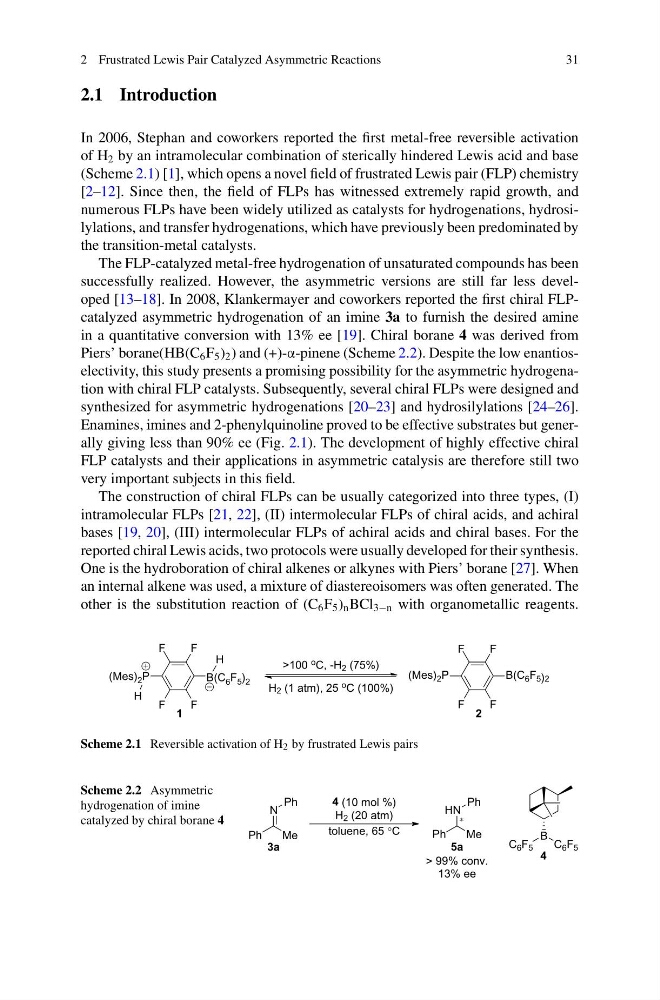
In 2006, Stephan and coworkers reported the first metal-free reversible activation
of H 2 by an intramolecular combination of sterically hindered Lewis acid and base
(Scheme 2.1) [1], which opens a novel field of frustrated Lewis pair (FLP) chemistry
[2–12]. Since then, the field of FLPs has witnessed extremely rapid growth, and
numerous FLPs have been widely utilized as catalysts for hydrogenations, hydrosilylations, and transfer hydrogenations, which have previously been predominated by
the transition-metal catalysts.
The FLP-catalyzed metal-free hydrogenation of unsaturated compounds has been
successfully realized. However, the asymmetric versions are still far less developed [13–18]. In 2008, Klankermayer and coworkers reported the first chiral FLPcatalyzed asymmetric hydrogenation of an imine 3a to furnish the desired amine
in a quantitative conversion with 13% ee [19]. Chiral borane 4 was derived from
Piers’ borane(HB(C 6 F 5 ) 2 ) and (+)-α-pinene (Scheme 2.2). Despite the low enantioselectivity, this study presents a promising possibility for the asymmetric hydrogenation with chiral FLP catalysts. Subsequently, several chiral FLPs were designed and
synthesized for asymmetric hydrogenations [20–23] and hydrosilylations [24–26].
Enamines, imines and 2-phenylquinoline proved to be effective substrates but generally giving less than 90% ee (Fig. 2.1). The development of highly effective chiral
FLP catalysts and their applications in asymmetric catalysis are therefore still two
very important subjects in this field.
The construction of chiral FLPs can be usually categorized into three types, (I)
intramolecular FLPs [21, 22], (II) intermolecular FLPs of chiral acids, and achiral
bases [19, 20], (III) intermolecular FLPs of achiral acids and chiral bases. For the
reported chiral Lewis acids, two protocols were usually developed for their synthesis.
One is the hydroboration of chiral alkenes or alkynes with Piers’ borane [27]. When
an internal alkene was used, a mixture of diastereoisomers was often generated. The
other is the substitution reaction of (C 6 F 5 ) n BCl 3−n with organometallic reagents.
B(C 6 F 5 ) 2
(Mes) 2 P
F
F
H
H
B(C 6 F 5)2
(Mes) 2 P
F
F
F
F
>100 o C, -H 2 (75%)
H 2 (1 atm), 25 o C (100%)
F
F
1
2
Scheme 2.1 Reversible activation of H 2 by frustrated Lewis pairs
Scheme 2.2 Asymmetric
hydrogenation of imine
catalyzed by chiral borane 4
Ph
Me
N
Ph
toluene, 65 °C
Ph
∗
Me
HN
Ph
> 99% conv.
13% ee
B
C 6 F 5
C 6 F 5
4 (10 mol %)
H 2 (20 atm)
3a
5a
4
31
2.1 Introduction
In 2006, Stephan and coworkers reported the first metal-free reversible activation
of H 2 by an intramolecular combination of sterically hindered Lewis acid and base
(Scheme 2.1) [1], which opens a novel field of frustrated Lewis pair (FLP) chemistry
[2–12]. Since then, the field of FLPs has witnessed extremely rapid growth, and
numerous FLPs have been widely utilized as catalysts for hydrogenations, hydrosilylations, and transfer hydrogenations, which have previously been predominated by
the transition-metal catalysts.
The FLP-catalyzed metal-free hydrogenation of unsaturated compounds has been
successfully realized. However, the asymmetric versions are still far less developed [13–18]. In 2008, Klankermayer and coworkers reported the first chiral FLPcatalyzed asymmetric hydrogenation of an imine 3a to furnish the desired amine
in a quantitative conversion with 13% ee [19]. Chiral borane 4 was derived from
Piers’ borane(HB(C 6 F 5 ) 2 ) and (+)-α-pinene (Scheme 2.2). Despite the low enantioselectivity, this study presents a promising possibility for the asymmetric hydrogenation with chiral FLP catalysts. Subsequently, several chiral FLPs were designed and
synthesized for asymmetric hydrogenations [20–23] and hydrosilylations [24–26].
Enamines, imines and 2-phenylquinoline proved to be effective substrates but generally giving less than 90% ee (Fig. 2.1). The development of highly effective chiral
FLP catalysts and their applications in asymmetric catalysis are therefore still two
very important subjects in this field.
The construction of chiral FLPs can be usually categorized into three types, (I)
intramolecular FLPs [21, 22], (II) intermolecular FLPs of chiral acids, and achiral
bases [19, 20], (III) intermolecular FLPs of achiral acids and chiral bases. For the
reported chiral Lewis acids, two protocols were usually developed for their synthesis.
One is the hydroboration of chiral alkenes or alkynes with Piers’ borane [27]. When
an internal alkene was used, a mixture of diastereoisomers was often generated. The
other is the substitution reaction of (C 6 F 5 ) n BCl 3−n with organometallic reagents.
B(C 6 F 5 ) 2
(Mes) 2 P
F
F
H
H
B(C 6 F 5)2
(Mes) 2 P
F
F
F
F
>100 o C, -H 2 (75%)
H 2 (1 atm), 25 o C (100%)
F
F
1
2
Scheme 2.1 Reversible activation of H 2 by frustrated Lewis pairs
Scheme 2.2 Asymmetric
hydrogenation of imine
catalyzed by chiral borane 4
Ph
Me
N
Ph
toluene, 65 °C
Ph
∗
Me
HN
Ph
> 99% conv.
13% ee
B
C 6 F 5
C 6 F 5
4 (10 mol %)
H 2 (20 atm)
3a
5a
4