

378
F. Holtrop et al.
Ge
Hf(Cp) 2
SiMe 3
SiMe 3
B(C 6 F 5 ) 3
+
SET
Ge
Hf(Cp) 2
SiMe 3
SiMe 3
B(C 6 F 5 ) 3
+
Ge
Hf(Cp) 2
SiMe 3
SiMe 3
B(C 6 F 5 ) 3
Ge
Hf(Cp) 2
Me 3 Si
SiMe 3
28
29
30
31
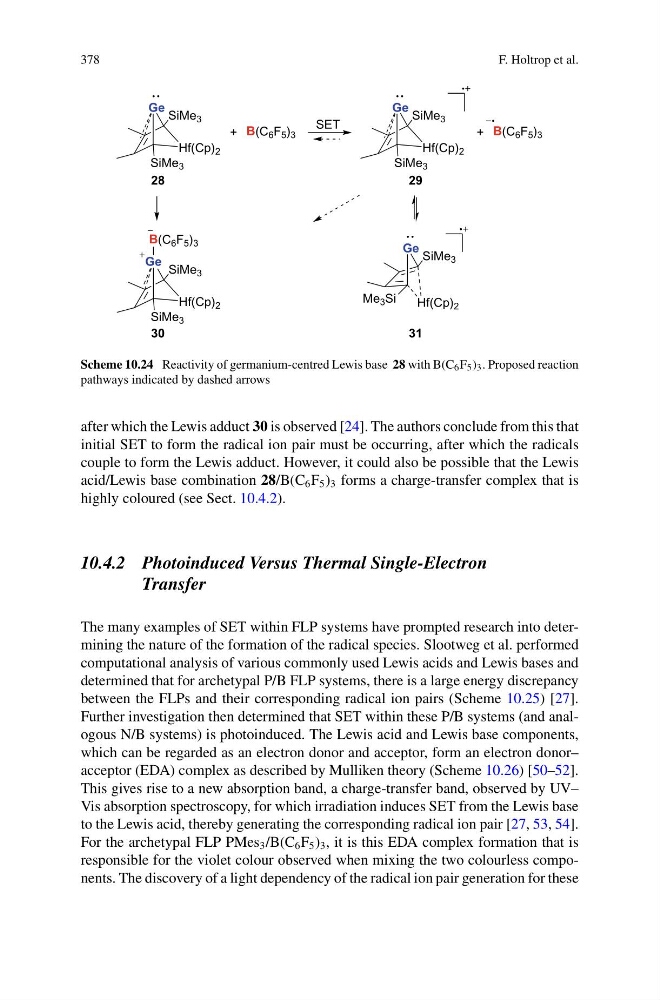
Scheme 10.24 Reactivity of germanium-centred Lewis base 28 with B(C 6 F 5 ) 3 . Proposed reaction
pathways indicated by dashed arrows
after which the Lewis adduct 30 is observed [24]. The authors conclude from this that
initial SET to form the radical ion pair must be occurring, after which the radicals
couple to form the Lewis adduct. However, it could also be possible that the Lewis
acid/Lewis base combination 28/B(C 6 F 5 ) 3 forms a charge-transfer complex that is
highly coloured (see Sect. 10.4.2).
10.4.2 Photoinduced Versus Thermal Single-Electron
Transfer
The many examples of SET within FLP systems have prompted research into determining the nature of the formation of the radical species. Slootweg et al. performed
computational analysis of various commonly used Lewis acids and Lewis bases and
determined that for archetypal P/B FLP systems, there is a large energy discrepancy
between the FLPs and their corresponding radical ion pairs (Scheme 10.25) [27].
Further investigation then determined that SET within these P/B systems (and analogous N/B systems) is photoinduced. The Lewis acid and Lewis base components,
which can be regarded as an electron donor and acceptor, form an electron donor–
acceptor (EDA) complex as described by Mulliken theory (Scheme 10.26) [50–52].
This gives rise to a new absorption band, a charge-transfer band, observed by UV–
Vis absorption spectroscopy, for which irradiation induces SET from the Lewis base
to the Lewis acid, thereby generating the corresponding radical ion pair [27, 53, 54].
For the archetypal FLP PMes 3 /B(C 6 F 5 ) 3 , it is this EDA complex formation that is
responsible for the violet colour observed when mixing the two colourless components. The discovery of a light dependency of the radical ion pair generation for these
F. Holtrop et al.
Ge
Hf(Cp) 2
SiMe 3
SiMe 3
B(C 6 F 5 ) 3
+
SET
Ge
Hf(Cp) 2
SiMe 3
SiMe 3
B(C 6 F 5 ) 3
+
Ge
Hf(Cp) 2
SiMe 3
SiMe 3
B(C 6 F 5 ) 3
Ge
Hf(Cp) 2
Me 3 Si
SiMe 3
28
29
30
31
Scheme 10.24 Reactivity of germanium-centred Lewis base 28 with B(C 6 F 5 ) 3 . Proposed reaction
pathways indicated by dashed arrows
after which the Lewis adduct 30 is observed [24]. The authors conclude from this that
initial SET to form the radical ion pair must be occurring, after which the radicals
couple to form the Lewis adduct. However, it could also be possible that the Lewis
acid/Lewis base combination 28/B(C 6 F 5 ) 3 forms a charge-transfer complex that is
highly coloured (see Sect. 10.4.2).
10.4.2 Photoinduced Versus Thermal Single-Electron
Transfer
The many examples of SET within FLP systems have prompted research into determining the nature of the formation of the radical species. Slootweg et al. performed
computational analysis of various commonly used Lewis acids and Lewis bases and
determined that for archetypal P/B FLP systems, there is a large energy discrepancy
between the FLPs and their corresponding radical ion pairs (Scheme 10.25) [27].
Further investigation then determined that SET within these P/B systems (and analogous N/B systems) is photoinduced. The Lewis acid and Lewis base components,
which can be regarded as an electron donor and acceptor, form an electron donor–
acceptor (EDA) complex as described by Mulliken theory (Scheme 10.26) [50–52].
This gives rise to a new absorption band, a charge-transfer band, observed by UV–
Vis absorption spectroscopy, for which irradiation induces SET from the Lewis base
to the Lewis acid, thereby generating the corresponding radical ion pair [27, 53, 54].
For the archetypal FLP PMes 3 /B(C 6 F 5 ) 3 , it is this EDA complex formation that is
responsible for the violet colour observed when mixing the two colourless components. The discovery of a light dependency of the radical ion pair generation for these