

10 Radicals in Frustrated Lewis Pair Chemistry
379
tBu 3 P
R 3 P
B(C 6 F 5 ) 3
B(C 6 F 5 ) 3
-3.03 eV
5.95 eV
5.54 eV
[D,A]
[D ,A ]
Mes 3 P
2.92 eV
2.51 eV
67.2
kcal mol
-1
57.8
kcal mol
-1
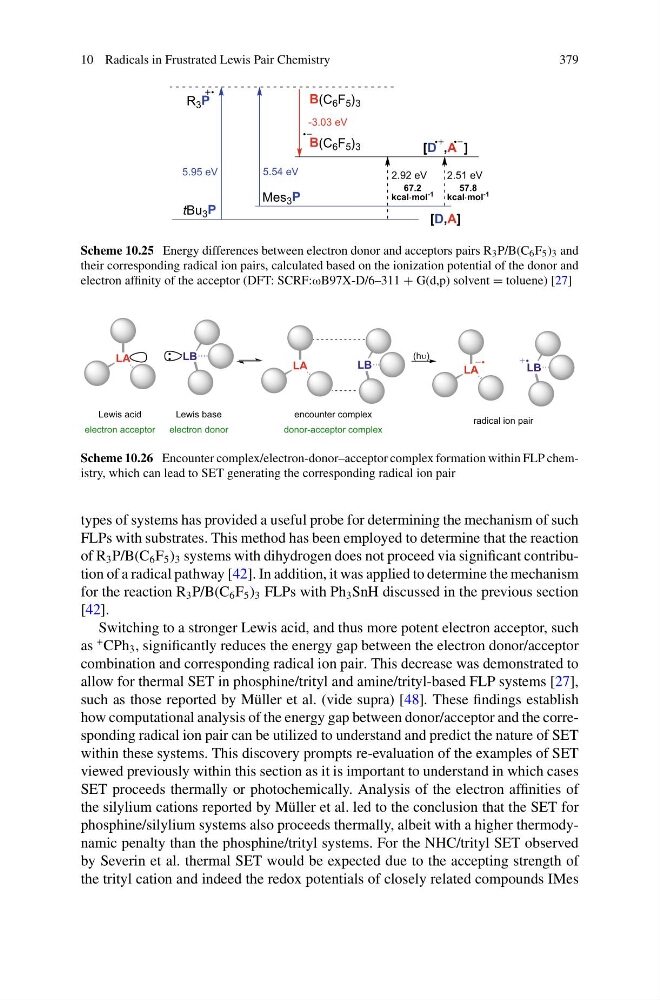
Scheme 10.25 Energy differences between electron donor and acceptors pairs R 3 P/B(C 6 F 5 ) 3 and
their corresponding radical ion pairs, calculated based on the ionization potential of the donor and
electron affinity of the acceptor (DFT: SCRF:ωB97X-D/6–311 + G(d,p) solvent = toluene) [27]
LB
LA
electron donor
electron acceptor
LB
LA
donor-acceptor complex
Lewis acid
Lewis base
encounter complex
LB
LA
(h )
radical ion pair
Scheme 10.26 Encounter complex/electron-donor–acceptor complex formation within FLP chemistry, which can lead to SET generating the corresponding radical ion pair
types of systems has provided a useful probe for determining the mechanism of such
FLPs with substrates. This method has been employed to determine that the reaction
of R 3 P/B(C 6 F 5 ) 3 systems with dihydrogen does not proceed via significant contribution of a radical pathway [42]. In addition, it was applied to determine the mechanism
for the reaction R 3 P/B(C 6 F 5 ) 3 FLPs with Ph 3 SnH discussed in the previous section
[42].
Switching to a stronger Lewis acid, and thus more potent electron acceptor, such
as
+ CPh 3 , significantly reduces the energy gap between the electron donor/acceptor
combination and corresponding radical ion pair. This decrease was demonstrated to
allow for thermal SET in phosphine/trityl and amine/trityl-based FLP systems [27],
such as those reported by Müller et al. (vide supra) [48]. These findings establish
how computational analysis of the energy gap between donor/acceptor and the corresponding radical ion pair can be utilized to understand and predict the nature of SET
within these systems. This discovery prompts re-evaluation of the examples of SET
viewed previously within this section as it is important to understand in which cases
SET proceeds thermally or photochemically. Analysis of the electron affinities of
the silylium cations reported by Müller et al. led to the conclusion that the SET for
phosphine/silylium systems also proceeds thermally, albeit with a higher thermodynamic penalty than the phosphine/trityl systems. For the NHC/trityl SET observed
by Severin et al. thermal SET would be expected due to the accepting strength of
the trityl cation and indeed the redox potentials of closely related compounds IMes
379
tBu 3 P
R 3 P
B(C 6 F 5 ) 3
B(C 6 F 5 ) 3
-3.03 eV
5.95 eV
5.54 eV
[D,A]
[D ,A ]
Mes 3 P
2.92 eV
2.51 eV
67.2
kcal mol
-1
57.8
kcal mol
-1
Scheme 10.25 Energy differences between electron donor and acceptors pairs R 3 P/B(C 6 F 5 ) 3 and
their corresponding radical ion pairs, calculated based on the ionization potential of the donor and
electron affinity of the acceptor (DFT: SCRF:ωB97X-D/6–311 + G(d,p) solvent = toluene) [27]
LB
LA
electron donor
electron acceptor
LB
LA
donor-acceptor complex
Lewis acid
Lewis base
encounter complex
LB
LA
(h )
radical ion pair
Scheme 10.26 Encounter complex/electron-donor–acceptor complex formation within FLP chemistry, which can lead to SET generating the corresponding radical ion pair
types of systems has provided a useful probe for determining the mechanism of such
FLPs with substrates. This method has been employed to determine that the reaction
of R 3 P/B(C 6 F 5 ) 3 systems with dihydrogen does not proceed via significant contribution of a radical pathway [42]. In addition, it was applied to determine the mechanism
for the reaction R 3 P/B(C 6 F 5 ) 3 FLPs with Ph 3 SnH discussed in the previous section
[42].
Switching to a stronger Lewis acid, and thus more potent electron acceptor, such
as
+ CPh 3 , significantly reduces the energy gap between the electron donor/acceptor
combination and corresponding radical ion pair. This decrease was demonstrated to
allow for thermal SET in phosphine/trityl and amine/trityl-based FLP systems [27],
such as those reported by Müller et al. (vide supra) [48]. These findings establish
how computational analysis of the energy gap between donor/acceptor and the corresponding radical ion pair can be utilized to understand and predict the nature of SET
within these systems. This discovery prompts re-evaluation of the examples of SET
viewed previously within this section as it is important to understand in which cases
SET proceeds thermally or photochemically. Analysis of the electron affinities of
the silylium cations reported by Müller et al. led to the conclusion that the SET for
phosphine/silylium systems also proceeds thermally, albeit with a higher thermodynamic penalty than the phosphine/trityl systems. For the NHC/trityl SET observed
by Severin et al. thermal SET would be expected due to the accepting strength of
the trityl cation and indeed the redox potentials of closely related compounds IMes