

10 Radicals in Frustrated Lewis Pair Chemistry
377
reduction of diazonium 24 using NaSPh suggests that after heterolytic cleavage of
PhS–SPh forming [PhSPtBu 3 ]
+ , SET occurs between the remaining thiolate fragment (SPh
– ) and the diazonium species 24, leading to formation of the diazonium
radical species 26 and SPh
• (which dimerizes to PhS–SPh; Scheme 10.21c).
Radical formation within Lewis acid/Lewis base combinations was further
explored by Klare and Müller et al. who reported SET for a variety of R 3 P/
+ SiR 3
and R 3 P/
+ CPh 3 systems (Scheme 10.22) [48]. These stronger cationic Lewis acids
induced facile SET generating the corresponding radical ion pairs of which the
phosphine radical cations were observed by EPR spectroscopy. The silylium radicals were not observed; this was attributed to their known short lifetimes under
the reaction conditions. In contrast, when using the trityl cation (CPh 3
+ ), a persistent radical is formed, which allowed for the observation of both radical species
of the P(Tipp) 3
•+ /
• CPh 3 radical pair by EPR spectroscopy [48]. Very recently, the
Severin group demonstrated that the phosphine Lewis base can be replaced by an
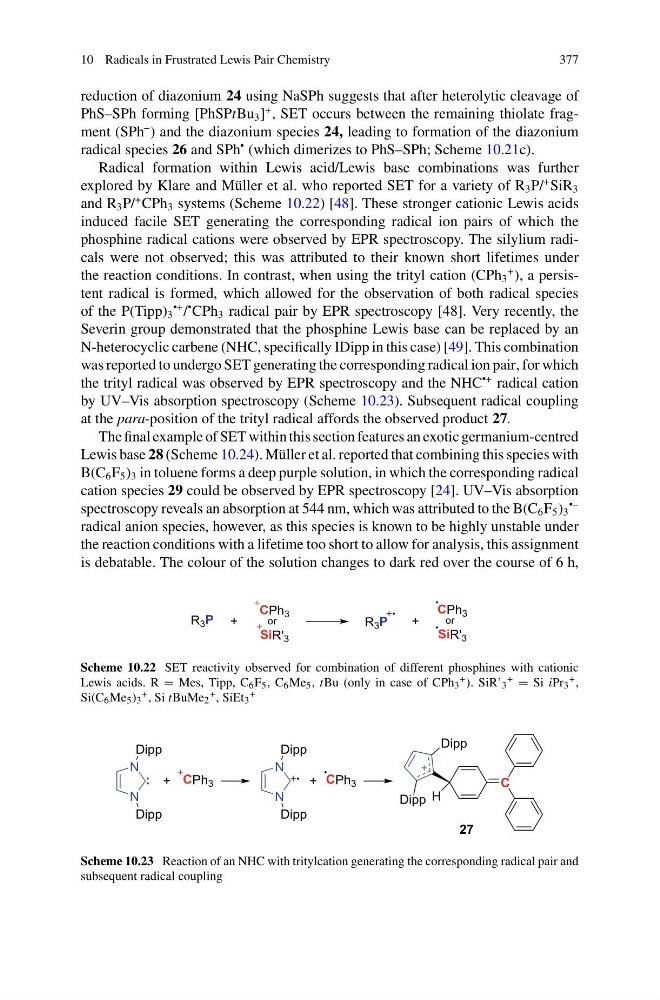
N-heterocyclic carbene (NHC, specifically IDipp in this case) [49]. This combination
was reported to undergo SET generating the corresponding radical ion pair, for which
the trityl radical was observed by EPR spectroscopy and the NHC
•+ radical cation
by UV–Vis absorption spectroscopy (Scheme 10.23). Subsequent radical coupling
at the para-position of the trityl radical affords the observed product 27.
The final example of SET within this section features an exotic germanium-centred
Lewis base 28 (Scheme 10.24). Müller et al. reported that combining this species with
B(C 6 F 5 ) 3 in toluene forms a deep purple solution, in which the corresponding radical
cation species 29 could be observed by EPR spectroscopy [24]. UV–Vis absorption
spectroscopy reveals an absorption at 544 nm, which was attributed to the B(C 6 F 5 ) 3
•–
radical anion species, however, as this species is known to be highly unstable under
the reaction conditions with a lifetime too short to allow for analysis, this assignment
is debatable. The colour of the solution changes to dark red over the course of 6 h,
R 3 P
CPh 3
SiR' 3
R 3 P
+
+
or
CPh 3
SiR' 3
or
Scheme 10.22 SET reactivity observed for combination of different phosphines with cationic
Lewis acids. R = Mes, Tipp, C 6 F 5 , C 6 Me 5 , tBu (only in case of CPh 3
+ ). SiR’ 3
+ = Si iPr 3
+ ,
Si(C 6 Me 5 ) 3
+ , Si tBuMe 2
+ , SiEt 3
+
+
+
CPh 3
CPh 3
N
N
Dipp
Dipp
N
N
Dipp
Dipp
C
H
Dipp
Dipp
27
Scheme 10.23 Reaction of an NHC with tritylcation generating the corresponding radical pair and
subsequent radical coupling
377
reduction of diazonium 24 using NaSPh suggests that after heterolytic cleavage of
PhS–SPh forming [PhSPtBu 3 ]
+ , SET occurs between the remaining thiolate fragment (SPh
– ) and the diazonium species 24, leading to formation of the diazonium
radical species 26 and SPh
• (which dimerizes to PhS–SPh; Scheme 10.21c).
Radical formation within Lewis acid/Lewis base combinations was further
explored by Klare and Müller et al. who reported SET for a variety of R 3 P/
+ SiR 3
and R 3 P/
+ CPh 3 systems (Scheme 10.22) [48]. These stronger cationic Lewis acids
induced facile SET generating the corresponding radical ion pairs of which the
phosphine radical cations were observed by EPR spectroscopy. The silylium radicals were not observed; this was attributed to their known short lifetimes under
the reaction conditions. In contrast, when using the trityl cation (CPh 3
+ ), a persistent radical is formed, which allowed for the observation of both radical species
of the P(Tipp) 3
•+ /
• CPh 3 radical pair by EPR spectroscopy [48]. Very recently, the
Severin group demonstrated that the phosphine Lewis base can be replaced by an
N-heterocyclic carbene (NHC, specifically IDipp in this case) [49]. This combination
was reported to undergo SET generating the corresponding radical ion pair, for which
the trityl radical was observed by EPR spectroscopy and the NHC
•+ radical cation
by UV–Vis absorption spectroscopy (Scheme 10.23). Subsequent radical coupling
at the para-position of the trityl radical affords the observed product 27.
The final example of SET within this section features an exotic germanium-centred
Lewis base 28 (Scheme 10.24). Müller et al. reported that combining this species with
B(C 6 F 5 ) 3 in toluene forms a deep purple solution, in which the corresponding radical
cation species 29 could be observed by EPR spectroscopy [24]. UV–Vis absorption
spectroscopy reveals an absorption at 544 nm, which was attributed to the B(C 6 F 5 ) 3
•–
radical anion species, however, as this species is known to be highly unstable under
the reaction conditions with a lifetime too short to allow for analysis, this assignment
is debatable. The colour of the solution changes to dark red over the course of 6 h,
R 3 P
CPh 3
SiR' 3
R 3 P
+
+
or
CPh 3
SiR' 3
or
Scheme 10.22 SET reactivity observed for combination of different phosphines with cationic
Lewis acids. R = Mes, Tipp, C 6 F 5 , C 6 Me 5 , tBu (only in case of CPh 3
+ ). SiR’ 3
+ = Si iPr 3
+ ,
Si(C 6 Me 5 ) 3
+ , Si tBuMe 2
+ , SiEt 3
+
+
+
CPh 3
CPh 3
N
N
Dipp
Dipp
N
N
Dipp
Dipp
C
H
Dipp
Dipp
27
Scheme 10.23 Reaction of an NHC with tritylcation generating the corresponding radical pair and
subsequent radical coupling