

376
F. Holtrop et al.
Cl
Cl
Cl
Cl
O
O
Cl
Cl
Cl
Cl
O
O
B(C 6 F 5 ) 3
Cl
Cl
Cl
Cl
O
O
B(C 6 F 5 ) 3
Cl
Cl
Cl
Cl
O
O
B(C 6 F 5 ) 3
Cl
Cl
Cl
Cl
O
O
B(C 6 F 5 ) 3
B
( C
6
F
5
) 3
PMes 3
PMes 3
Cl
Cl
Cl
Cl
O
O
B(C 6 F 5 ) 3
B(C 6 F 5 ) 3
2 PMes 3
- B
( C
6
F
5
) 3
B
( C
6
F
5
) 3
- B
( C
6
F
5
) 3
PMes 3
B(C 6 F 5 ) 3
E A = 4.45 eV
E A = 5.57 eV
B(C 6 F 5 ) 3
-B(C 6 F 5 ) 3
PMes 3
PMes 3
B(C 6 F 5 ) 3
Cl
Cl
Cl
Cl
O
O
B(C 6 F 5 ) 3
PMes 3
+ TCQ
- TCQ
Cl
Cl
Cl
Cl
O
O
B(C 6 F 5 ) 3
2 PMes 3
2
radical
coupling
radical
coupling
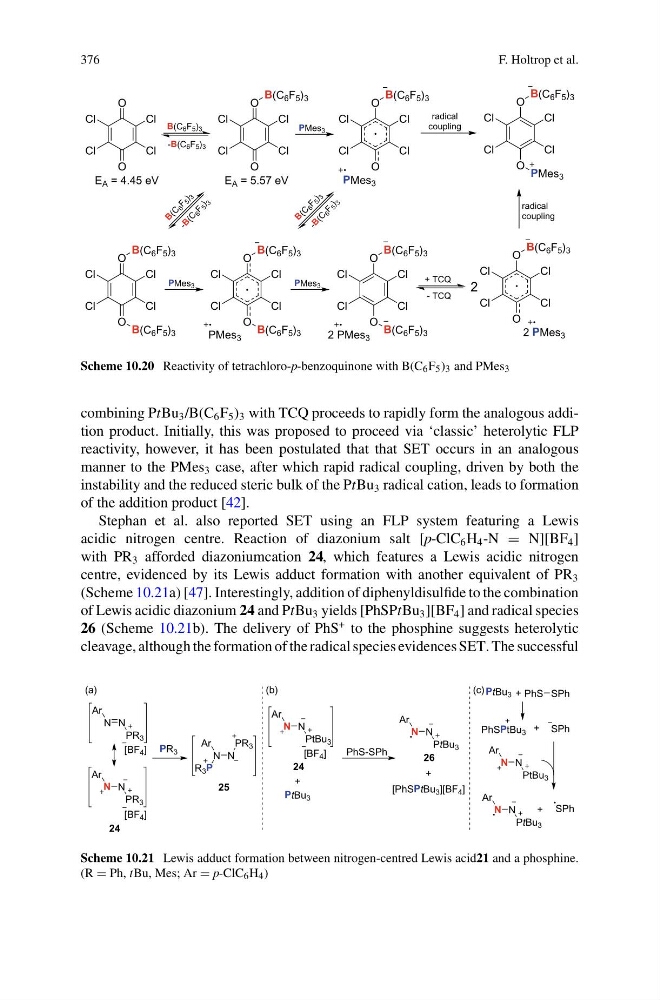
Scheme 10.20 Reactivity of tetrachloro-p-benzoquinone with B(C 6 F 5 ) 3 and PMes 3
combining PtBu 3 /B(C 6 F 5 ) 3 with TCQ proceeds to rapidly form the analogous addition product. Initially, this was proposed to proceed via ‘classic’ heterolytic FLP
reactivity, however, it has been postulated that that SET occurs in an analogous
manner to the PMes 3 case, after which rapid radical coupling, driven by both the
instability and the reduced steric bulk of the PtBu 3 radical cation, leads to formation
of the addition product [42].
Stephan et al. also reported SET using an FLP system featuring a Lewis
acidic nitrogen centre. Reaction of diazonium salt [p-ClC 6 H 4 -N = N][BF 4 ]
with PR 3 afforded diazoniumcation 24, which features a Lewis acidic nitrogen
centre, evidenced by its Lewis adduct formation with another equivalent of PR 3
(Scheme 10.21a) [47]. Interestingly, addition of diphenyldisulfide to the combination
of Lewis acidic diazonium 24 and PtBu 3 yields [PhSPtBu 3 ][BF 4 ] and radical species
26 (Scheme 10.21b). The delivery of PhS
+ to the phosphine suggests heterolytic
cleavage, although the formation of the radical species evidences SET. The successful
N N
Ar
PR 3
N N
Ar
PR 3
N N
Ar
R 3 P
PR 3
[BF 4 ]
[BF 4 ]
PR 3
N N
Ar
PtBu 3
[BF 4 ]
PhS-SPh
+
PtBu 3
N N
Ar
PtBu 3
[PhSPtBu 3 ][BF 4 ]
+
(a)
(b)
(c) PtBu 3 PhS SPh
PhSPtBu 3
SPh
N N
Ar
PtBu 3
+
+
N N
Ar
PtBu 3
+ SPh
25
24
26
24
Scheme 10.21 Lewis adduct formation between nitrogen-centred Lewis acid21 and a phosphine.
(R = Ph, tBu, Mes; Ar = p-ClC 6 H 4 )
F. Holtrop et al.
Cl
Cl
Cl
Cl
O
O
Cl
Cl
Cl
Cl
O
O
B(C 6 F 5 ) 3
Cl
Cl
Cl
Cl
O
O
B(C 6 F 5 ) 3
Cl
Cl
Cl
Cl
O
O
B(C 6 F 5 ) 3
Cl
Cl
Cl
Cl
O
O
B(C 6 F 5 ) 3
B
( C
6
F
5
) 3
PMes 3
PMes 3
Cl
Cl
Cl
Cl
O
O
B(C 6 F 5 ) 3
B(C 6 F 5 ) 3
2 PMes 3
- B
( C
6
F
5
) 3
B
( C
6
F
5
) 3
- B
( C
6
F
5
) 3
PMes 3
B(C 6 F 5 ) 3
E A = 4.45 eV
E A = 5.57 eV
B(C 6 F 5 ) 3
-B(C 6 F 5 ) 3
PMes 3
PMes 3
B(C 6 F 5 ) 3
Cl
Cl
Cl
Cl
O
O
B(C 6 F 5 ) 3
PMes 3
+ TCQ
- TCQ
Cl
Cl
Cl
Cl
O
O
B(C 6 F 5 ) 3
2 PMes 3
2
radical
coupling
radical
coupling
Scheme 10.20 Reactivity of tetrachloro-p-benzoquinone with B(C 6 F 5 ) 3 and PMes 3
combining PtBu 3 /B(C 6 F 5 ) 3 with TCQ proceeds to rapidly form the analogous addition product. Initially, this was proposed to proceed via ‘classic’ heterolytic FLP
reactivity, however, it has been postulated that that SET occurs in an analogous
manner to the PMes 3 case, after which rapid radical coupling, driven by both the
instability and the reduced steric bulk of the PtBu 3 radical cation, leads to formation
of the addition product [42].
Stephan et al. also reported SET using an FLP system featuring a Lewis
acidic nitrogen centre. Reaction of diazonium salt [p-ClC 6 H 4 -N = N][BF 4 ]
with PR 3 afforded diazoniumcation 24, which features a Lewis acidic nitrogen
centre, evidenced by its Lewis adduct formation with another equivalent of PR 3
(Scheme 10.21a) [47]. Interestingly, addition of diphenyldisulfide to the combination
of Lewis acidic diazonium 24 and PtBu 3 yields [PhSPtBu 3 ][BF 4 ] and radical species
26 (Scheme 10.21b). The delivery of PhS
+ to the phosphine suggests heterolytic
cleavage, although the formation of the radical species evidences SET. The successful
N N
Ar
PR 3
N N
Ar
PR 3
N N
Ar
R 3 P
PR 3
[BF 4 ]
[BF 4 ]
PR 3
N N
Ar
PtBu 3
[BF 4 ]
PhS-SPh
+
PtBu 3
N N
Ar
PtBu 3
[PhSPtBu 3 ][BF 4 ]
+
(a)
(b)
(c) PtBu 3 PhS SPh
PhSPtBu 3
SPh
N N
Ar
PtBu 3
+
+
N N
Ar
PtBu 3
+ SPh
25
24
26
24
Scheme 10.21 Lewis adduct formation between nitrogen-centred Lewis acid21 and a phosphine.
(R = Ph, tBu, Mes; Ar = p-ClC 6 H 4 )