

10 Radicals in Frustrated Lewis Pair Chemistry
375
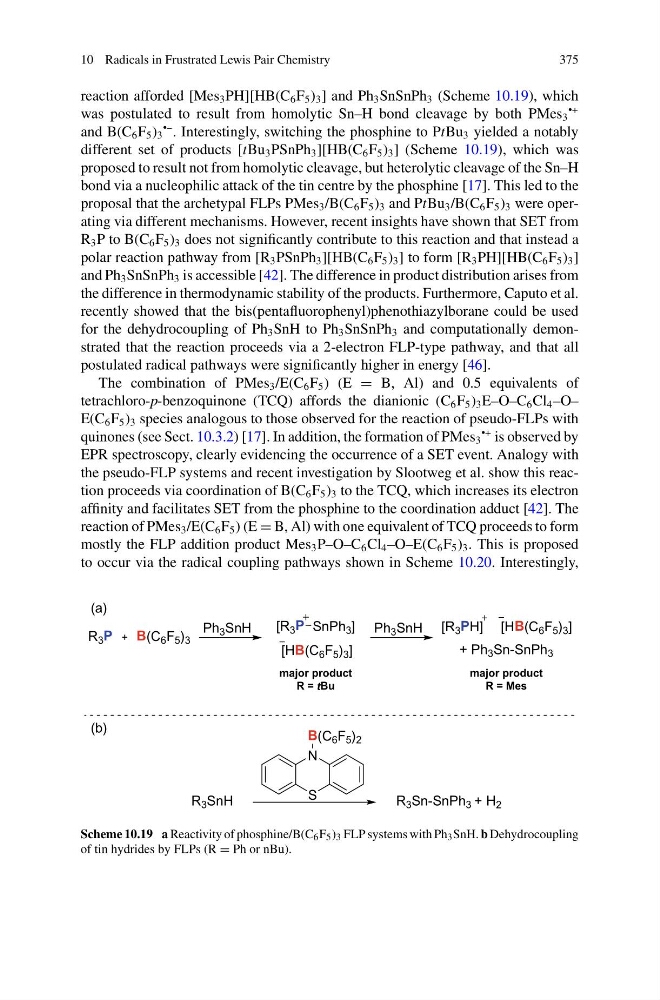
reaction afforded [Mes 3 PH][HB(C 6 F 5 ) 3 ] and Ph 3 SnSnPh 3 (Scheme 10.19), which
was postulated to result from homolytic Sn–H bond cleavage by both PMes 3
•+
and B(C 6 F 5 ) 3
•– . Interestingly, switching the phosphine to PtBu 3 yielded a notably
different set of products [tBu 3 PSnPh 3 ][HB(C 6 F 5 ) 3 ] (Scheme 10.19), which was
proposed to result not from homolytic cleavage, but heterolytic cleavage of the Sn–H
bond via a nucleophilic attack of the tin centre by the phosphine [17]. This led to the
proposal that the archetypal FLPs PMes 3 /B(C 6 F 5 ) 3 and PtBu 3 /B(C 6 F 5 ) 3 were operating via different mechanisms. However, recent insights have shown that SET from
R 3 P to B(C 6 F 5 ) 3 does not significantly contribute to this reaction and that instead a
polar reaction pathway from [R 3 PSnPh 3 ][HB(C 6 F 5 ) 3 ] to form [R 3 PH][HB(C 6 F 5 ) 3 ]
and Ph 3 SnSnPh 3 is accessible [42]. The difference in product distribution arises from
the difference in thermodynamic stability of the products. Furthermore, Caputo et al.
recently showed that the bis(pentafluorophenyl)phenothiazylborane could be used
for the dehydrocoupling of Ph 3 SnH to Ph 3 SnSnPh 3 and computationally demonstrated that the reaction proceeds via a 2-electron FLP-type pathway, and that all
postulated radical pathways were significantly higher in energy [46].
The combination of PMes 3 /E(C 6 F 5 ) (E = B, Al) and 0.5 equivalents of
tetrachloro-p-benzoquinone (TCQ) affords the dianionic (C 6 F 5 ) 3 E–O–C 6 Cl 4 –O–
E(C 6 F 5 ) 3 species analogous to those observed for the reaction of pseudo-FLPs with
quinones (see Sect. 10.3.2) [17]. In addition, the formation of PMes 3
•+ is observed by
EPR spectroscopy, clearly evidencing the occurrence of a SET event. Analogy with
the pseudo-FLP systems and recent investigation by Slootweg et al. show this reaction proceeds via coordination of B(C 6 F 5 ) 3 to the TCQ, which increases its electron
affinity and facilitates SET from the phosphine to the coordination adduct [42]. The
reaction of PMes 3 /E(C 6 F 5 ) (E = B, Al) with one equivalent of TCQ proceeds to form
mostly the FLP addition product Mes 3 P–O–C 6 Cl 4 –O–E(C 6 F 5 ) 3 . This is proposed
to occur via the radical coupling pathways shown in Scheme 10.20. Interestingly,
R 3 P
B(C 6 F 5 ) 3
Ph 3 SnH
+
[R 3 P SnPh 3 ]
[HB(C 6 F 5 ) 3 ]
+ Ph 3 Sn-SnPh 3
[HB(C 6 F 5 ) 3 ]
[R 3 PH]
Ph 3 SnH
major product
R = tBu
major product
R = Mes
R 3 SnH
R 3 Sn-SnPh 3
B(C 6 F 5 ) 2
N
S
+ H 2
(a)
(b)
Scheme 10.19 a Reactivity of phosphine/B(C 6 F 5 ) 3 FLP systems with Ph 3 SnH. b Dehydrocoupling
of tin hydrides by FLPs (R = Ph or nBu).
375
reaction afforded [Mes 3 PH][HB(C 6 F 5 ) 3 ] and Ph 3 SnSnPh 3 (Scheme 10.19), which
was postulated to result from homolytic Sn–H bond cleavage by both PMes 3
•+
and B(C 6 F 5 ) 3
•– . Interestingly, switching the phosphine to PtBu 3 yielded a notably
different set of products [tBu 3 PSnPh 3 ][HB(C 6 F 5 ) 3 ] (Scheme 10.19), which was
proposed to result not from homolytic cleavage, but heterolytic cleavage of the Sn–H
bond via a nucleophilic attack of the tin centre by the phosphine [17]. This led to the
proposal that the archetypal FLPs PMes 3 /B(C 6 F 5 ) 3 and PtBu 3 /B(C 6 F 5 ) 3 were operating via different mechanisms. However, recent insights have shown that SET from
R 3 P to B(C 6 F 5 ) 3 does not significantly contribute to this reaction and that instead a
polar reaction pathway from [R 3 PSnPh 3 ][HB(C 6 F 5 ) 3 ] to form [R 3 PH][HB(C 6 F 5 ) 3 ]
and Ph 3 SnSnPh 3 is accessible [42]. The difference in product distribution arises from
the difference in thermodynamic stability of the products. Furthermore, Caputo et al.
recently showed that the bis(pentafluorophenyl)phenothiazylborane could be used
for the dehydrocoupling of Ph 3 SnH to Ph 3 SnSnPh 3 and computationally demonstrated that the reaction proceeds via a 2-electron FLP-type pathway, and that all
postulated radical pathways were significantly higher in energy [46].
The combination of PMes 3 /E(C 6 F 5 ) (E = B, Al) and 0.5 equivalents of
tetrachloro-p-benzoquinone (TCQ) affords the dianionic (C 6 F 5 ) 3 E–O–C 6 Cl 4 –O–
E(C 6 F 5 ) 3 species analogous to those observed for the reaction of pseudo-FLPs with
quinones (see Sect. 10.3.2) [17]. In addition, the formation of PMes 3
•+ is observed by
EPR spectroscopy, clearly evidencing the occurrence of a SET event. Analogy with
the pseudo-FLP systems and recent investigation by Slootweg et al. show this reaction proceeds via coordination of B(C 6 F 5 ) 3 to the TCQ, which increases its electron
affinity and facilitates SET from the phosphine to the coordination adduct [42]. The
reaction of PMes 3 /E(C 6 F 5 ) (E = B, Al) with one equivalent of TCQ proceeds to form
mostly the FLP addition product Mes 3 P–O–C 6 Cl 4 –O–E(C 6 F 5 ) 3 . This is proposed
to occur via the radical coupling pathways shown in Scheme 10.20. Interestingly,
R 3 P
B(C 6 F 5 ) 3
Ph 3 SnH
+
[R 3 P SnPh 3 ]
[HB(C 6 F 5 ) 3 ]
+ Ph 3 Sn-SnPh 3
[HB(C 6 F 5 ) 3 ]
[R 3 PH]
Ph 3 SnH
major product
R = tBu
major product
R = Mes
R 3 SnH
R 3 Sn-SnPh 3
B(C 6 F 5 ) 2
N
S
+ H 2
(a)
(b)
Scheme 10.19 a Reactivity of phosphine/B(C 6 F 5 ) 3 FLP systems with Ph 3 SnH. b Dehydrocoupling
of tin hydrides by FLPs (R = Ph or nBu).