

374
F. Holtrop et al.
10.4 Single-Electron Transfer Within Frustrated Lewis
Pair Systems
Radicals can be generated within frustrated Lewis pair systems through SET from
the Lewis base to the Lewis acid. This leads to formation of the corresponding radical
ion pair. This section explores examples of this phenomenon and aims to provide
an understanding of when SET occurs. Furthermore, this section analyses the nature
of the radical ion pairs and discusses recent developments of their application in
synthesis.
10.4.1 SET to Generate Radical Ion Pairs
In 2013, Wang et al. reported B(C 6 F 5 ) 3 reacting as a single-electron oxidant when
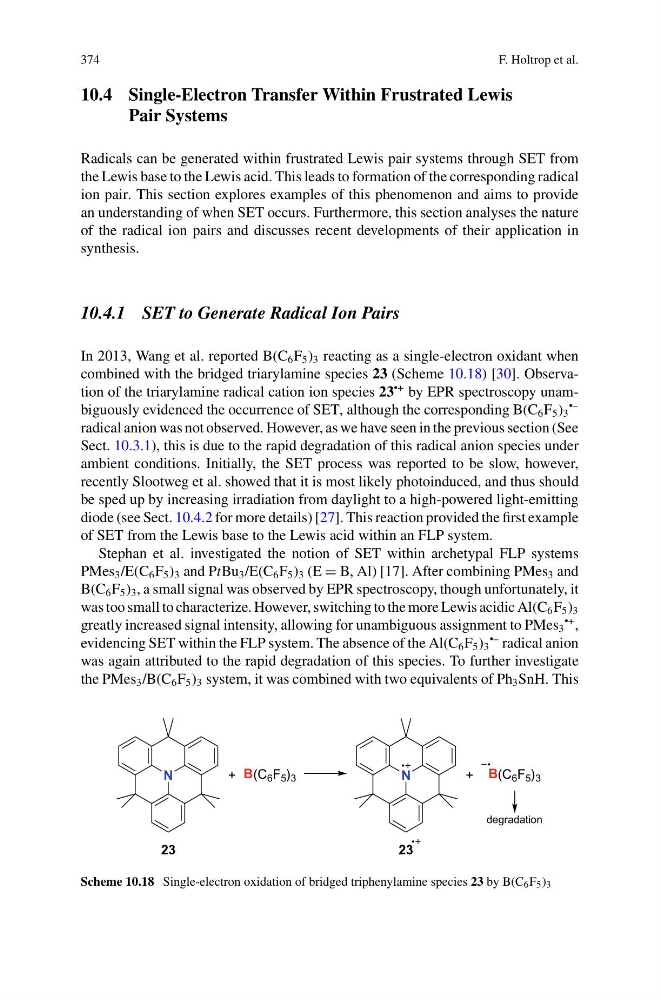
combined with the bridged triarylamine species 23 (Scheme 10.18) [30]. Observation of the triarylamine radical cation ion species 23
•+ by EPR spectroscopy unambiguously evidenced the occurrence of SET, although the corresponding B(C 6 F 5 ) 3
•–
radical anion was not observed. However, as we have seen in the previous section (See
Sect. 10.3.1), this is due to the rapid degradation of this radical anion species under
ambient conditions. Initially, the SET process was reported to be slow, however,
recently Slootweg et al. showed that it is most likely photoinduced, and thus should
be sped up by increasing irradiation from daylight to a high-powered light-emitting
diode (see Sect. 10.4.2 for more details) [27]. This reaction provided the first example
of SET from the Lewis base to the Lewis acid within an FLP system.
Stephan et al. investigated the notion of SET within archetypal FLP systems
PMes 3 /E(C 6 F 5 ) 3 and PtBu 3 /E(C 6 F 5 ) 3 (E = B, Al) [17]. After combining PMes 3 and
B(C 6 F 5 ) 3 , a small signal was observed by EPR spectroscopy, though unfortunately, it
was too small to characterize. However, switching to the more Lewis acidic Al(C 6 F 5 ) 3
greatly increased signal intensity, allowing for unambiguous assignment to PMes 3
•+ ,
evidencing SET within the FLP system. The absence of the Al(C 6 F 5 ) 3
•– radical anion
was again attributed to the rapid degradation of this species. To further investigate
the PMes 3 /B(C 6 F 5 ) 3 system, it was combined with two equivalents of Ph 3 SnH. This
N
B(C 6 F 5 ) 3
+
N
B(C 6 F 5 ) 3
+
degradation
23
23
Scheme 10.18 Single-electron oxidation of bridged triphenylamine species 23 by B(C 6 F 5 ) 3
F. Holtrop et al.
10.4 Single-Electron Transfer Within Frustrated Lewis
Pair Systems
Radicals can be generated within frustrated Lewis pair systems through SET from
the Lewis base to the Lewis acid. This leads to formation of the corresponding radical
ion pair. This section explores examples of this phenomenon and aims to provide
an understanding of when SET occurs. Furthermore, this section analyses the nature
of the radical ion pairs and discusses recent developments of their application in
synthesis.
10.4.1 SET to Generate Radical Ion Pairs
In 2013, Wang et al. reported B(C 6 F 5 ) 3 reacting as a single-electron oxidant when
combined with the bridged triarylamine species 23 (Scheme 10.18) [30]. Observation of the triarylamine radical cation ion species 23
•+ by EPR spectroscopy unambiguously evidenced the occurrence of SET, although the corresponding B(C 6 F 5 ) 3
•–
radical anion was not observed. However, as we have seen in the previous section (See
Sect. 10.3.1), this is due to the rapid degradation of this radical anion species under
ambient conditions. Initially, the SET process was reported to be slow, however,
recently Slootweg et al. showed that it is most likely photoinduced, and thus should
be sped up by increasing irradiation from daylight to a high-powered light-emitting
diode (see Sect. 10.4.2 for more details) [27]. This reaction provided the first example
of SET from the Lewis base to the Lewis acid within an FLP system.
Stephan et al. investigated the notion of SET within archetypal FLP systems
PMes 3 /E(C 6 F 5 ) 3 and PtBu 3 /E(C 6 F 5 ) 3 (E = B, Al) [17]. After combining PMes 3 and
B(C 6 F 5 ) 3 , a small signal was observed by EPR spectroscopy, though unfortunately, it
was too small to characterize. However, switching to the more Lewis acidic Al(C 6 F 5 ) 3
greatly increased signal intensity, allowing for unambiguous assignment to PMes 3
•+ ,
evidencing SET within the FLP system. The absence of the Al(C 6 F 5 ) 3
•– radical anion
was again attributed to the rapid degradation of this species. To further investigate
the PMes 3 /B(C 6 F 5 ) 3 system, it was combined with two equivalents of Ph 3 SnH. This
N
B(C 6 F 5 ) 3
+
N
B(C 6 F 5 ) 3
+
degradation
23
23
Scheme 10.18 Single-electron oxidation of bridged triphenylamine species 23 by B(C 6 F 5 ) 3