

10 Radicals in Frustrated Lewis Pair Chemistry
373
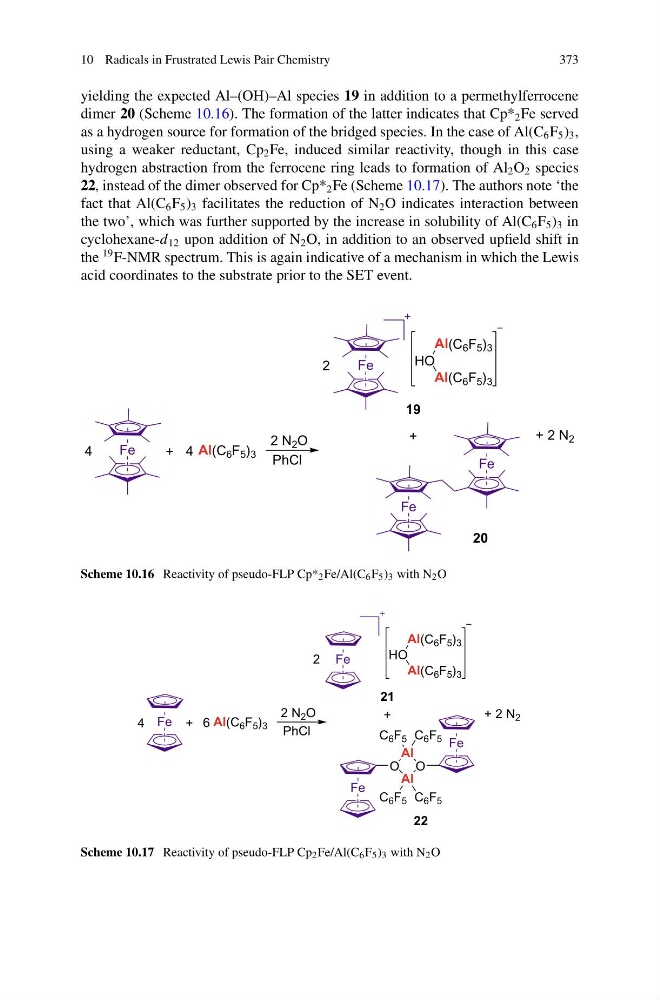
yielding the expected Al–(OH)–Al species 19 in addition to a permethylferrocene
dimer 20 (Scheme 10.16). The formation of the latter indicates that Cp* 2 Fe served
as a hydrogen source for formation of the bridged species. In the case of Al(C 6 F 5 ) 3 ,
using a weaker reductant, Cp 2 Fe, induced similar reactivity, though in this case
hydrogen abstraction from the ferrocene ring leads to formation of Al 2 O 2 species
22, instead of the dimer observed for Cp* 2 Fe (Scheme 10.17). The authors note ‘the
fact that Al(C 6 F 5 ) 3 facilitates the reduction of N 2 O indicates interaction between
the two’, which was further supported by the increase in solubility of Al(C 6 F 5 ) 3 in
cyclohexane-d 12 upon addition of N 2 O, in addition to an observed upfield shift in
the
19 F-NMR spectrum. This is again indicative of a mechanism in which the Lewis
acid coordinates to the substrate prior to the SET event.
Fe
Fe
Fe
Fe
Al(C 6 F 5 ) 3 PhCl
+
2 N 2 O
Al(C 6 F 5 ) 3
HO
Al(C 6 F 5 ) 3
+
20
4
2
4
+ 2 N 2
19
Scheme 10.16 Reactivity of pseudo-FLP Cp* 2 Fe/Al(C 6 F 5 ) 3 with N 2 O
Fe
Fe
Fe
Fe
Al(C 6 F 5 ) 3 PhCl
+
2 N 2 O
Al(C 6 F 5 ) 3
HO
Al(C 6 F 5 ) 3
+
O
Al
O
Al
C 6 F 5 C 6 F 5
C 6 F 5 C 6 F 5
+ 2 N 2
4
6
2
22
21
Scheme 10.17 Reactivity of pseudo-FLP Cp 2 Fe/Al(C 6 F 5 ) 3 with N 2 O
373
yielding the expected Al–(OH)–Al species 19 in addition to a permethylferrocene
dimer 20 (Scheme 10.16). The formation of the latter indicates that Cp* 2 Fe served
as a hydrogen source for formation of the bridged species. In the case of Al(C 6 F 5 ) 3 ,
using a weaker reductant, Cp 2 Fe, induced similar reactivity, though in this case
hydrogen abstraction from the ferrocene ring leads to formation of Al 2 O 2 species
22, instead of the dimer observed for Cp* 2 Fe (Scheme 10.17). The authors note ‘the
fact that Al(C 6 F 5 ) 3 facilitates the reduction of N 2 O indicates interaction between
the two’, which was further supported by the increase in solubility of Al(C 6 F 5 ) 3 in
cyclohexane-d 12 upon addition of N 2 O, in addition to an observed upfield shift in
the
19 F-NMR spectrum. This is again indicative of a mechanism in which the Lewis
acid coordinates to the substrate prior to the SET event.
Fe
Fe
Fe
Fe
Al(C 6 F 5 ) 3 PhCl
+
2 N 2 O
Al(C 6 F 5 ) 3
HO
Al(C 6 F 5 ) 3
+
20
4
2
4
+ 2 N 2
19
Scheme 10.16 Reactivity of pseudo-FLP Cp* 2 Fe/Al(C 6 F 5 ) 3 with N 2 O
Fe
Fe
Fe
Fe
Al(C 6 F 5 ) 3 PhCl
+
2 N 2 O
Al(C 6 F 5 ) 3
HO
Al(C 6 F 5 ) 3
+
O
Al
O
Al
C 6 F 5 C 6 F 5
C 6 F 5 C 6 F 5
+ 2 N 2
4
6
2
22
21
Scheme 10.17 Reactivity of pseudo-FLP Cp 2 Fe/Al(C 6 F 5 ) 3 with N 2 O