

372
F. Holtrop et al.
leads to the possibility that SET directly from Cp* 2 Fe to this interaction complex
could induce homolytic Sn–H bond cleavage to form the observed products, thus
circumventing formation of the highly unstable B(C 6 F 5 ) 3
•– radical anion. Combining
Cp* 2 Fe/B(C 6 F 5 ) 3 (1:2) with TEMPO yields the expected formal addition product of
B(C 6 F 5 ) 3
•– to the TEMPO radical trap (Scheme 10.14b). It is noteworthy that TEMPO
is known to coordinate to B(C 6 F 5 ) 3 [43], and so it is again possible that this occurs
prior to SET, leading to reduction of the TEMPO–B(C 6 F 5 ) 3 complex, rather than
of B(C 6 F 5 ) 3 . Fortunately, the reaction of Cp* 2 Fe/B(C 6 F 5 ) 3 with p-benzoquinone,
which is also known to coordinate to B(C 6 F 5 ) 3 , provides some valuable insight.
Stephan et al. reported that combining these reagents in a 2:2:1 ratio leads to the
formation of the expected dianionic B–(O–C 6 H 4 –O)–B species (Scheme 10.14c)
[17]. Interestingly, Erker et al. demonstrated that using a 1:2:1 ratio yields the analogous radical anion species, featuring both B(C 6 F 5 ) 3 moieties strongly bound to the
p-benzoquinone (Scheme 10.14d) [44]. In addition, they reported that for a variety
of different quinone species, coordination to two equivalents of B(C 6 F 5 ) 3 leads to
a significant shift in redox potentials, which facilitates SET from a range of donors
(Cp* 2 Fe,
• CPh 3 , TEMPO) [44]. This supports the notion that the highly unstable
B(C 6 F 5 ) 3
•– is not an intermediate in the pseudo-FLP-type reactivity, but rather that
B(C 6 F 5 ) 3 coordination to the substrate facilitates the reduction of the resulting adduct.
Pseudo-FLP-type reactivity was also exploited by the Severin group, who demonstrated that this could be harnessed to react with N 2 O [45]. As seen in Sect. 10.2.1,
N 2 O can undergo N–O bond scission to liberate N 2 and formally generate an
oxyl radical anion O
•– . This process is known to be induced by single-electron
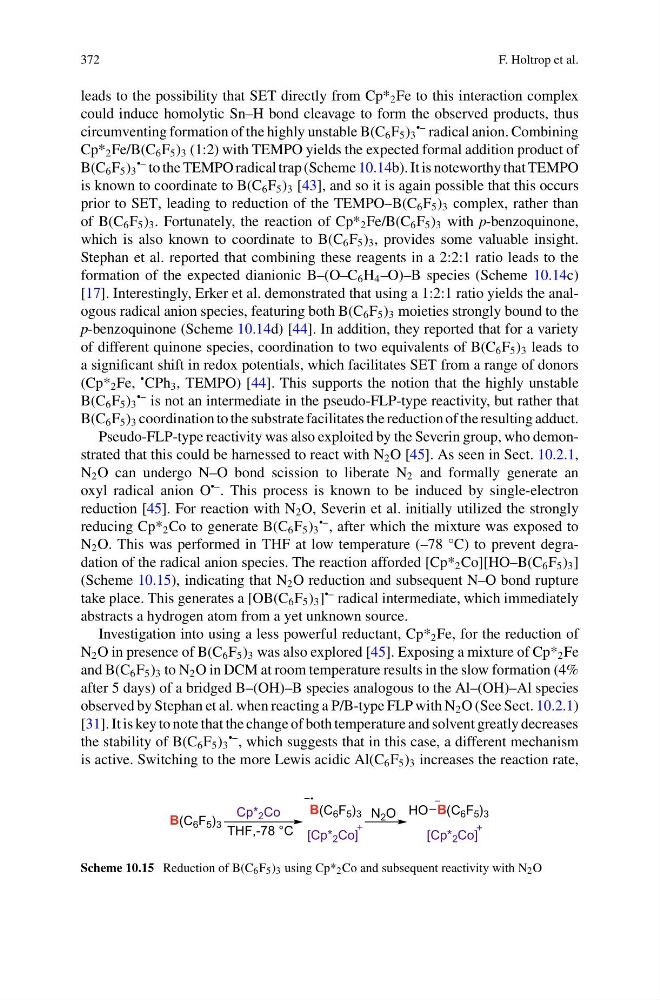
reduction [45]. For reaction with N 2 O, Severin et al. initially utilized the strongly
reducing Cp* 2 Co to generate B(C 6 F 5 ) 3
•– , after which the mixture was exposed to
N 2 O. This was performed in THF at low temperature (–78 °C) to prevent degradation of the radical anion species. The reaction afforded [Cp* 2 Co][HO–B(C 6 F 5 ) 3 ]
(Scheme 10.15), indicating that N 2 O reduction and subsequent N–O bond rupture
take place. This generates a [OB(C 6 F 5 ) 3 ]
•– radical intermediate, which immediately
abstracts a hydrogen atom from a yet unknown source.
Investigation into using a less powerful reductant, Cp* 2 Fe, for the reduction of
N 2 O in presence of B(C 6 F 5 ) 3 was also explored [45]. Exposing a mixture of Cp* 2 Fe
and B(C 6 F 5 ) 3 to N 2 O in DCM at room temperature results in the slow formation (4%
after 5 days) of a bridged B–(OH)–B species analogous to the Al–(OH)–Al species
observed by Stephan et al. when reacting a P/B-type FLP with N 2 O (See Sect. 10.2.1)
[31]. It is key to note that the change of both temperature and solvent greatly decreases
the stability of B(C 6 F 5 ) 3
•– , which suggests that in this case, a different mechanism
is active. Switching to the more Lewis acidic Al(C 6 F 5 ) 3 increases the reaction rate,
B(C 6 F 5 ) 3
Cp* 2 Co
THF,-78 °C
B(C 6 F 5 ) 3
[Cp* 2 Co]
B(C 6 F 5 ) 3
[Cp* 2 Co]
N 2 O HO
Scheme 10.15 Reduction of B(C 6 F 5 ) 3 using Cp* 2 Co and subsequent reactivity with N 2 O
F. Holtrop et al.
leads to the possibility that SET directly from Cp* 2 Fe to this interaction complex
could induce homolytic Sn–H bond cleavage to form the observed products, thus
circumventing formation of the highly unstable B(C 6 F 5 ) 3
•– radical anion. Combining
Cp* 2 Fe/B(C 6 F 5 ) 3 (1:2) with TEMPO yields the expected formal addition product of
B(C 6 F 5 ) 3
•– to the TEMPO radical trap (Scheme 10.14b). It is noteworthy that TEMPO
is known to coordinate to B(C 6 F 5 ) 3 [43], and so it is again possible that this occurs
prior to SET, leading to reduction of the TEMPO–B(C 6 F 5 ) 3 complex, rather than
of B(C 6 F 5 ) 3 . Fortunately, the reaction of Cp* 2 Fe/B(C 6 F 5 ) 3 with p-benzoquinone,
which is also known to coordinate to B(C 6 F 5 ) 3 , provides some valuable insight.
Stephan et al. reported that combining these reagents in a 2:2:1 ratio leads to the
formation of the expected dianionic B–(O–C 6 H 4 –O)–B species (Scheme 10.14c)
[17]. Interestingly, Erker et al. demonstrated that using a 1:2:1 ratio yields the analogous radical anion species, featuring both B(C 6 F 5 ) 3 moieties strongly bound to the
p-benzoquinone (Scheme 10.14d) [44]. In addition, they reported that for a variety
of different quinone species, coordination to two equivalents of B(C 6 F 5 ) 3 leads to
a significant shift in redox potentials, which facilitates SET from a range of donors
(Cp* 2 Fe,
• CPh 3 , TEMPO) [44]. This supports the notion that the highly unstable
B(C 6 F 5 ) 3
•– is not an intermediate in the pseudo-FLP-type reactivity, but rather that
B(C 6 F 5 ) 3 coordination to the substrate facilitates the reduction of the resulting adduct.
Pseudo-FLP-type reactivity was also exploited by the Severin group, who demonstrated that this could be harnessed to react with N 2 O [45]. As seen in Sect. 10.2.1,
N 2 O can undergo N–O bond scission to liberate N 2 and formally generate an
oxyl radical anion O
•– . This process is known to be induced by single-electron
reduction [45]. For reaction with N 2 O, Severin et al. initially utilized the strongly
reducing Cp* 2 Co to generate B(C 6 F 5 ) 3
•– , after which the mixture was exposed to
N 2 O. This was performed in THF at low temperature (–78 °C) to prevent degradation of the radical anion species. The reaction afforded [Cp* 2 Co][HO–B(C 6 F 5 ) 3 ]
(Scheme 10.15), indicating that N 2 O reduction and subsequent N–O bond rupture
take place. This generates a [OB(C 6 F 5 ) 3 ]
•– radical intermediate, which immediately
abstracts a hydrogen atom from a yet unknown source.
Investigation into using a less powerful reductant, Cp* 2 Fe, for the reduction of
N 2 O in presence of B(C 6 F 5 ) 3 was also explored [45]. Exposing a mixture of Cp* 2 Fe
and B(C 6 F 5 ) 3 to N 2 O in DCM at room temperature results in the slow formation (4%
after 5 days) of a bridged B–(OH)–B species analogous to the Al–(OH)–Al species
observed by Stephan et al. when reacting a P/B-type FLP with N 2 O (See Sect. 10.2.1)
[31]. It is key to note that the change of both temperature and solvent greatly decreases
the stability of B(C 6 F 5 ) 3
•– , which suggests that in this case, a different mechanism
is active. Switching to the more Lewis acidic Al(C 6 F 5 ) 3 increases the reaction rate,
B(C 6 F 5 ) 3
Cp* 2 Co
THF,-78 °C
B(C 6 F 5 ) 3
[Cp* 2 Co]
B(C 6 F 5 ) 3
[Cp* 2 Co]
N 2 O HO
Scheme 10.15 Reduction of B(C 6 F 5 ) 3 using Cp* 2 Co and subsequent reactivity with N 2 O