

10 Radicals in Frustrated Lewis Pair Chemistry
367
of the archetypal Lewis acids used in FLP chemistry, B(C 6 F 5 ) 3 and its aluminium
analogue Al(C 6 F 5 ) 3 , using sandwich complexes.
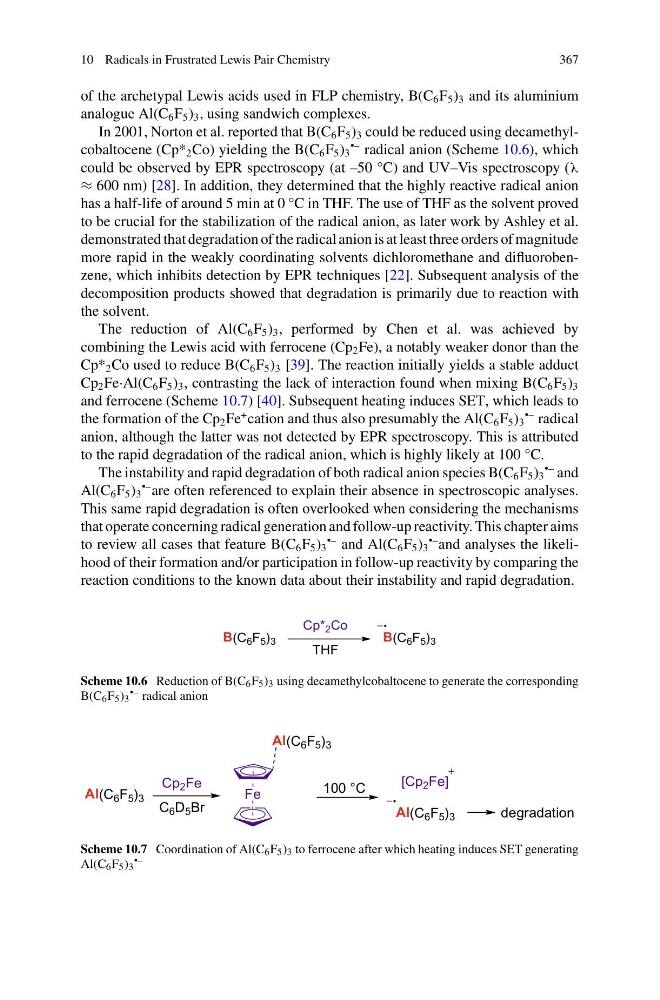
In 2001, Norton et al. reported that B(C 6 F 5 ) 3 could be reduced using decamethylcobaltocene (Cp* 2 Co) yielding the B(C 6 F 5 ) 3
•– radical anion (Scheme 10.6), which
could be observed by EPR spectroscopy (at –50 °C) and UV–Vis spectroscopy (λ
≈ 600 nm) [28]. In addition, they determined that the highly reactive radical anion
has a half-life of around 5 min at 0 °C in THF. The use of THF as the solvent proved
to be crucial for the stabilization of the radical anion, as later work by Ashley et al.
demonstrated that degradation of the radical anion is at least three orders of magnitude
more rapid in the weakly coordinating solvents dichloromethane and difluorobenzene, which inhibits detection by EPR techniques [22]. Subsequent analysis of the
decomposition products showed that degradation is primarily due to reaction with
the solvent.
The reduction of Al(C 6 F 5 ) 3 , performed by Chen et al. was achieved by
combining the Lewis acid with ferrocene (Cp 2 Fe), a notably weaker donor than the
Cp* 2 Co used to reduce B(C 6 F 5 ) 3 [39]. The reaction initially yields a stable adduct
Cp 2 Fe·Al(C 6 F 5 ) 3 , contrasting the lack of interaction found when mixing B(C 6 F 5 ) 3
and ferrocene (Scheme 10.7) [40]. Subsequent heating induces SET, which leads to
the formation of the Cp 2 Fe
+ cation and thus also presumably the Al(C 6 F 5 ) 3
•– radical
anion, although the latter was not detected by EPR spectroscopy. This is attributed
to the rapid degradation of the radical anion, which is highly likely at 100 °C.
The instability and rapid degradation of both radical anion species B(C 6 F 5 ) 3
•– and
Al(C 6 F 5 ) 3
•– are often referenced to explain their absence in spectroscopic analyses.
This same rapid degradation is often overlooked when considering the mechanisms
that operate concerning radical generation and follow-up reactivity. This chapter aims
to review all cases that feature B(C 6 F 5 ) 3
•– and Al(C 6 F 5 ) 3
•– and analyses the likelihood of their formation and/or participation in follow-up reactivity by comparing the
reaction conditions to the known data about their instability and rapid degradation.
B(C 6 F 5 ) 3
Cp* 2 Co
THF
B(C 6 F 5 ) 3
Scheme 10.6 Reduction of B(C 6 F 5 ) 3 using decamethylcobaltocene to generate the corresponding
B(C 6 F 5 ) 3
•– radical anion
Al(C 6 F 5 ) 3
Cp 2 Fe
C 6 D 5 Br
Al(C 6 F 5 ) 3
100 °C
Al(C 6 F 5 ) 3
[Cp 2 Fe]
degradation
Fe
Scheme 10.7 Coordination of Al(C 6 F 5 ) 3 to ferrocene after which heating induces SET generating
Al(C 6 F 5 ) 3
•–
367
of the archetypal Lewis acids used in FLP chemistry, B(C 6 F 5 ) 3 and its aluminium
analogue Al(C 6 F 5 ) 3 , using sandwich complexes.
In 2001, Norton et al. reported that B(C 6 F 5 ) 3 could be reduced using decamethylcobaltocene (Cp* 2 Co) yielding the B(C 6 F 5 ) 3
•– radical anion (Scheme 10.6), which
could be observed by EPR spectroscopy (at –50 °C) and UV–Vis spectroscopy (λ
≈ 600 nm) [28]. In addition, they determined that the highly reactive radical anion
has a half-life of around 5 min at 0 °C in THF. The use of THF as the solvent proved
to be crucial for the stabilization of the radical anion, as later work by Ashley et al.
demonstrated that degradation of the radical anion is at least three orders of magnitude
more rapid in the weakly coordinating solvents dichloromethane and difluorobenzene, which inhibits detection by EPR techniques [22]. Subsequent analysis of the
decomposition products showed that degradation is primarily due to reaction with
the solvent.
The reduction of Al(C 6 F 5 ) 3 , performed by Chen et al. was achieved by
combining the Lewis acid with ferrocene (Cp 2 Fe), a notably weaker donor than the
Cp* 2 Co used to reduce B(C 6 F 5 ) 3 [39]. The reaction initially yields a stable adduct
Cp 2 Fe·Al(C 6 F 5 ) 3 , contrasting the lack of interaction found when mixing B(C 6 F 5 ) 3
and ferrocene (Scheme 10.7) [40]. Subsequent heating induces SET, which leads to
the formation of the Cp 2 Fe
+ cation and thus also presumably the Al(C 6 F 5 ) 3
•– radical
anion, although the latter was not detected by EPR spectroscopy. This is attributed
to the rapid degradation of the radical anion, which is highly likely at 100 °C.
The instability and rapid degradation of both radical anion species B(C 6 F 5 ) 3
•– and
Al(C 6 F 5 ) 3
•– are often referenced to explain their absence in spectroscopic analyses.
This same rapid degradation is often overlooked when considering the mechanisms
that operate concerning radical generation and follow-up reactivity. This chapter aims
to review all cases that feature B(C 6 F 5 ) 3
•– and Al(C 6 F 5 ) 3
•– and analyses the likelihood of their formation and/or participation in follow-up reactivity by comparing the
reaction conditions to the known data about their instability and rapid degradation.
B(C 6 F 5 ) 3
Cp* 2 Co
THF
B(C 6 F 5 ) 3
Scheme 10.6 Reduction of B(C 6 F 5 ) 3 using decamethylcobaltocene to generate the corresponding
B(C 6 F 5 ) 3
•– radical anion
Al(C 6 F 5 ) 3
Cp 2 Fe
C 6 D 5 Br
Al(C 6 F 5 ) 3
100 °C
Al(C 6 F 5 ) 3
[Cp 2 Fe]
degradation
Fe
Scheme 10.7 Coordination of Al(C 6 F 5 ) 3 to ferrocene after which heating induces SET generating
Al(C 6 F 5 ) 3
•–