

368
F. Holtrop et al.
10.3.2 Pseudo-FLP Reactivity
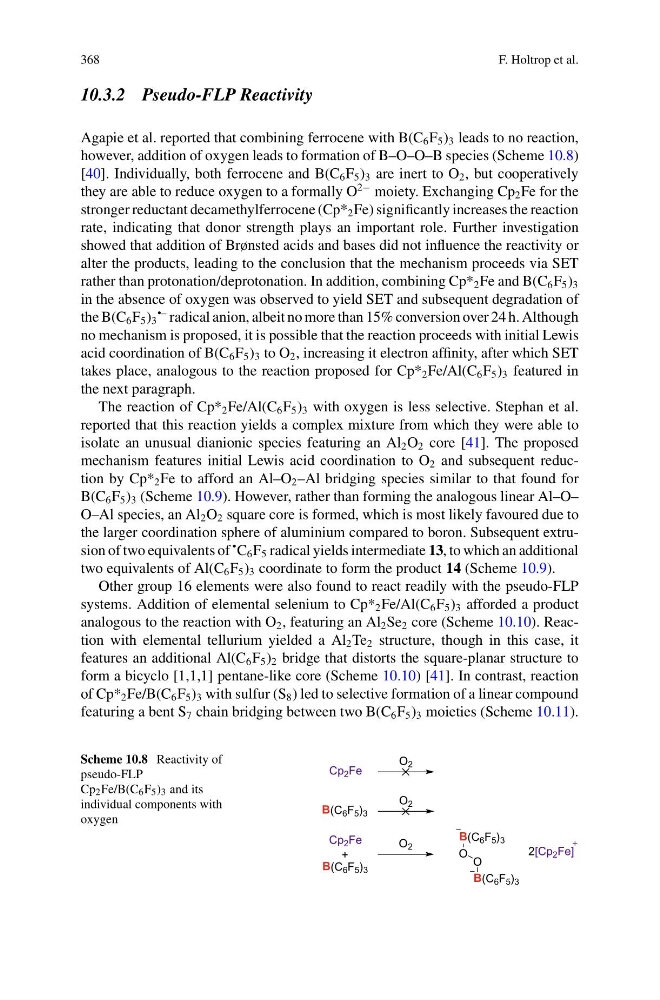
Agapie et al. reported that combining ferrocene with B(C 6 F 5 ) 3 leads to no reaction,
however, addition of oxygen leads to formation of B–O–O–B species (Scheme 10.8)
[40]. Individually, both ferrocene and B(C 6 F 5 ) 3 are inert to O 2 , but cooperatively
they are able to reduce oxygen to a formally O
2− moiety. Exchanging Cp 2 Fe for the
stronger reductant decamethylferrocene (Cp* 2 Fe) significantly increases the reaction
rate, indicating that donor strength plays an important role. Further investigation
showed that addition of Brønsted acids and bases did not influence the reactivity or
alter the products, leading to the conclusion that the mechanism proceeds via SET
rather than protonation/deprotonation. In addition, combining Cp* 2 Fe and B(C 6 F 5 ) 3
in the absence of oxygen was observed to yield SET and subsequent degradation of
the B(C 6 F 5 ) 3
•– radical anion, albeit no more than 15% conversion over 24 h. Although
no mechanism is proposed, it is possible that the reaction proceeds with initial Lewis
acid coordination of B(C 6 F 5 ) 3 to O 2 , increasing it electron affinity, after which SET
takes place, analogous to the reaction proposed for Cp* 2 Fe/Al(C 6 F 5 ) 3 featured in
the next paragraph.
The reaction of Cp* 2 Fe/Al(C 6 F 5 ) 3 with oxygen is less selective. Stephan et al.
reported that this reaction yields a complex mixture from which they were able to
isolate an unusual dianionic species featuring an Al 2 O 2 core [41]. The proposed
mechanism features initial Lewis acid coordination to O 2 and subsequent reduction by Cp* 2 Fe to afford an Al–O 2 –Al bridging species similar to that found for
B(C 6 F 5 ) 3 (Scheme 10.9). However, rather than forming the analogous linear Al–O–
O–Al species, an Al 2 O 2 square core is formed, which is most likely favoured due to
the larger coordination sphere of aluminium compared to boron. Subsequent extrusion of two equivalents of
• C 6 F 5 radical yields intermediate 13, to which an additional
two equivalents of Al(C 6 F 5 ) 3 coordinate to form the product 14 (Scheme 10.9).
Other group 16 elements were also found to react readily with the pseudo-FLP
systems. Addition of elemental selenium to Cp* 2 Fe/Al(C 6 F 5 ) 3 afforded a product
analogous to the reaction with O 2 , featuring an Al 2 Se 2 core (Scheme 10.10). Reaction with elemental tellurium yielded a Al 2 Te 2 structure, though in this case, it
features an additional Al(C 6 F 5 ) 2 bridge that distorts the square-planar structure to
form a bicyclo [1,1,1] pentane-like core (Scheme 10.10) [41]. In contrast, reaction
of Cp* 2 Fe/B(C 6 F 5 ) 3 with sulfur (S 8 ) led to selective formation of a linear compound
featuring a bent S 7 chain bridging between two B(C 6 F 5 ) 3 moieties (Scheme 10.11).
Scheme 10.8 Reactivity of
pseudo-FLP
Cp 2 Fe/B(C 6 F 5 ) 3 and its
individual components with
oxygen
Cp 2 Fe
O 2
B(C 6 F 5 ) 3
O 2
Cp 2 Fe
O 2
B(C 6 F 5 ) 3
+
O O
B(C 6 F 5 ) 3
B(C 6 F 5 ) 3
2[Cp 2 Fe]
F. Holtrop et al.
10.3.2 Pseudo-FLP Reactivity
Agapie et al. reported that combining ferrocene with B(C 6 F 5 ) 3 leads to no reaction,
however, addition of oxygen leads to formation of B–O–O–B species (Scheme 10.8)
[40]. Individually, both ferrocene and B(C 6 F 5 ) 3 are inert to O 2 , but cooperatively
they are able to reduce oxygen to a formally O
2− moiety. Exchanging Cp 2 Fe for the
stronger reductant decamethylferrocene (Cp* 2 Fe) significantly increases the reaction
rate, indicating that donor strength plays an important role. Further investigation
showed that addition of Brønsted acids and bases did not influence the reactivity or
alter the products, leading to the conclusion that the mechanism proceeds via SET
rather than protonation/deprotonation. In addition, combining Cp* 2 Fe and B(C 6 F 5 ) 3
in the absence of oxygen was observed to yield SET and subsequent degradation of
the B(C 6 F 5 ) 3
•– radical anion, albeit no more than 15% conversion over 24 h. Although
no mechanism is proposed, it is possible that the reaction proceeds with initial Lewis
acid coordination of B(C 6 F 5 ) 3 to O 2 , increasing it electron affinity, after which SET
takes place, analogous to the reaction proposed for Cp* 2 Fe/Al(C 6 F 5 ) 3 featured in
the next paragraph.
The reaction of Cp* 2 Fe/Al(C 6 F 5 ) 3 with oxygen is less selective. Stephan et al.
reported that this reaction yields a complex mixture from which they were able to
isolate an unusual dianionic species featuring an Al 2 O 2 core [41]. The proposed
mechanism features initial Lewis acid coordination to O 2 and subsequent reduction by Cp* 2 Fe to afford an Al–O 2 –Al bridging species similar to that found for
B(C 6 F 5 ) 3 (Scheme 10.9). However, rather than forming the analogous linear Al–O–
O–Al species, an Al 2 O 2 square core is formed, which is most likely favoured due to
the larger coordination sphere of aluminium compared to boron. Subsequent extrusion of two equivalents of
• C 6 F 5 radical yields intermediate 13, to which an additional
two equivalents of Al(C 6 F 5 ) 3 coordinate to form the product 14 (Scheme 10.9).
Other group 16 elements were also found to react readily with the pseudo-FLP
systems. Addition of elemental selenium to Cp* 2 Fe/Al(C 6 F 5 ) 3 afforded a product
analogous to the reaction with O 2 , featuring an Al 2 Se 2 core (Scheme 10.10). Reaction with elemental tellurium yielded a Al 2 Te 2 structure, though in this case, it
features an additional Al(C 6 F 5 ) 2 bridge that distorts the square-planar structure to
form a bicyclo [1,1,1] pentane-like core (Scheme 10.10) [41]. In contrast, reaction
of Cp* 2 Fe/B(C 6 F 5 ) 3 with sulfur (S 8 ) led to selective formation of a linear compound
featuring a bent S 7 chain bridging between two B(C 6 F 5 ) 3 moieties (Scheme 10.11).
Scheme 10.8 Reactivity of
pseudo-FLP
Cp 2 Fe/B(C 6 F 5 ) 3 and its
individual components with
oxygen
Cp 2 Fe
O 2
B(C 6 F 5 ) 3
O 2
Cp 2 Fe
O 2
B(C 6 F 5 ) 3
+
O O
B(C 6 F 5 ) 3
B(C 6 F 5 ) 3
2[Cp 2 Fe]