

366
F. Holtrop et al.
O
O
O
OH
B(C 6 F 5 ) 3
H 2
O
O
B(C 6 F 5 ) 3
B(C 6 F 5 ) 3
H
HO
OH
O
OH
6
3
-3
B(C 6 F 5 ) 3
O
OH
B(C 6 F 5 ) 3
B(C 6 F 5 ) 3
-C 6 F 5 H
O
O
(C 6 F 5 ) 2
B
8
9
1 0
7
12
11
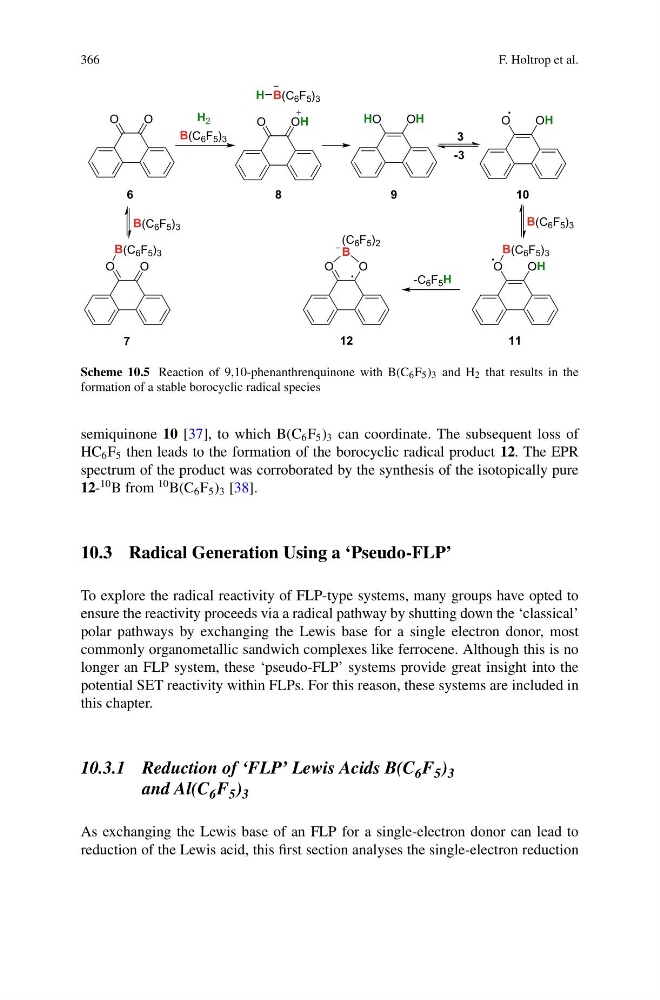
Scheme 10.5 Reaction of 9,10-phenanthrenquinone with B(C 6 F 5 ) 3 and H 2 that results in the
formation of a stable borocyclic radical species
semiquinone 10 [37], to which B(C 6 F 5 ) 3 can coordinate. The subsequent loss of
HC 6 F 5 then leads to the formation of the borocyclic radical product 12. The EPR
spectrum of the product was corroborated by the synthesis of the isotopically pure
1210 B from
10 B(C 6 F 5 ) 3 [38].
10.3 Radical Generation Using a ‘Pseudo-FLP’
To explore the radical reactivity of FLP-type systems, many groups have opted to
ensure the reactivity proceeds via a radical pathway by shutting down the ‘classical’
polar pathways by exchanging the Lewis base for a single electron donor, most
commonly organometallic sandwich complexes like ferrocene. Although this is no
longer an FLP system, these ‘pseudo-FLP’ systems provide great insight into the
potential SET reactivity within FLPs. For this reason, these systems are included in
this chapter.
10.3.1 Reduction of ‘FLP’ Lewis Acids B(C 6 F 5 ) 3
and Al(C 6 F 5 ) 3
As exchanging the Lewis base of an FLP for a single-electron donor can lead to
reduction of the Lewis acid, this first section analyses the single-electron reduction
F. Holtrop et al.
O
O
O
OH
B(C 6 F 5 ) 3
H 2
O
O
B(C 6 F 5 ) 3
B(C 6 F 5 ) 3
H
HO
OH
O
OH
6
3
-3
B(C 6 F 5 ) 3
O
OH
B(C 6 F 5 ) 3
B(C 6 F 5 ) 3
-C 6 F 5 H
O
O
(C 6 F 5 ) 2
B
8
9
1 0
7
12
11
Scheme 10.5 Reaction of 9,10-phenanthrenquinone with B(C 6 F 5 ) 3 and H 2 that results in the
formation of a stable borocyclic radical species
semiquinone 10 [37], to which B(C 6 F 5 ) 3 can coordinate. The subsequent loss of
HC 6 F 5 then leads to the formation of the borocyclic radical product 12. The EPR
spectrum of the product was corroborated by the synthesis of the isotopically pure
1210 B from
10 B(C 6 F 5 ) 3 [38].
10.3 Radical Generation Using a ‘Pseudo-FLP’
To explore the radical reactivity of FLP-type systems, many groups have opted to
ensure the reactivity proceeds via a radical pathway by shutting down the ‘classical’
polar pathways by exchanging the Lewis base for a single electron donor, most
commonly organometallic sandwich complexes like ferrocene. Although this is no
longer an FLP system, these ‘pseudo-FLP’ systems provide great insight into the
potential SET reactivity within FLPs. For this reason, these systems are included in
this chapter.
10.3.1 Reduction of ‘FLP’ Lewis Acids B(C 6 F 5 ) 3
and Al(C 6 F 5 ) 3
As exchanging the Lewis base of an FLP for a single-electron donor can lead to
reduction of the Lewis acid, this first section analyses the single-electron reduction