

10 Radicals in Frustrated Lewis Pair Chemistry
365
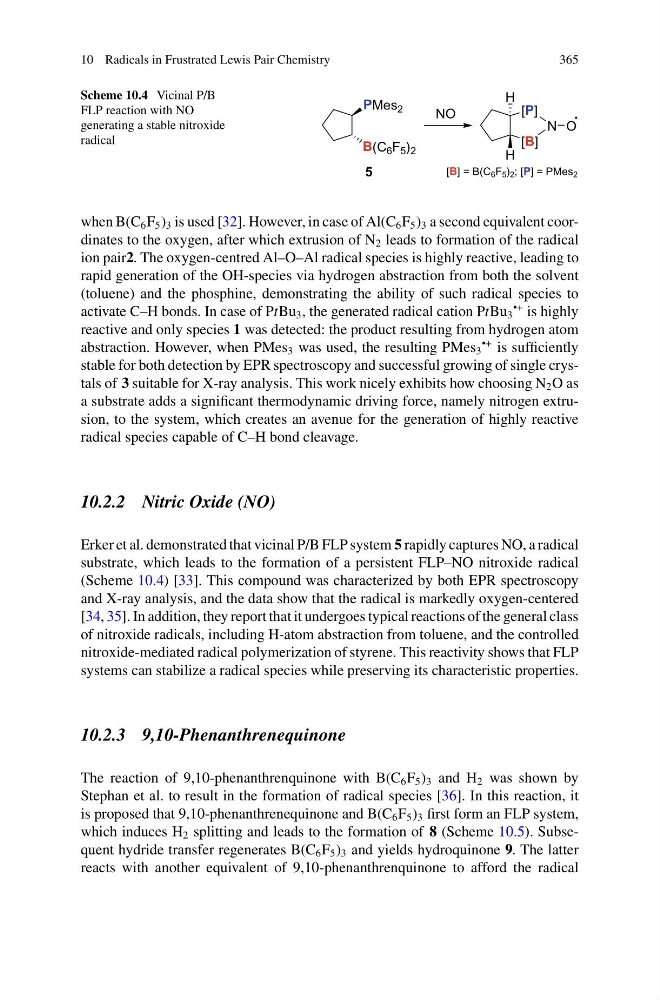
Scheme 10.4 Vicinal P/B
FLP reaction with NO
generating a stable nitroxide
radical
PMes 2
B(C 6 F 5 ) 2
NO
[B]
N
[P]
H
H
O
[B] = B(C 6 F 5 ) 2 ; [P] = PMes 2
5
when B(C 6 F 5 ) 3 is used [32]. However, in case of Al(C 6 F 5 ) 3 a second equivalent coordinates to the oxygen, after which extrusion of N 2 leads to formation of the radical
ion pair2. The oxygen-centred Al–O–Al radical species is highly reactive, leading to
rapid generation of the OH-species via hydrogen abstraction from both the solvent
(toluene) and the phosphine, demonstrating the ability of such radical species to
activate C–H bonds. In case of PtBu 3 , the generated radical cation PtBu 3
•+ is highly
reactive and only species 1 was detected: the product resulting from hydrogen atom
abstraction. However, when PMes 3 was used, the resulting PMes 3
•+ is sufficiently
stable for both detection by EPR spectroscopy and successful growing of single crystals of 3 suitable for X-ray analysis. This work nicely exhibits how choosing N 2 O as
a substrate adds a significant thermodynamic driving force, namely nitrogen extrusion, to the system, which creates an avenue for the generation of highly reactive
radical species capable of C–H bond cleavage.
10.2.2 Nitric Oxide (NO)
Erker et al. demonstrated that vicinal P/B FLP system 5 rapidly captures NO, a radical
substrate, which leads to the formation of a persistent FLP–NO nitroxide radical
(Scheme 10.4) [33]. This compound was characterized by both EPR spectroscopy
and X-ray analysis, and the data show that the radical is markedly oxygen-centered
[34, 35]. In addition, they report that it undergoes typical reactions of the general class
of nitroxide radicals, including H-atom abstraction from toluene, and the controlled
nitroxide-mediated radical polymerization of styrene. This reactivity shows that FLP
systems can stabilize a radical species while preserving its characteristic properties.
10.2.3 9,10-Phenanthrenequinone
The reaction of 9,10-phenanthrenquinone with B(C 6 F 5 ) 3 and H 2 was shown by
Stephan et al. to result in the formation of radical species [36]. In this reaction, it
is proposed that 9,10-phenanthrenequinone and B(C 6 F 5 ) 3 first form an FLP system,
which induces H 2 splitting and leads to the formation of 8 (Scheme 10.5). Subsequent hydride transfer regenerates B(C 6 F 5 ) 3 and yields hydroquinone 9. The latter
reacts with another equivalent of 9,10-phenanthrenquinone to afford the radical
365
Scheme 10.4 Vicinal P/B
FLP reaction with NO
generating a stable nitroxide
radical
PMes 2
B(C 6 F 5 ) 2
NO
[B]
N
[P]
H
H
O
[B] = B(C 6 F 5 ) 2 ; [P] = PMes 2
5
when B(C 6 F 5 ) 3 is used [32]. However, in case of Al(C 6 F 5 ) 3 a second equivalent coordinates to the oxygen, after which extrusion of N 2 leads to formation of the radical
ion pair2. The oxygen-centred Al–O–Al radical species is highly reactive, leading to
rapid generation of the OH-species via hydrogen abstraction from both the solvent
(toluene) and the phosphine, demonstrating the ability of such radical species to
activate C–H bonds. In case of PtBu 3 , the generated radical cation PtBu 3
•+ is highly
reactive and only species 1 was detected: the product resulting from hydrogen atom
abstraction. However, when PMes 3 was used, the resulting PMes 3
•+ is sufficiently
stable for both detection by EPR spectroscopy and successful growing of single crystals of 3 suitable for X-ray analysis. This work nicely exhibits how choosing N 2 O as
a substrate adds a significant thermodynamic driving force, namely nitrogen extrusion, to the system, which creates an avenue for the generation of highly reactive
radical species capable of C–H bond cleavage.
10.2.2 Nitric Oxide (NO)
Erker et al. demonstrated that vicinal P/B FLP system 5 rapidly captures NO, a radical
substrate, which leads to the formation of a persistent FLP–NO nitroxide radical
(Scheme 10.4) [33]. This compound was characterized by both EPR spectroscopy
and X-ray analysis, and the data show that the radical is markedly oxygen-centered
[34, 35]. In addition, they report that it undergoes typical reactions of the general class
of nitroxide radicals, including H-atom abstraction from toluene, and the controlled
nitroxide-mediated radical polymerization of styrene. This reactivity shows that FLP
systems can stabilize a radical species while preserving its characteristic properties.
10.2.3 9,10-Phenanthrenequinone
The reaction of 9,10-phenanthrenquinone with B(C 6 F 5 ) 3 and H 2 was shown by
Stephan et al. to result in the formation of radical species [36]. In this reaction, it
is proposed that 9,10-phenanthrenequinone and B(C 6 F 5 ) 3 first form an FLP system,
which induces H 2 splitting and leads to the formation of 8 (Scheme 10.5). Subsequent hydride transfer regenerates B(C 6 F 5 ) 3 and yields hydroquinone 9. The latter
reacts with another equivalent of 9,10-phenanthrenquinone to afford the radical