

364
F. Holtrop et al.
of an equilibrium between the FLP and its corresponding radical ion pair, however,
recent reports by Slootweg et al. demonstrated that it is, in fact, photo-induced SET
that leads to this radical formation [27]. The exploration of radical species in FLP
chemistry is a relatively nascent field, but a summary of the progress so far will
be discussed in this chapter. The reactivity has been grouped into three different
categories. First, this chapter will discuss radical substrates that have been combined
with FLP systems and the subsequent investigations of the resulting radical species.
Next, the focus will be on radical pairs that have been generated by exchanging
the Lewis base of an FLP system for a single-electron donor, which forces a SET
pathway. The final section details SET within actual FLP systems and provides the
conceptual framework for when SET occurs in FLP systems.
10.2 Reactions of FLP Systems with Radical Substrates
One way of generating radical species within FLP systems is the reaction of the
Lewis acid and base with a radical substrate or a substrate that will undergo a facile
transformation to generate radical species. This section focuses on these types of
systems for which the radical formation is substratebased, rather than promoted by
the Lewis acid/Lewis base system.
10.2.1 Nitrous Oxide (N 2 O)
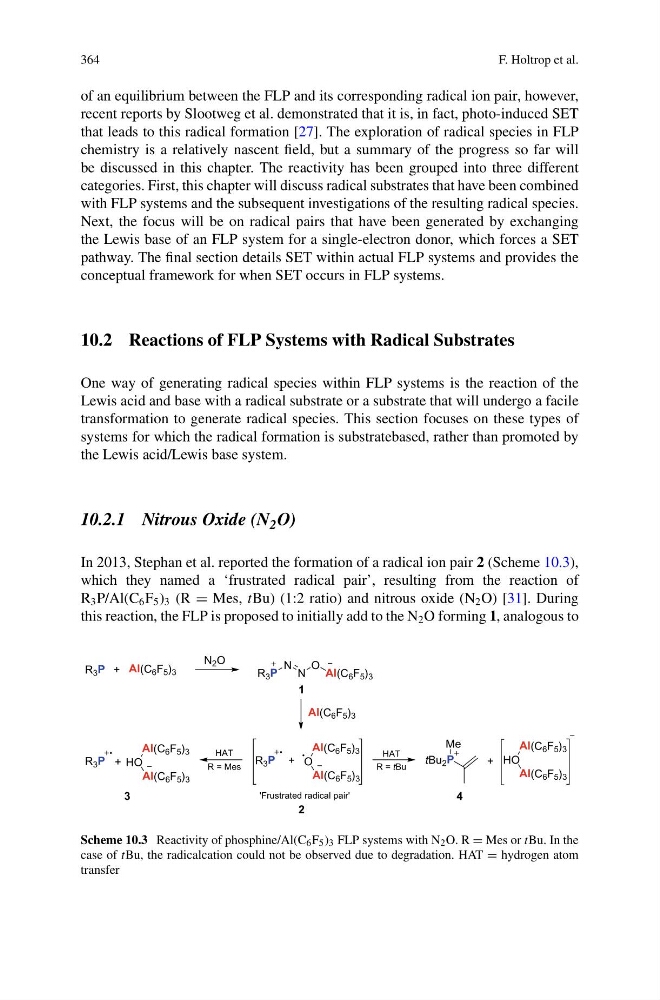
In 2013, Stephan et al. reported the formation of a radical ion pair 2 (Scheme 10.3),
which they named a ‘frustrated radical pair’, resulting from the reaction of
R 3 P/Al(C 6 F 5 ) 3 (R = Mes, tBu) (1:2 ratio) and nitrous oxide (N 2 O) [31]. During
this reaction, the FLP is proposed to initially add to the N 2 O forming 1, analogous to
R 3 P
Al(C 6 F 5 ) 3
N 2 O
+
R 3 P
N N
O Al(C 6 F 5 ) 3
Al(C 6 F 5 ) 3
R 3 P
O
Al(C 6 F 5 ) 3
Al(C 6 F 5 ) 3
+
'Frustrated radical pair'
R 3 P
HO
Al(C 6 F 5 ) 3
Al(C 6 F 5 ) 3
+
HAT
tBu 2 P
HO
Al(C 6 F 5 ) 3
Al(C 6 F 5 ) 3
Me
R = Mes
HAT
R = tBu
+
4
2
1
3
Scheme 10.3 Reactivity of phosphine/Al(C 6 F 5 ) 3 FLP systems with N 2 O. R = Mes or tBu. In the
case of tBu, the radicalcation could not be observed due to degradation. HAT = hydrogen atom
transfer
F. Holtrop et al.
of an equilibrium between the FLP and its corresponding radical ion pair, however,
recent reports by Slootweg et al. demonstrated that it is, in fact, photo-induced SET
that leads to this radical formation [27]. The exploration of radical species in FLP
chemistry is a relatively nascent field, but a summary of the progress so far will
be discussed in this chapter. The reactivity has been grouped into three different
categories. First, this chapter will discuss radical substrates that have been combined
with FLP systems and the subsequent investigations of the resulting radical species.
Next, the focus will be on radical pairs that have been generated by exchanging
the Lewis base of an FLP system for a single-electron donor, which forces a SET
pathway. The final section details SET within actual FLP systems and provides the
conceptual framework for when SET occurs in FLP systems.
10.2 Reactions of FLP Systems with Radical Substrates
One way of generating radical species within FLP systems is the reaction of the
Lewis acid and base with a radical substrate or a substrate that will undergo a facile
transformation to generate radical species. This section focuses on these types of
systems for which the radical formation is substratebased, rather than promoted by
the Lewis acid/Lewis base system.
10.2.1 Nitrous Oxide (N 2 O)
In 2013, Stephan et al. reported the formation of a radical ion pair 2 (Scheme 10.3),
which they named a ‘frustrated radical pair’, resulting from the reaction of
R 3 P/Al(C 6 F 5 ) 3 (R = Mes, tBu) (1:2 ratio) and nitrous oxide (N 2 O) [31]. During
this reaction, the FLP is proposed to initially add to the N 2 O forming 1, analogous to
R 3 P
Al(C 6 F 5 ) 3
N 2 O
+
R 3 P
N N
O Al(C 6 F 5 ) 3
Al(C 6 F 5 ) 3
R 3 P
O
Al(C 6 F 5 ) 3
Al(C 6 F 5 ) 3
+
'Frustrated radical pair'
R 3 P
HO
Al(C 6 F 5 ) 3
Al(C 6 F 5 ) 3
+
HAT
tBu 2 P
HO
Al(C 6 F 5 ) 3
Al(C 6 F 5 ) 3
Me
R = Mes
HAT
R = tBu
+
4
2
1
3
Scheme 10.3 Reactivity of phosphine/Al(C 6 F 5 ) 3 FLP systems with N 2 O. R = Mes or tBu. In the
case of tBu, the radicalcation could not be observed due to degradation. HAT = hydrogen atom
transfer