

10 Radicals in Frustrated Lewis Pair Chemistry
363
P
B
H H
P
B
P
H
B H
P
B
P
B
H H
2e polar pathway
H 2
H 2
Radical ion pair
Homolytic cleavage
1e radical pathway
Heterolytic cleavage
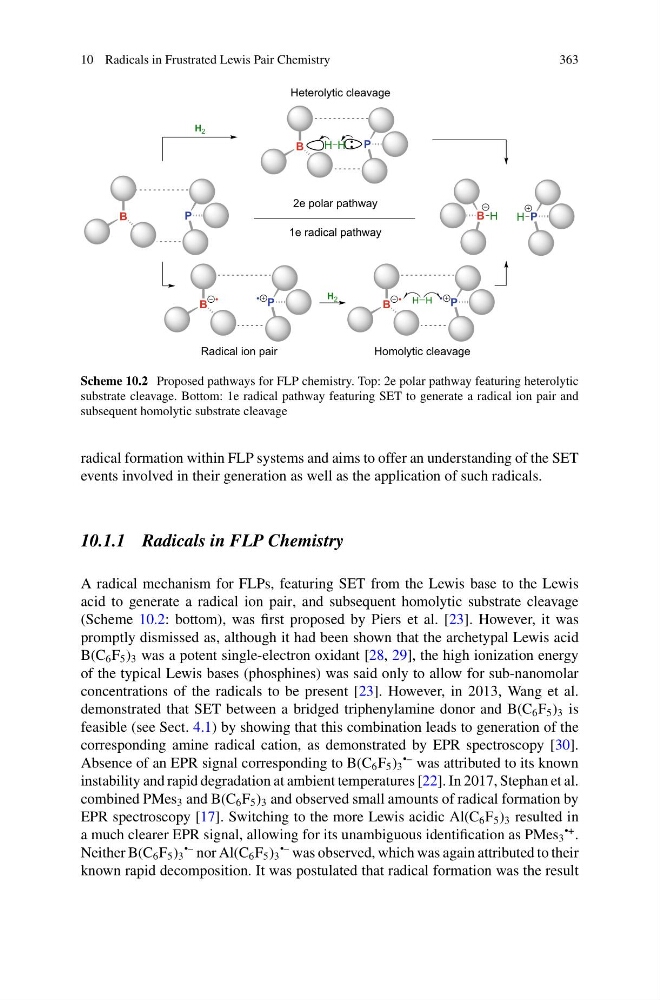
Scheme 10.2 Proposed pathways for FLP chemistry. Top: 2e polar pathway featuring heterolytic
substrate cleavage. Bottom: 1e radical pathway featuring SET to generate a radical ion pair and
subsequent homolytic substrate cleavage
radical formation within FLP systems and aims to offer an understanding of the SET
events involved in their generation as well as the application of such radicals.
10.1.1 Radicals in FLP Chemistry
A radical mechanism for FLPs, featuring SET from the Lewis base to the Lewis
acid to generate a radical ion pair, and subsequent homolytic substrate cleavage
(Scheme 10.2: bottom), was first proposed by Piers et al. [23]. However, it was
promptly dismissed as, although it had been shown that the archetypal Lewis acid
B(C 6 F 5 ) 3 was a potent single-electron oxidant [28, 29], the high ionization energy
of the typical Lewis bases (phosphines) was said only to allow for sub-nanomolar
concentrations of the radicals to be present [23]. However, in 2013, Wang et al.
demonstrated that SET between a bridged triphenylamine donor and B(C 6 F 5 ) 3 is
feasible (see Sect. 4.1) by showing that this combination leads to generation of the
corresponding amine radical cation, as demonstrated by EPR spectroscopy [30].
Absence of an EPR signal corresponding to B(C 6 F 5 ) 3
•– was attributed to its known
instability and rapid degradation at ambient temperatures [22]. In 2017, Stephan et al.
combined PMes 3 and B(C 6 F 5 ) 3 and observed small amounts of radical formation by
EPR spectroscopy [17]. Switching to the more Lewis acidic Al(C 6 F 5 ) 3 resulted in
a much clearer EPR signal, allowing for its unambiguous identification as PMes 3
•+ .
Neither B(C 6 F 5 ) 3
•– nor Al(C 6 F 5 ) 3
•– was observed, which was again attributed to their
known rapid decomposition. It was postulated that radical formation was the result
363
P
B
H H
P
B
P
H
B H
P
B
P
B
H H
2e polar pathway
H 2
H 2
Radical ion pair
Homolytic cleavage
1e radical pathway
Heterolytic cleavage
Scheme 10.2 Proposed pathways for FLP chemistry. Top: 2e polar pathway featuring heterolytic
substrate cleavage. Bottom: 1e radical pathway featuring SET to generate a radical ion pair and
subsequent homolytic substrate cleavage
radical formation within FLP systems and aims to offer an understanding of the SET
events involved in their generation as well as the application of such radicals.
10.1.1 Radicals in FLP Chemistry
A radical mechanism for FLPs, featuring SET from the Lewis base to the Lewis
acid to generate a radical ion pair, and subsequent homolytic substrate cleavage
(Scheme 10.2: bottom), was first proposed by Piers et al. [23]. However, it was
promptly dismissed as, although it had been shown that the archetypal Lewis acid
B(C 6 F 5 ) 3 was a potent single-electron oxidant [28, 29], the high ionization energy
of the typical Lewis bases (phosphines) was said only to allow for sub-nanomolar
concentrations of the radicals to be present [23]. However, in 2013, Wang et al.
demonstrated that SET between a bridged triphenylamine donor and B(C 6 F 5 ) 3 is
feasible (see Sect. 4.1) by showing that this combination leads to generation of the
corresponding amine radical cation, as demonstrated by EPR spectroscopy [30].
Absence of an EPR signal corresponding to B(C 6 F 5 ) 3
•– was attributed to its known
instability and rapid degradation at ambient temperatures [22]. In 2017, Stephan et al.
combined PMes 3 and B(C 6 F 5 ) 3 and observed small amounts of radical formation by
EPR spectroscopy [17]. Switching to the more Lewis acidic Al(C 6 F 5 ) 3 resulted in
a much clearer EPR signal, allowing for its unambiguous identification as PMes 3
•+ .
Neither B(C 6 F 5 ) 3
•– nor Al(C 6 F 5 ) 3
•– was observed, which was again attributed to their
known rapid decomposition. It was postulated that radical formation was the result