

362
F. Holtrop et al.
TCQ
tetrachloro-p-benzoquinone
TEMPO
(2,2,6,6-tetramethylpiperidin-1-yl)oxyl
Tipp
2,4,6-triisopropylphenyl
trityl
triphenylmethyl
10.1 Introduction
Frustrated Lewis pairs (FLPs) combine a Lewis acid, an electron pair acceptor, and
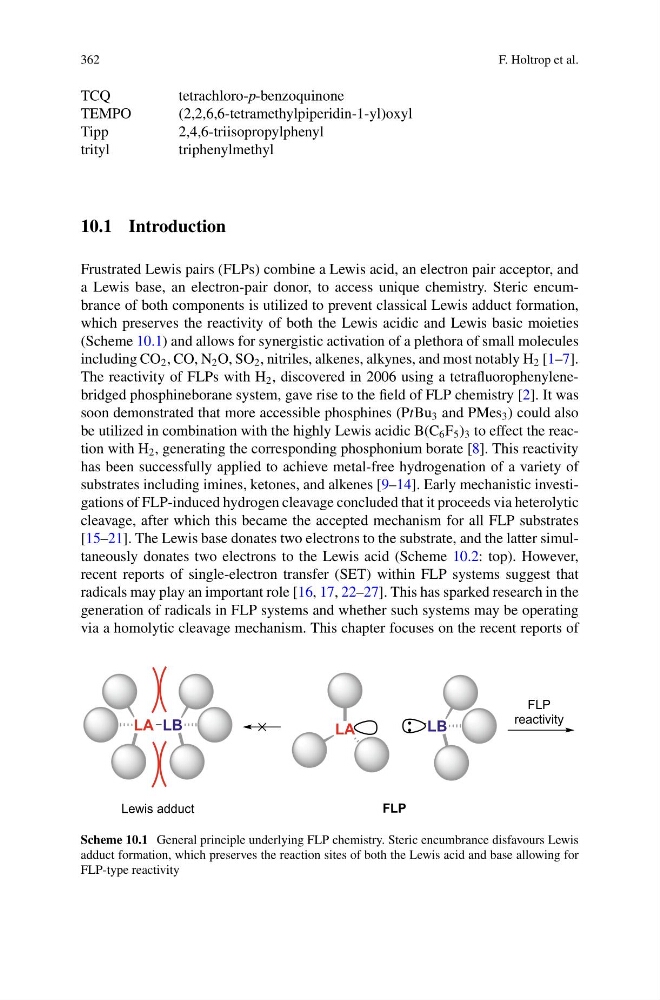
a Lewis base, an electron-pair donor, to access unique chemistry. Steric encumbrance of both components is utilized to prevent classical Lewis adduct formation,
which preserves the reactivity of both the Lewis acidic and Lewis basic moieties
(Scheme 10.1) and allows for synergistic activation of a plethora of small molecules
including CO 2 , CO, N 2 O, SO 2 , nitriles, alkenes, alkynes, and most notably H 2 [1–7].
The reactivity of FLPs with H 2 , discovered in 2006 using a tetrafluorophenylenebridged phosphineborane system, gave rise to the field of FLP chemistry [2]. It was
soon demonstrated that more accessible phosphines (PtBu 3 and PMes 3 ) could also
be utilized in combination with the highly Lewis acidic B(C 6 F 5 ) 3 to effect the reaction with H 2 , generating the corresponding phosphonium borate [8]. This reactivity
has been successfully applied to achieve metal-free hydrogenation of a variety of
substrates including imines, ketones, and alkenes [9–14]. Early mechanistic investigations of FLP-induced hydrogen cleavage concluded that it proceeds via heterolytic
cleavage, after which this became the accepted mechanism for all FLP substrates
[15–21]. The Lewis base donates two electrons to the substrate, and the latter simultaneously donates two electrons to the Lewis acid (Scheme 10.2: top). However,
recent reports of single-electron transfer (SET) within FLP systems suggest that
radicals may play an important role [16, 17, 22–27]. This has sparked research in the
generation of radicals in FLP systems and whether such systems may be operating
via a homolytic cleavage mechanism. This chapter focuses on the recent reports of
LB
LA
LA LB
FLP
Lewis adduct
FLP
reactivity
Scheme 10.1 General principle underlying FLP chemistry. Steric encumbrance disfavours Lewis
adduct formation, which preserves the reaction sites of both the Lewis acid and base allowing for
FLP-type reactivity
F. Holtrop et al.
TCQ
tetrachloro-p-benzoquinone
TEMPO
(2,2,6,6-tetramethylpiperidin-1-yl)oxyl
Tipp
2,4,6-triisopropylphenyl
trityl
triphenylmethyl
10.1 Introduction
Frustrated Lewis pairs (FLPs) combine a Lewis acid, an electron pair acceptor, and
a Lewis base, an electron-pair donor, to access unique chemistry. Steric encumbrance of both components is utilized to prevent classical Lewis adduct formation,
which preserves the reactivity of both the Lewis acidic and Lewis basic moieties
(Scheme 10.1) and allows for synergistic activation of a plethora of small molecules
including CO 2 , CO, N 2 O, SO 2 , nitriles, alkenes, alkynes, and most notably H 2 [1–7].
The reactivity of FLPs with H 2 , discovered in 2006 using a tetrafluorophenylenebridged phosphineborane system, gave rise to the field of FLP chemistry [2]. It was
soon demonstrated that more accessible phosphines (PtBu 3 and PMes 3 ) could also
be utilized in combination with the highly Lewis acidic B(C 6 F 5 ) 3 to effect the reaction with H 2 , generating the corresponding phosphonium borate [8]. This reactivity
has been successfully applied to achieve metal-free hydrogenation of a variety of
substrates including imines, ketones, and alkenes [9–14]. Early mechanistic investigations of FLP-induced hydrogen cleavage concluded that it proceeds via heterolytic
cleavage, after which this became the accepted mechanism for all FLP substrates
[15–21]. The Lewis base donates two electrons to the substrate, and the latter simultaneously donates two electrons to the Lewis acid (Scheme 10.2: top). However,
recent reports of single-electron transfer (SET) within FLP systems suggest that
radicals may play an important role [16, 17, 22–27]. This has sparked research in the
generation of radicals in FLP systems and whether such systems may be operating
via a homolytic cleavage mechanism. This chapter focuses on the recent reports of
LB
LA
LA LB
FLP
Lewis adduct
FLP
reactivity
Scheme 10.1 General principle underlying FLP chemistry. Steric encumbrance disfavours Lewis
adduct formation, which preserves the reaction sites of both the Lewis acid and base allowing for
FLP-type reactivity