

9 Frustrated Lewis Pairs Based on Transition Metals
345
Scheme 9.25 Proposed catalytic cycle for C–H borylation mediated by polar heterobimetallic
compound 41[CuFe] highlighting key cooperative transition states
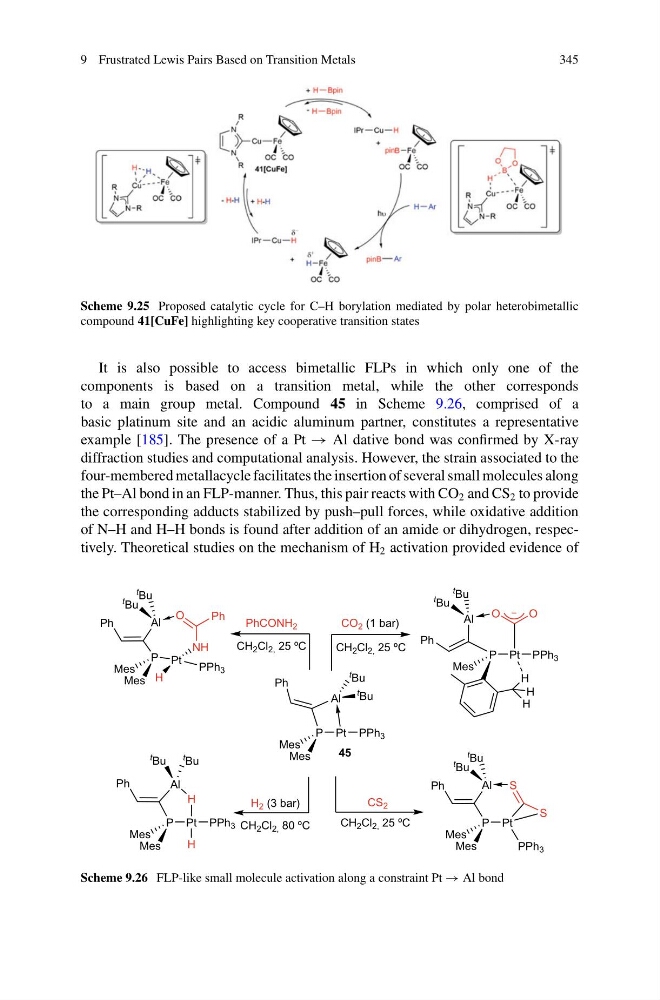
It is also possible to access bimetallic FLPs in which only one of the
components is based on a transition metal, while the other corresponds
to a main group metal. Compound 45 in Scheme 9.26, comprised of a
basic platinum site and an acidic aluminum partner, constitutes a representative
example [185]. The presence of a Pt → Al dative bond was confirmed by X-ray
diffraction studies and computational analysis. However, the strain associated to the
four-membered metallacycle facilitates the insertion of several small molecules along
the Pt–Al bond in an FLP-manner. Thus, this pair reacts with CO 2 and CS 2 to provide
the corresponding adducts stabilized by push–pull forces, while oxidative addition
of N–H and H–H bonds is found after addition of an amide or dihydrogen, respectively. Theoretical studies on the mechanism of H 2 activation provided evidence of
P Pt PPh 3
Mes
Mes
Al
t Bu
t Bu
Ph
P Pt PPh 3
Mes
Al
t Bu
t Bu
Ph
O
O
H
H
H
P Pt
PPh 3
Mes
Mes
Al
t Bu
t Bu
Ph
S
S
P Pt PPh 3
Mes
Mes
Al
t Bu
t Bu
Ph
H
H
P Pt
PPh 3
Mes
Mes
Al
t Bu
t Bu
Ph
NH
Ph
O
H
45
PhCONH 2
CO 2 (1 bar)
H 2 (3 bar)
CS 2
CH 2 Cl 2, 25 ºC
CH 2 Cl 2, 25 ºC
CH 2 Cl 2, 80 ºC
CH 2 Cl 2, 25 ºC
Scheme 9.26 FLP-like small molecule activation along a constraint Pt → Al bond
345
Scheme 9.25 Proposed catalytic cycle for C–H borylation mediated by polar heterobimetallic
compound 41[CuFe] highlighting key cooperative transition states
It is also possible to access bimetallic FLPs in which only one of the
components is based on a transition metal, while the other corresponds
to a main group metal. Compound 45 in Scheme 9.26, comprised of a
basic platinum site and an acidic aluminum partner, constitutes a representative
example [185]. The presence of a Pt → Al dative bond was confirmed by X-ray
diffraction studies and computational analysis. However, the strain associated to the
four-membered metallacycle facilitates the insertion of several small molecules along
the Pt–Al bond in an FLP-manner. Thus, this pair reacts with CO 2 and CS 2 to provide
the corresponding adducts stabilized by push–pull forces, while oxidative addition
of N–H and H–H bonds is found after addition of an amide or dihydrogen, respectively. Theoretical studies on the mechanism of H 2 activation provided evidence of
P Pt PPh 3
Mes
Mes
Al
t Bu
t Bu
Ph
P Pt PPh 3
Mes
Al
t Bu
t Bu
Ph
O
O
H
H
H
P Pt
PPh 3
Mes
Mes
Al
t Bu
t Bu
Ph
S
S
P Pt PPh 3
Mes
Mes
Al
t Bu
t Bu
Ph
H
H
P Pt
PPh 3
Mes
Mes
Al
t Bu
t Bu
Ph
NH
Ph
O
H
45
PhCONH 2
CO 2 (1 bar)
H 2 (3 bar)
CS 2
CH 2 Cl 2, 25 ºC
CH 2 Cl 2, 25 ºC
CH 2 Cl 2, 80 ºC
CH 2 Cl 2, 25 ºC
Scheme 9.26 FLP-like small molecule activation along a constraint Pt → Al bond