

346
N. Hidalgo et al.
an FLP-like transition state in which dihydrogen coordinates side-on to the acidic Al
center and end-on to the basic Pt nucleus.
In an interesting study, Sakaki extended the idea of TMFLPs to multiply bonded
complexes [186], for which a polarization of the M–M multiple bond is proposed
to parallel the polarization found in encounter complexes of FLP systems. The
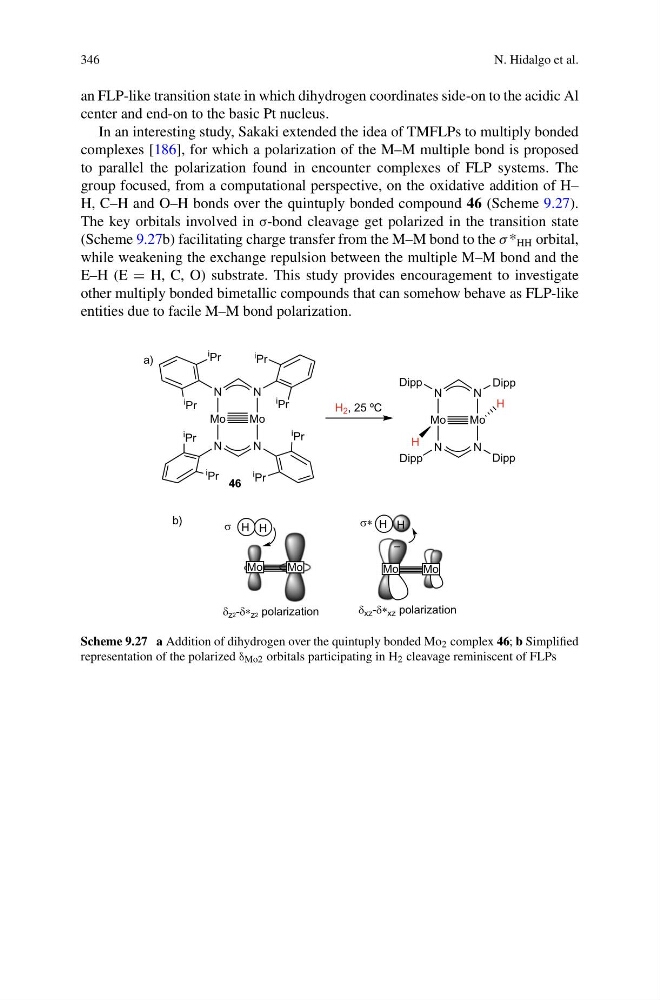
group focused, from a computational perspective, on the oxidative addition of H–
H, C–H and O–H bonds over the quintuply bonded compound 46 (Scheme 9.27).
The key orbitals involved in σ-bond cleavage get polarized in the transition state
(Scheme 9.27b) facilitating charge transfer from the M–M bond to the σ * HH orbital,
while weakening the exchange repulsion between the multiple M–M bond and the
E–H (E = H, C, O) substrate. This study provides encouragement to investigate
other multiply bonded bimetallic compounds that can somehow behave as FLP-like
entities due to facile M–M bond polarization.
Mo
Mo
H H
Mo
Mo
polarization
H H
polarization
Mo
Mo
N
N
N
N
i Pr
i Pr
i Pr
i Pr
i Pr
i Pr
i Pr
i Pr
Mo
Mo
N
N
N
N
Dipp
Dipp
Dipp
Dipp
H
H
H 2 , 25 ºC
b)
a)
46
Scheme 9.27 a Addition of dihydrogen over the quintuply bonded Mo 2 complex 46; b Simplified
representation of the polarized δ Mo2 orbitals participating in H 2 cleavage reminiscent of FLPs
N. Hidalgo et al.
an FLP-like transition state in which dihydrogen coordinates side-on to the acidic Al
center and end-on to the basic Pt nucleus.
In an interesting study, Sakaki extended the idea of TMFLPs to multiply bonded
complexes [186], for which a polarization of the M–M multiple bond is proposed
to parallel the polarization found in encounter complexes of FLP systems. The
group focused, from a computational perspective, on the oxidative addition of H–
H, C–H and O–H bonds over the quintuply bonded compound 46 (Scheme 9.27).
The key orbitals involved in σ-bond cleavage get polarized in the transition state
(Scheme 9.27b) facilitating charge transfer from the M–M bond to the σ * HH orbital,
while weakening the exchange repulsion between the multiple M–M bond and the
E–H (E = H, C, O) substrate. This study provides encouragement to investigate
other multiply bonded bimetallic compounds that can somehow behave as FLP-like
entities due to facile M–M bond polarization.
Mo
Mo
H H
Mo
Mo
polarization
H H
polarization
Mo
Mo
N
N
N
N
i Pr
i Pr
i Pr
i Pr
i Pr
i Pr
i Pr
i Pr
Mo
Mo
N
N
N
N
Dipp
Dipp
Dipp
Dipp
H
H
H 2 , 25 ºC
b)
a)
46
Scheme 9.27 a Addition of dihydrogen over the quintuply bonded Mo 2 complex 46; b Simplified
representation of the polarized δ Mo2 orbitals participating in H 2 cleavage reminiscent of FLPs