

344
N. Hidalgo et al.
N
N
Cu
R
R
Fe
OC CO
41[CuFe]
N
N
Cu
R
R
R
R
Cu
N
N
S
C
S
Fe
CO
CO
Cp
S
S
C
Fe
OC
OC
Cp
N
N
Cu
R
R
I
Fe
OC CO
H 3 C
N
N
Cu
R
R
H
Fe
OC CO
H
N
N
Cu
R
R
Cl
Fe
OC CO
CH 3 I
BzCl
H 2
CS 2
N
N
Cu
R
R
H
Fe
OC CO
H
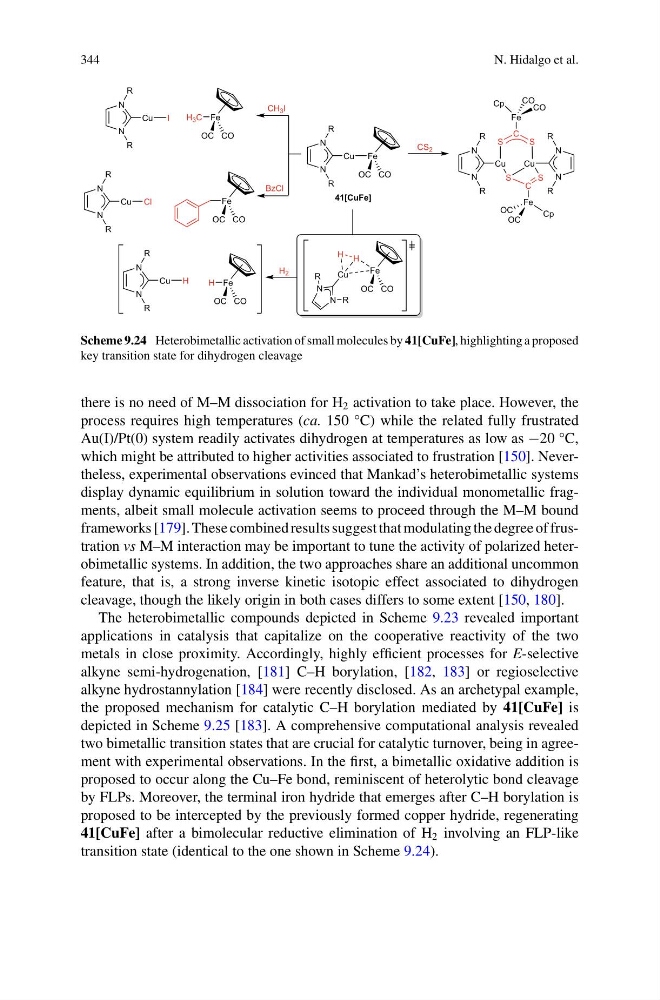
Scheme 9.24 Heterobimetallic activation of small molecules by 41[CuFe], highlighting a proposed
key transition state for dihydrogen cleavage
there is no need of M–M dissociation for H 2 activation to take place. However, the
process requires high temperatures (ca. 150 °C) while the related fully frustrated
Au(I)/Pt(0) system readily activates dihydrogen at temperatures as low as −20 °C,
which might be attributed to higher activities associated to frustration [150]. Nevertheless, experimental observations evinced that Mankad’s heterobimetallic systems
display dynamic equilibrium in solution toward the individual monometallic fragments, albeit small molecule activation seems to proceed through the M–M bound
frameworks [179]. These combined results suggest that modulating the degree of frustration vs M–M interaction may be important to tune the activity of polarized heterobimetallic systems. In addition, the two approaches share an additional uncommon
feature, that is, a strong inverse kinetic isotopic effect associated to dihydrogen
cleavage, though the likely origin in both cases differs to some extent [150, 180].
The heterobimetallic compounds depicted in Scheme 9.23 revealed important
applications in catalysis that capitalize on the cooperative reactivity of the two
metals in close proximity. Accordingly, highly efficient processes for E-selective
alkyne semi-hydrogenation, [181] C–H borylation, [182, 183] or regioselective
alkyne hydrostannylation [184] were recently disclosed. As an archetypal example,
the proposed mechanism for catalytic C–H borylation mediated by 41[CuFe] is
depicted in Scheme 9.25 [183]. A comprehensive computational analysis revealed
two bimetallic transition states that are crucial for catalytic turnover, being in agreement with experimental observations. In the first, a bimetallic oxidative addition is
proposed to occur along the Cu–Fe bond, reminiscent of heterolytic bond cleavage
by FLPs. Moreover, the terminal iron hydride that emerges after C–H borylation is
proposed to be intercepted by the previously formed copper hydride, regenerating
41[CuFe] after a bimolecular reductive elimination of H 2 involving an FLP-like
transition state (identical to the one shown in Scheme 9.24).
N. Hidalgo et al.
N
N
Cu
R
R
Fe
OC CO
41[CuFe]
N
N
Cu
R
R
R
R
Cu
N
N
S
C
S
Fe
CO
CO
Cp
S
S
C
Fe
OC
OC
Cp
N
N
Cu
R
R
I
Fe
OC CO
H 3 C
N
N
Cu
R
R
H
Fe
OC CO
H
N
N
Cu
R
R
Cl
Fe
OC CO
CH 3 I
BzCl
H 2
CS 2
N
N
Cu
R
R
H
Fe
OC CO
H
Scheme 9.24 Heterobimetallic activation of small molecules by 41[CuFe], highlighting a proposed
key transition state for dihydrogen cleavage
there is no need of M–M dissociation for H 2 activation to take place. However, the
process requires high temperatures (ca. 150 °C) while the related fully frustrated
Au(I)/Pt(0) system readily activates dihydrogen at temperatures as low as −20 °C,
which might be attributed to higher activities associated to frustration [150]. Nevertheless, experimental observations evinced that Mankad’s heterobimetallic systems
display dynamic equilibrium in solution toward the individual monometallic fragments, albeit small molecule activation seems to proceed through the M–M bound
frameworks [179]. These combined results suggest that modulating the degree of frustration vs M–M interaction may be important to tune the activity of polarized heterobimetallic systems. In addition, the two approaches share an additional uncommon
feature, that is, a strong inverse kinetic isotopic effect associated to dihydrogen
cleavage, though the likely origin in both cases differs to some extent [150, 180].
The heterobimetallic compounds depicted in Scheme 9.23 revealed important
applications in catalysis that capitalize on the cooperative reactivity of the two
metals in close proximity. Accordingly, highly efficient processes for E-selective
alkyne semi-hydrogenation, [181] C–H borylation, [182, 183] or regioselective
alkyne hydrostannylation [184] were recently disclosed. As an archetypal example,
the proposed mechanism for catalytic C–H borylation mediated by 41[CuFe] is
depicted in Scheme 9.25 [183]. A comprehensive computational analysis revealed
two bimetallic transition states that are crucial for catalytic turnover, being in agreement with experimental observations. In the first, a bimetallic oxidative addition is
proposed to occur along the Cu–Fe bond, reminiscent of heterolytic bond cleavage
by FLPs. Moreover, the terminal iron hydride that emerges after C–H borylation is
proposed to be intercepted by the previously formed copper hydride, regenerating
41[CuFe] after a bimolecular reductive elimination of H 2 involving an FLP-like
transition state (identical to the one shown in Scheme 9.24).