

9 Frustrated Lewis Pairs Based on Transition Metals
343
Pt
P(
t Bu) 3
P(
t Bu) 3
H
+
MeOH
(5 equiv)
25 ºC
+ Ag(OMe)
Pt
(
t
Bu) 3 P
(
t
Bu) 3 P
Ag NTf 2
Pt
P(
t
Bu) 3
P(
t
Bu) 3
Ag
H
H
NTf 2
Pt
P(
t
Bu) 3
P(
t
Bu) 3
Ag
Pt
P(
t
Bu) 3
P(
t
Bu) 3
H
H
+
R
R
R = H, Ph
H 2 (1 atm)
5 h, -20 ºC
HCCR
25 ºC
5 min
Pt
P(
t
Bu) 3
P(
t
Bu) 3
H
+
L
L = OH 2 or NH 3
H 2 O or NH 3
+ Ag(XH n )
(X = O,N)
NTf 2
NTf 2
Wet
acetone
Pt
(
t
Bu) 3 P
(
t
Bu) 3 P
Cu(NCMe) n
Pt
P( t Bu) 3
P( t Bu) 3
+
PF 6
H
NCMe
a)
b)
40
39
+
PF 6
+ [Cu]OH
25 ºC, 1 h
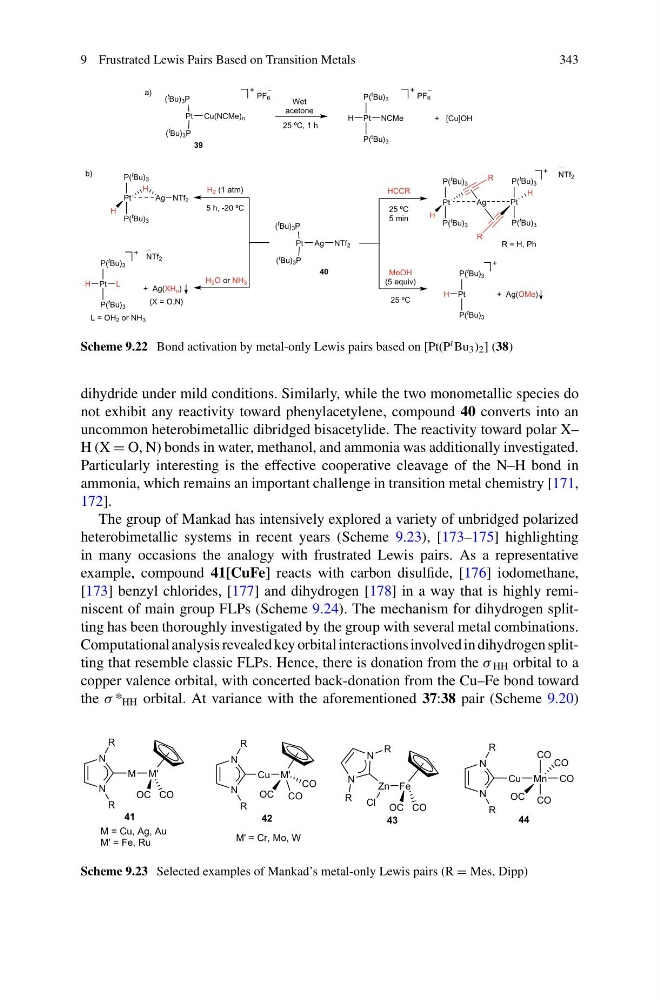
Scheme 9.22 Bond activation by metal-only Lewis pairs based on [Pt(P t Bu 3 ) 2 ] (38)
dihydride under mild conditions. Similarly, while the two monometallic species do
not exhibit any reactivity toward phenylacetylene, compound 40 converts into an
uncommon heterobimetallic dibridged bisacetylide. The reactivity toward polar X–
H (X = O, N) bonds in water, methanol, and ammonia was additionally investigated.
Particularly interesting is the effective cooperative cleavage of the N–H bond in
ammonia, which remains an important challenge in transition metal chemistry [171,
172].
The group of Mankad has intensively explored a variety of unbridged polarized
heterobimetallic systems in recent years (Scheme 9.23), [173–175] highlighting
in many occasions the analogy with frustrated Lewis pairs. As a representative
example, compound 41[CuFe] reacts with carbon disulfide, [176] iodomethane,
[173] benzyl chlorides, [177] and dihydrogen [178] in a way that is highly reminiscent of main group FLPs (Scheme 9.24). The mechanism for dihydrogen splitting has been thoroughly investigated by the group with several metal combinations.
Computational analysis revealed key orbital interactions involved in dihydrogen splitting that resemble classic FLPs. Hence, there is donation from the σ HH orbital to a
copper valence orbital, with concerted back-donation from the Cu–Fe bond toward
the σ * HH orbital. At variance with the aforementioned 37:38 pair (Scheme 9.20)
N
N
M
R
R
M'
OC CO
M = Cu, Ag, Au
M' = Fe, Ru
N
N
Zn
R
R
Fe
OC CO
Cl
N
N
Cu
R
R
Mn
OC
CO
CO
CO
CO
N
N
Cu
R
R
M'
OC CO
M' = Cr, Mo, W
CO
41
42
43
44
Scheme 9.23 Selected examples of Mankad’s metal-only Lewis pairs (R = Mes, Dipp)
343
Pt
P(
t Bu) 3
P(
t Bu) 3
H
+
MeOH
(5 equiv)
25 ºC
+ Ag(OMe)
Pt
(
t
Bu) 3 P
(
t
Bu) 3 P
Ag NTf 2
Pt
P(
t
Bu) 3
P(
t
Bu) 3
Ag
H
H
NTf 2
Pt
P(
t
Bu) 3
P(
t
Bu) 3
Ag
Pt
P(
t
Bu) 3
P(
t
Bu) 3
H
H
+
R
R
R = H, Ph
H 2 (1 atm)
5 h, -20 ºC
HCCR
25 ºC
5 min
Pt
P(
t
Bu) 3
P(
t
Bu) 3
H
+
L
L = OH 2 or NH 3
H 2 O or NH 3
+ Ag(XH n )
(X = O,N)
NTf 2
NTf 2
Wet
acetone
Pt
(
t
Bu) 3 P
(
t
Bu) 3 P
Cu(NCMe) n
Pt
P( t Bu) 3
P( t Bu) 3
+
PF 6
H
NCMe
a)
b)
40
39
+
PF 6
+ [Cu]OH
25 ºC, 1 h
Scheme 9.22 Bond activation by metal-only Lewis pairs based on [Pt(P t Bu 3 ) 2 ] (38)
dihydride under mild conditions. Similarly, while the two monometallic species do
not exhibit any reactivity toward phenylacetylene, compound 40 converts into an
uncommon heterobimetallic dibridged bisacetylide. The reactivity toward polar X–
H (X = O, N) bonds in water, methanol, and ammonia was additionally investigated.
Particularly interesting is the effective cooperative cleavage of the N–H bond in
ammonia, which remains an important challenge in transition metal chemistry [171,
172].
The group of Mankad has intensively explored a variety of unbridged polarized
heterobimetallic systems in recent years (Scheme 9.23), [173–175] highlighting
in many occasions the analogy with frustrated Lewis pairs. As a representative
example, compound 41[CuFe] reacts with carbon disulfide, [176] iodomethane,
[173] benzyl chlorides, [177] and dihydrogen [178] in a way that is highly reminiscent of main group FLPs (Scheme 9.24). The mechanism for dihydrogen splitting has been thoroughly investigated by the group with several metal combinations.
Computational analysis revealed key orbital interactions involved in dihydrogen splitting that resemble classic FLPs. Hence, there is donation from the σ HH orbital to a
copper valence orbital, with concerted back-donation from the Cu–Fe bond toward
the σ * HH orbital. At variance with the aforementioned 37:38 pair (Scheme 9.20)
N
N
M
R
R
M'
OC CO
M = Cu, Ag, Au
M' = Fe, Ru
N
N
Zn
R
R
Fe
OC CO
Cl
N
N
Cu
R
R
Mn
OC
CO
CO
CO
CO
N
N
Cu
R
R
M'
OC CO
M' = Cr, Mo, W
CO
41
42
43
44
Scheme 9.23 Selected examples of Mankad’s metal-only Lewis pairs (R = Mes, Dipp)