

336
N. Hidalgo et al.
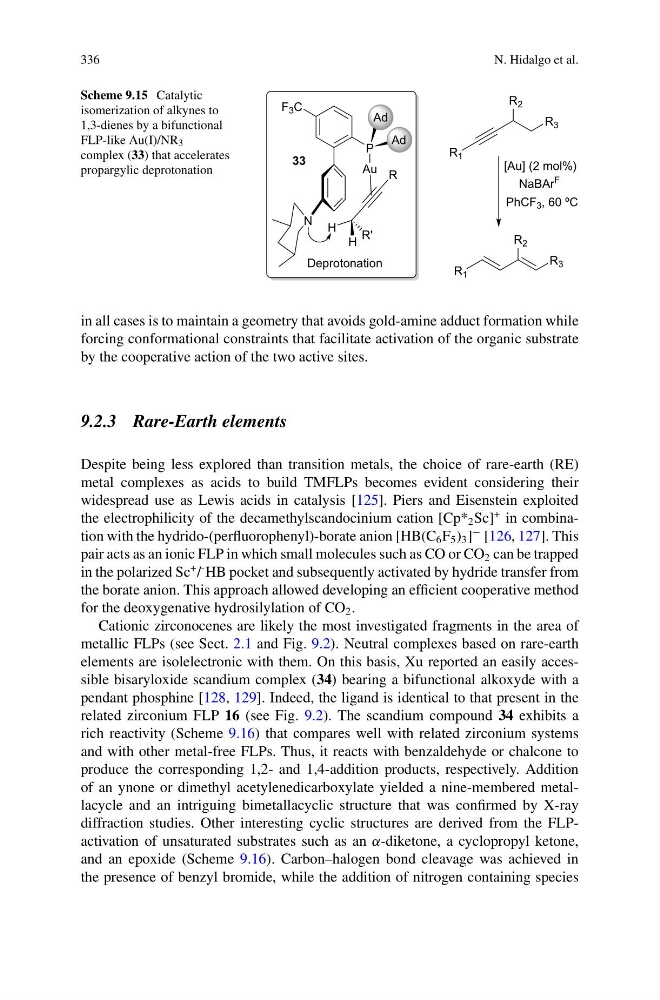
Scheme 9.15 Catalytic
isomerization of alkynes to
1,3-dienes by a bifunctional
FLP-like Au(I)/NR 3
complex (33) that accelerates
propargylic deprotonation
N
P
Au R
Ad
Ad
H
H
R'
Deprotonation
F 3 C
R 1
R 3
R 1
R 3
R 2
R 2
[Au] (2 mol%)
NaBAr
F
PhCF 3 , 60 ºC
33
in all cases is to maintain a geometry that avoids gold-amine adduct formation while
forcing conformational constraints that facilitate activation of the organic substrate
by the cooperative action of the two active sites.
9.2.3 Rare-Earth elements
Despite being less explored than transition metals, the choice of rare-earth (RE)
metal complexes as acids to build TMFLPs becomes evident considering their
widespread use as Lewis acids in catalysis [125]. Piers and Eisenstein exploited
the electrophilicity of the decamethylscandocinium cation [Cp* 2 Sc]
+ in combination with the hydrido-(perfluorophenyl)-borate anion [HB(C 6 F 5 ) 3 ]
− [126, 127]. This
pair acts as an ionic FLP in which small molecules such as CO or CO 2 can be trapped
in the polarized Sc
+ /
- HB pocket and subsequently activated by hydride transfer from
the borate anion. This approach allowed developing an efficient cooperative method
for the deoxygenative hydrosilylation of CO 2 .
Cationic zirconocenes are likely the most investigated fragments in the area of
metallic FLPs (see Sect. 2.1 and Fig. 9.2). Neutral complexes based on rare-earth
elements are isolelectronic with them. On this basis, Xu reported an easily accessible bisaryloxide scandium complex (34) bearing a bifunctional alkoxyde with a
pendant phosphine [128, 129]. Indeed, the ligand is identical to that present in the
related zirconium FLP 16 (see Fig. 9.2). The scandium compound 34 exhibits a
rich reactivity (Scheme 9.16) that compares well with related zirconium systems
and with other metal-free FLPs. Thus, it reacts with benzaldehyde or chalcone to
produce the corresponding 1,2- and 1,4-addition products, respectively. Addition
of an ynone or dimethyl acetylenedicarboxylate yielded a nine-membered metallacycle and an intriguing bimetallacyclic structure that was confirmed by X-ray
diffraction studies. Other interesting cyclic structures are derived from the FLPactivation of unsaturated substrates such as an α-diketone, a cyclopropyl ketone,
and an epoxide (Scheme 9.16). Carbon–halogen bond cleavage was achieved in
the presence of benzyl bromide, while the addition of nitrogen containing species
N. Hidalgo et al.
Scheme 9.15 Catalytic
isomerization of alkynes to
1,3-dienes by a bifunctional
FLP-like Au(I)/NR 3
complex (33) that accelerates
propargylic deprotonation
N
P
Au R
Ad
Ad
H
H
R'
Deprotonation
F 3 C
R 1
R 3
R 1
R 3
R 2
R 2
[Au] (2 mol%)
NaBAr
F
PhCF 3 , 60 ºC
33
in all cases is to maintain a geometry that avoids gold-amine adduct formation while
forcing conformational constraints that facilitate activation of the organic substrate
by the cooperative action of the two active sites.
9.2.3 Rare-Earth elements
Despite being less explored than transition metals, the choice of rare-earth (RE)
metal complexes as acids to build TMFLPs becomes evident considering their
widespread use as Lewis acids in catalysis [125]. Piers and Eisenstein exploited
the electrophilicity of the decamethylscandocinium cation [Cp* 2 Sc]
+ in combination with the hydrido-(perfluorophenyl)-borate anion [HB(C 6 F 5 ) 3 ]
− [126, 127]. This
pair acts as an ionic FLP in which small molecules such as CO or CO 2 can be trapped
in the polarized Sc
+ /
- HB pocket and subsequently activated by hydride transfer from
the borate anion. This approach allowed developing an efficient cooperative method
for the deoxygenative hydrosilylation of CO 2 .
Cationic zirconocenes are likely the most investigated fragments in the area of
metallic FLPs (see Sect. 2.1 and Fig. 9.2). Neutral complexes based on rare-earth
elements are isolelectronic with them. On this basis, Xu reported an easily accessible bisaryloxide scandium complex (34) bearing a bifunctional alkoxyde with a
pendant phosphine [128, 129]. Indeed, the ligand is identical to that present in the
related zirconium FLP 16 (see Fig. 9.2). The scandium compound 34 exhibits a
rich reactivity (Scheme 9.16) that compares well with related zirconium systems
and with other metal-free FLPs. Thus, it reacts with benzaldehyde or chalcone to
produce the corresponding 1,2- and 1,4-addition products, respectively. Addition
of an ynone or dimethyl acetylenedicarboxylate yielded a nine-membered metallacycle and an intriguing bimetallacyclic structure that was confirmed by X-ray
diffraction studies. Other interesting cyclic structures are derived from the FLPactivation of unsaturated substrates such as an α-diketone, a cyclopropyl ketone,
and an epoxide (Scheme 9.16). Carbon–halogen bond cleavage was achieved in
the presence of benzyl bromide, while the addition of nitrogen containing species